German Center for Vertigo and Balance Disorders, Ludwig Maximilian University of Munich, Munich, Germany.
Department of Neurology, Ludwig Maximilian University of Munich, Munich, Germany.
Eur J Neurol. 2022 Dec;29(12):3693-3700. doi: 10.1111/ene.15546. Epub 2022 Sep 21.
Dizziness and vertigo are common symptoms after COVID-19-vaccination. We aimed to prospectively evaluate objective central or peripheral vestibular function in patients with dizziness, vertigo, and postural symptoms that started or worsened after COVID-19-vaccination.
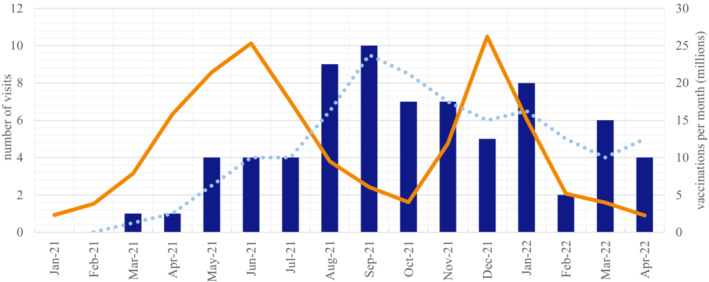
Of 4137 patients who presented between January 2021 and April 2022 at the German Center for Vertigo and Balance Disorders, Ludwig Maximilian University of Munich, we identified 72 patients (mean age = 47 years) with enduring vestibular symptoms following COVID-19 vaccination. All underwent medical history-taking, and neurological and neuro-otological workup with bithermal caloric test, video head-impulse test, orthoptics, and audiometry. Diagnoses were based on international criteria. The distribution of diagnoses was compared to a cohort of 39,964 patients seen before the COVID-19 pandemic.
Symptom onset was within the first 4 weeks postvaccination. The most prevalent diagnoses were somatoform vestibular disorders (34.7%), vestibular migraine (19.4%), and overlap syndromes of both (18.1%). These disorders were significantly overrepresented compared to the prepandemic control cohort. Thirty-six percent of patients with somatoform complaints reported a positive history of depressive or anxiety disorders. Nine patients presented with benign paroxysmal positional vertigo, three with acute unilateral vestibulopathy, and seven with different entities (vestibular paroxysmia, Ménière disease, polyneuropathy, ocular muscular paresis). Causally related central vestibular deficits were lacking. Novel peripheral vestibular deficits were found in four patients.
Newly induced persistent vestibular deficits following COVID-19 vaccination were rare. The predominant causes of prolonged vestibular complaints were somatoform vestibular disorders and vestibular migraine, possibly triggered or aggravated by stress-related circumstances due to the COVID-19 pandemic or vaccination. An increase of other central or peripheral vestibular syndromes after COVID-19 vaccination was not observed.
头晕和眩晕是 COVID-19 疫苗接种后的常见症状。我们旨在前瞻性评估头晕、眩晕和姿势症状患者的客观中枢或外周前庭功能,这些症状在 COVID-19 疫苗接种后开始或恶化。
在 2021 年 1 月至 2022 年 4 月期间,在德国慕尼黑路德维希马克西米利安大学眩晕与平衡障碍中心就诊的 4137 名患者中,我们确定了 72 名(平均年龄为 47 岁)COVID-19 疫苗接种后持续存在前庭症状的患者。所有患者均接受了病史采集以及神经学和神经耳科检查,包括双侧温度试验、视频头脉冲试验、眼动检查和听力检查。诊断基于国际标准。将诊断分布与 COVID-19 大流行前就诊的 39964 名患者队列进行比较。
症状发作在接种疫苗后 4 周内。最常见的诊断是躯体形式的前庭障碍(34.7%)、前庭性偏头痛(19.4%)和两者的重叠综合征(18.1%)。与大流行前的对照组相比,这些疾病明显更为常见。36%有躯体症状的患者报告有抑郁或焦虑障碍的阳性病史。9 名患者表现为良性阵发性位置性眩晕,3 名患者表现为急性单侧前庭病,7 名患者表现为不同的疾病(前庭阵发性失调、梅尼埃病、多发性神经病、眼肌瘫痪)。没有发现与病因相关的中枢性前庭功能障碍。4 名患者出现新的周围性前庭功能障碍。
COVID-19 疫苗接种后新诱导的持续性前庭功能障碍很少见。导致持续性前庭症状的主要原因是躯体形式的前庭障碍和前庭性偏头痛,可能是由于 COVID-19 大流行或疫苗接种引起的与压力相关的情况而被触发或加重。未观察到 COVID-19 疫苗接种后其他中枢或周围性前庭综合征的增加。