Program in Placebo Studies, Beth Israel Deaconess Medical Center, Harvard Medical School, Boston, Massachusetts.
Division of Gastroenterology, Beth Israel Deaconess Medical Center, Harvard Medical School, Boston, Massachusetts.
JAMA Netw Open. 2022 Jan 4;5(1):e2143955. doi: 10.1001/jamanetworkopen.2021.43955.
Adverse events (AEs) after placebo treatment are common in randomized clinical drug trials. Systematic evidence regarding these nocebo responses in vaccine trials is important for COVID-19 vaccination worldwide especially because concern about AEs is reported to be a reason for vaccination hesitancy.
To compare the frequencies of AEs reported in the placebo groups of COVID-19 vaccine trials with those reported in the vaccine groups.
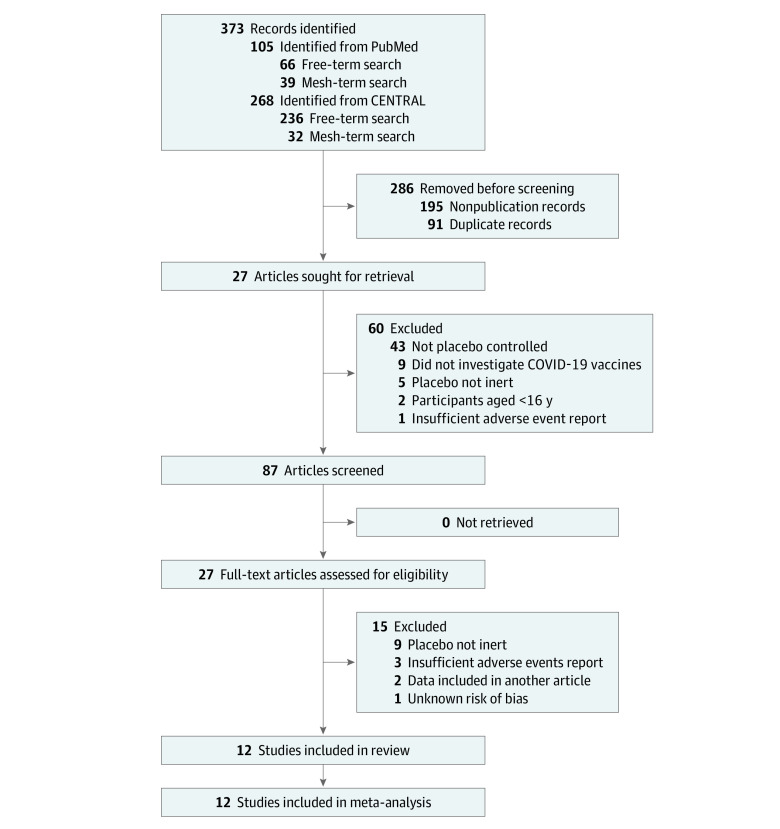
For this systematic review and meta-analysis, the Medline (PubMed) and Cochrane Central Register of Controlled Trials (CENTRAL) databases were searched systematically using medical subheading terms and free-text keywords for trials of COVID-19 vaccines published up to July 14, 2021.
Randomized clinical trials of COVID-19 vaccines that investigated adults aged 16 years or older were selected if they assessed solicited AEs within 7 days of injection, included an inert placebo arm, and provided AE reports for both the vaccine and placebo groups separately. Full texts were reviewed for eligibility by 2 independent reviewers.
Data extraction and quality assessment were performed independently by 2 reviewers, adhering to the Preferred Reporting Items for Systematic Reviews and Meta-analyses (PRISMA) guideline and using the Cochrane risk-of-bias tool. Meta-analyses were based on random-effects models.
The primary outcomes were the proportions of placebo recipients reporting overall, systemic, and local (injection-site) AEs as well as logarithmic odds ratios (ORs) to evaluate group differences. Outcomes were tested for significance using z tests with 95% CIs.
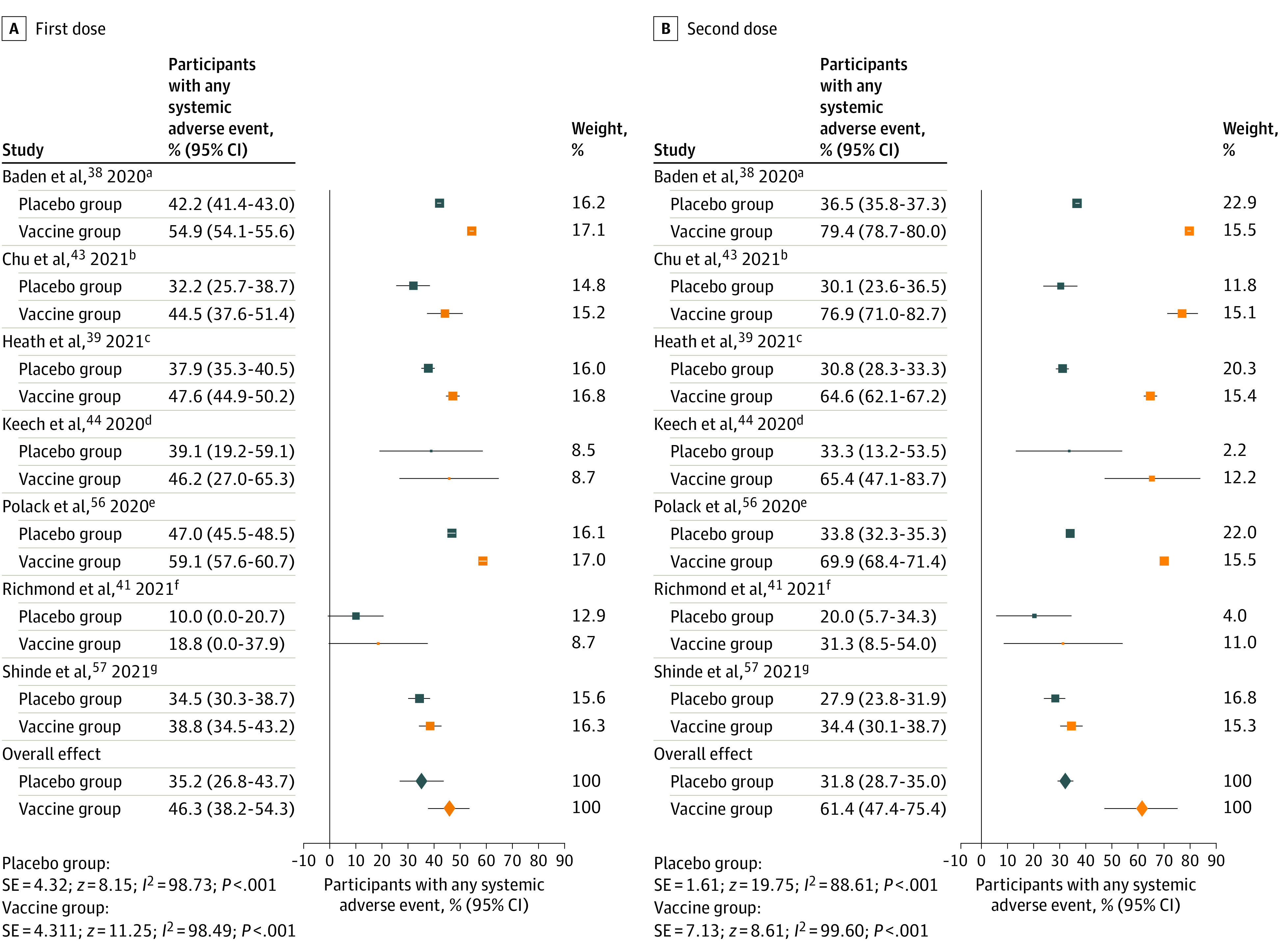
Twelve articles with AE reports for 45 380 participants (22 578 placebo recipients and 22 802 vaccine recipients) were analyzed. After the first dose, 35.2% (95% CI, 26.7%-43.7%) of placebo recipients experienced systemic AEs, with headache (19.3%; 95% CI, 13.6%-25.1%) and fatigue (16.7%; 95% CI, 9.8%-23.6%) being most common. After the second dose, 31.8% (95% CI, 28.7%-35.0%) of placebo recipients reported systemic AEs. The ratio between placebo and vaccine arms showed that nocebo responses accounted for 76.0% of systemic AEs after the first COVID-19 vaccine dose and for 51.8% after the second dose. Significantly more vaccine recipients reported AEs, but the group difference for systemic AEs was small after the first dose (OR, -0.47; 95% CI, -0.54 to -0.40; P < .001; standardized mean difference, -0.26; 95% CI, -0.30 to -0.22) and large after the second dose (OR, -1.36; 95% CI, -1.86 to -0.86; P < .001; standardized mean difference, -0.75; 95% CI, -1.03 to -0.47).
In this systematic review and meta-analysis, significantly more AEs were reported in vaccine groups compared with placebo groups, but the rates of reported AEs in the placebo arms were still substantial. Public vaccination programs should consider these high rates of AEs in placebo arms.
在随机临床试验中,安慰剂治疗后的不良事件(AE)很常见。关于疫苗试验中这些负面反应的系统证据对全球 COVID-19 疫苗接种至关重要,特别是因为据报道,对 AE 的担忧是疫苗犹豫的一个原因。
比较 COVID-19 疫苗试验安慰剂组报告的 AE 频率与疫苗组报告的 AE 频率。
在这项系统评价和荟萃分析中,使用医学主题词和自由文本关键词,对截至 2021 年 7 月 14 日发表的 COVID-19 疫苗试验的 Medline(PubMed)和 Cochrane 对照试验中心注册库(CENTRAL)数据库进行了系统搜索。选择了评估 16 岁及以上成年人的 COVID-19 疫苗的随机临床试验,如果它们在注射后 7 天内评估了征集的 AE,包括惰性安慰剂臂,并分别为疫苗和安慰剂组提供 AE 报告,则入选。两名独立审查员对全文进行了评估。
数据提取和质量评估由两名独立审查员独立进行,遵循系统评价和荟萃分析的首选报告项目(PRISMA)指南,并使用 Cochrane 偏倚风险工具。荟萃分析基于随机效应模型。
主要结果是报告总体、全身和局部(注射部位)AE 的安慰剂接受者的比例,以及评估组间差异的对数优势比(OR)。使用 95%CI 的 z 检验测试结果的显著性。
分析了 12 篇报告 AE 报告的文章,涉及 45380 名参与者(22578 名安慰剂接受者和 22802 名疫苗接受者)。在第一次给药后,35.2%(95%CI,26.7%-43.7%)的安慰剂接受者经历了全身 AE,其中头痛(19.3%;95%CI,13.6%-25.1%)和疲劳(16.7%;95%CI,9.8%-23.6%)最为常见。在第二次给药后,31.8%(95%CI,28.7%-35.0%)的安慰剂接受者报告了全身 AE。安慰剂与疫苗臂的比值表明,第一次 COVID-19 疫苗接种后,负面反应占全身 AE 的 76.0%,第二次接种后占 51.8%。报告 AE 的疫苗接受者明显更多,但第一次剂量后全身 AE 的组间差异较小(OR,-0.47;95%CI,-0.54 至-0.40;P<0.001;标准化均数差,-0.26;95%CI,-0.30 至-0.22),第二次剂量后较大(OR,-1.36;95%CI,-1.86 至-0.86;P<0.001;标准化均数差,-0.75;95%CI,-1.03 至-0.47)。
在这项系统评价和荟萃分析中,与安慰剂组相比,疫苗组报告的 AE 明显更多,但安慰剂组报告的 AE 发生率仍然很高。公共疫苗接种计划应考虑到安慰剂组中这些高发生率的 AE。