Tagawa Ryoichi, Watanabe Daiki, Ito Kyoko, Otsuyama Takeru, Nakayama Kyosuke, Sanbongi Chiaki, Miyachi Motohiko
Nutrition and Food Function Research Department, Food Microbiology and Function Research Laboratories, R&D Division, Meiji Co., Ltd., 1-29-1 Nanakuni, Hachioji, Tokyo, 192-0919, Japan.
Faculty of Sport Sciences, Waseda University, 2-579-15 Mikajima, Tokorozawa-city, Saitama, 359-1192, Japan.
Sports Med Open. 2022 Sep 4;8(1):110. doi: 10.1186/s40798-022-00508-w.
Protein supplementation augments muscle strength gain during resistance training. Although some studies focus on the dose-response relationship of total protein intake to muscle mass or strength, the detailed dose-response relationship between total protein intake and muscle strength increase is yet to be clarified, especially in the absence of resistance training.
We aimed to assess the detailed dose-response relationship between protein supplementation and muscle strength, with and without resistance training.
Systematic review with meta-analysis.
PubMed and Ichushi-Web (last accessed on March 23, 2022).
Randomized controlled trials investigating the effects of protein intake on muscle strength.
A random-effects model and a spline model.
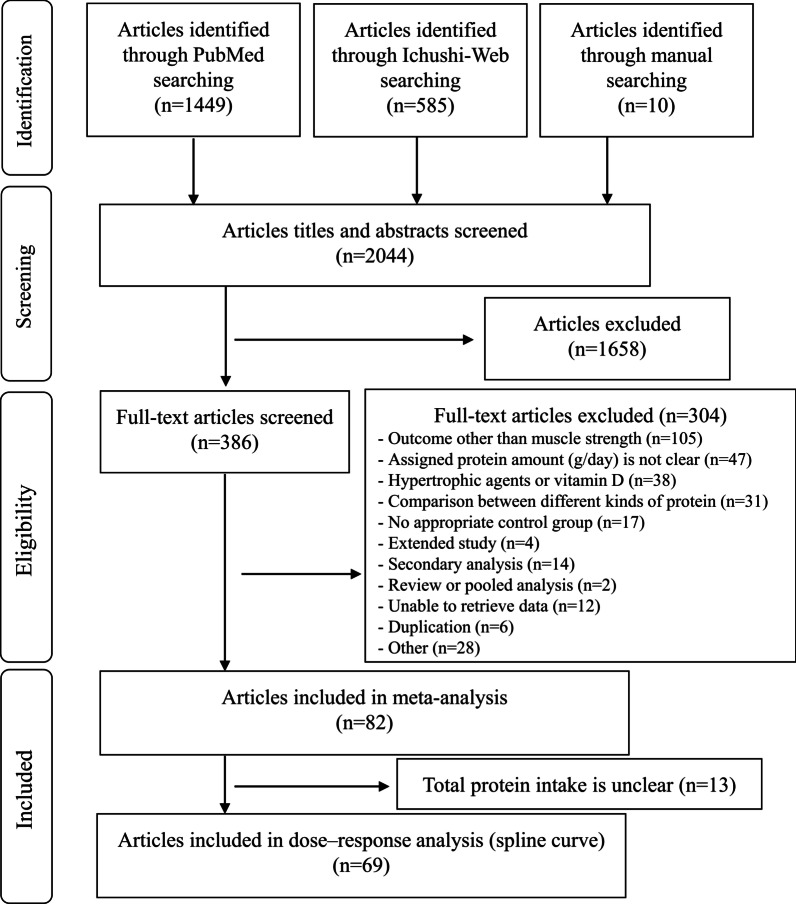
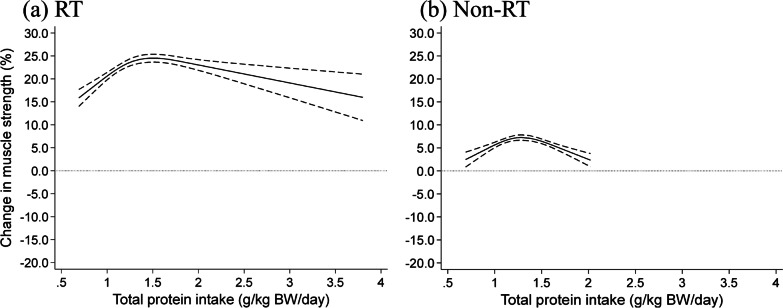
A total of 82 articles were obtained for meta-analyses, and data from 69 articles were used to create spline curves. Muscle strength increase was significantly augmented only with resistance training (MD 2.01%, 95% CI 1.09-2.93) and was not augmented if resistance training was absent (MD 0.13%, 95% CI - 1.53 to 1.79). In the dose-response analysis using a spline model, muscle strength increase with resistance training showed a dose-dependent positive association with total protein intake, which is 0.72% (95% CI 0.40-1.04%) increase in muscle strength per 0.1 g/kg body weight [BW]/d increase in total protein intake up to 1.5 g/kg BW/d, but no further gains were observed thereafter.
Concurrent use of resistance training is essential for protein supplementation to improve muscle strength. This study indicates that 1.5 g/kg BW/d may be the most appropriate amount of total protein intake for maintaining and augmenting muscle strength along with resistance training.
补充蛋白质可增强抗阻训练期间的肌肉力量增长。尽管一些研究关注总蛋白摄入量与肌肉质量或力量之间的剂量反应关系,但总蛋白摄入量与肌肉力量增加之间的详细剂量反应关系仍有待阐明,尤其是在缺乏抗阻训练的情况下。
我们旨在评估补充蛋白质与肌肉力量之间在有或无抗阻训练情况下的详细剂量反应关系。
系统评价与荟萃分析。
PubMed和Ichushi-Web(最后访问时间为2022年3月23日)。
研究蛋白质摄入量对肌肉力量影响的随机对照试验。
随机效应模型和样条模型。
共获得82篇文章用于荟萃分析,69篇文章的数据用于绘制样条曲线。仅在进行抗阻训练时,肌肉力量增加才显著增强(平均差2.01%,95%置信区间1.09 - 2.93),而在没有抗阻训练时则未增强(平均差0.13%,95%置信区间 - 1.53至1.79)。在使用样条模型的剂量反应分析中,进行抗阻训练时肌肉力量增加与总蛋白摄入量呈剂量依赖性正相关,即总蛋白摄入量每增加0.1 g/kg体重[BW]/天,肌肉力量增加0.72%(95%置信区间0.40 - 1.04%),直至总蛋白摄入量达到1.5 g/kg BW/天,但此后未观察到进一步增加。
同时进行抗阻训练对于补充蛋白质以提高肌肉力量至关重要。本研究表明,1.5 g/kg BW/天可能是与抗阻训练一起维持和增强肌肉力量的最适宜总蛋白摄入量。