Shengli Clinical Medical College of Fujian Medical University, Fuzhou, China.
Department of Geriatric Medicine, Fujian Provincial Hospital, Fuzhou, China.
Geriatr Gerontol Int. 2022 Sep;22(9):759-765. doi: 10.1111/ggi.14451. Epub 2022 Aug 5.
The evaluations of handgrip strength (HGS) weakness and asymmetry have implications for the comprehensive geriatric assessment. The aim of this study was to investigate the association of HGS weakness and asymmetry on cardiovascular outcomes in older outpatients.
This was a prospective observational cohort study of 364 Geriatrics outpatients aged ≥60 years, in which all participants carried out HGS tests at baseline. Patients with HGS <28 kg for men and <18 kg for women were diagnosed as HGS weakness, and HGS ratio <0.90 or >1.10 were diagnosed as HGS asymmetry. Primary outcomes defined as the major adverse cardiovascular event and composite end-points were assessed during a 21-month median follow-up.
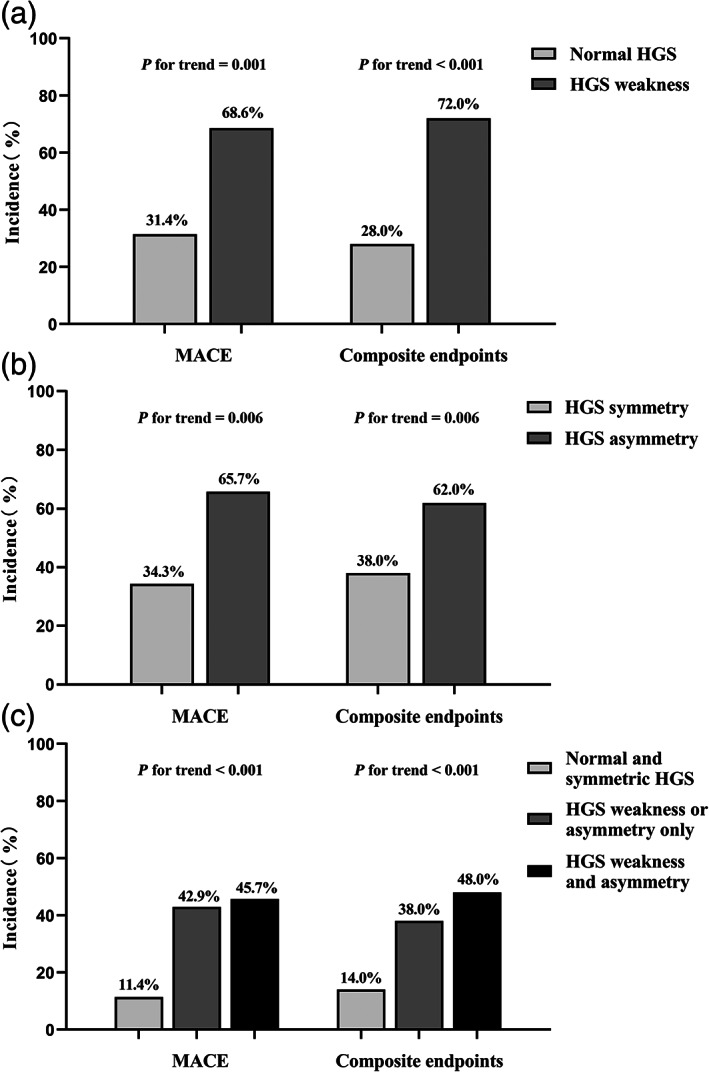
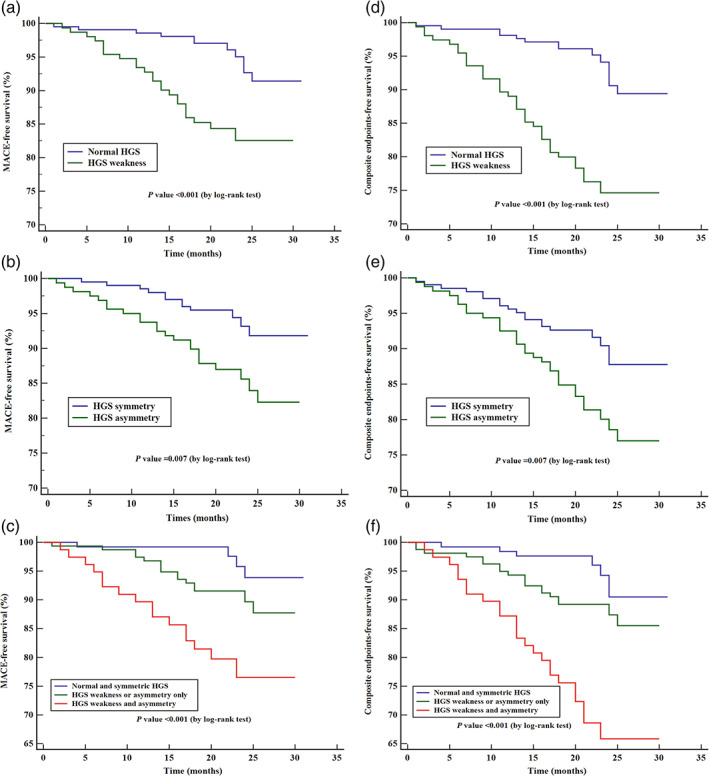
Among 364 participants, 155 (42.6%) showed HGS weakness, and 160 (44.0%) showed HGS asymmetry. HGS weakness was associated with major adverse cardiovascular events (HR 2.76, 95% CI 1.22-6.27) and composite end-points (HR 2.84, 95% CI 1.40-5.77). However, no significant correlation between HGS asymmetry and cardiovascular outcomes was observed. Compared with the normal and symmetric HGS group, older adults with HGS weakness and asymmetry together had a higher risk of major adverse cardiovascular events (HR 5.23, 95% CI 1.56-17.54) and composite end-points (HR 4.00, 95% CI 1.56-10.28).
HGS weakness and asymmetry together might increase the risk of cardiovascular outcomes in older outpatients. HGS asymmetry offers complementary information to HGS weakness when making a comprehensive assessment of HGS. Geriatr Gerontol Int 2022; 22: 759-765.
握力(HGS)减弱和不对称的评估对综合老年评估具有重要意义。本研究旨在探讨老年门诊患者 HGS 减弱和不对称与心血管结局的关系。
这是一项对 364 名年龄≥60 岁的老年科门诊患者进行的前瞻性观察队列研究,所有患者在基线时均进行 HGS 测试。男性 HGS<28kg 和女性 HGS<18kg 被诊断为 HGS 减弱,HGS 比值<0.90 或>1.10 被诊断为 HGS 不对称。主要终点定义为主要不良心血管事件和复合终点,在 21 个月的中位随访期间进行评估。
在 364 名参与者中,155 名(42.6%)表现出 HGS 减弱,160 名(44.0%)表现出 HGS 不对称。HGS 减弱与主要不良心血管事件(HR 2.76,95%CI 1.22-6.27)和复合终点(HR 2.84,95%CI 1.40-5.77)相关。然而,HGS 不对称与心血管结局之间没有显著相关性。与 HGS 正常和对称组相比,HGS 减弱和不对称并存的老年人发生主要不良心血管事件(HR 5.23,95%CI 1.56-17.54)和复合终点(HR 4.00,95%CI 1.56-10.28)的风险更高。
HGS 减弱和不对称并存可能会增加老年门诊患者心血管结局的风险。在对 HGS 进行综合评估时,HGS 不对称为 HGS 减弱提供了补充信息。老年医学与老年病学杂志 2022;22:759-765。