Chang Tian-Gen, Shi Zai, Zhao Honglong, Song Qingfeng, He Zhonghu, Van Rie Jeroen, Den Boer Bart, Galle Alexander, Zhu Xin-Guang
National Key Laboratory for Plant Molecular Genetics, Center for Excellence in Molecular Plant Sciences, Chinese Academy of Sciences, Shanghai 200032, China.
Insitute of Crop Sciences, Chinese Academy of Agricultural Sciences, Beijing 100081, China.
Plant Phenomics. 2022 Jul 21;2022:9758148. doi: 10.34133/2022/9758148. eCollection 2022.
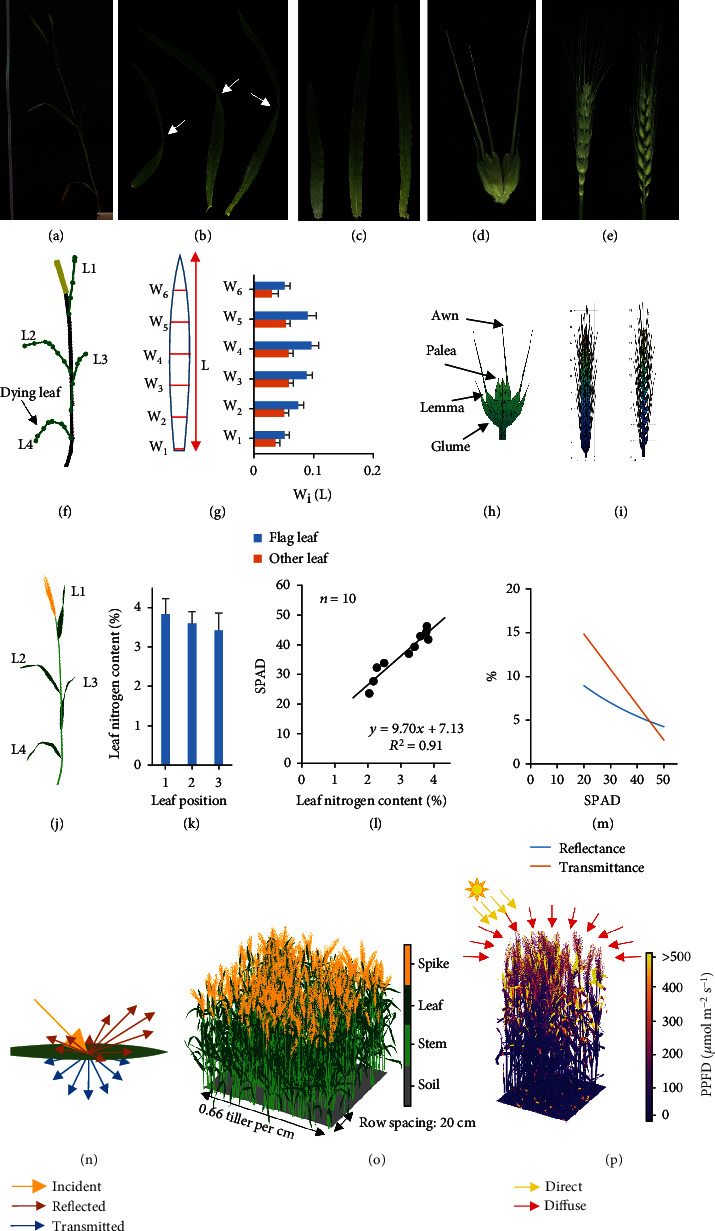
Canopy photosynthesis is the sum of photosynthesis of all above-ground photosynthetic tissues. Quantitative roles of nonfoliar tissues in canopy photosynthesis remain elusive due to methodology limitations. Here, we develop the first canopy photosynthesis model incorporating all above-ground photosynthetic tissues and validate this model on wheat with state-of-the-art gas exchange measurement facilities. The new model precisely predicts wheat canopy gas exchange rates at different growth stages, weather conditions, and canopy architectural perturbations. Using the model, we systematically study (1) the contribution of both foliar and nonfoliar tissues to wheat canopy photosynthesis and (2) the responses of wheat canopy photosynthesis to plant physiological and architectural changes. We found that (1) at tillering, heading, and milking stages, nonfoliar tissues can contribute ~4, ~32, and ~50% of daily gross canopy photosynthesis ( ; ~2, ~15, and ~-13% of daily net canopy photosynthesis, ) and absorb ~6, ~42, and ~60% of total light, respectively; (2) under favorable condition, increasing spike photosynthetic activity, rather than enlarging spike size or awn size, can enhance canopy photosynthesis; (3) covariation in tissue respiratory rate and photosynthetic rate may be a major factor responsible for less than expected increase in daily ; and (4) in general, erect leaves, lower spike position, shorter plant height, and proper plant densities can benefit daily . Overall, the model, together with the facilities for quantifying plant architecture and tissue gas exchange, provides an integrated platform to study canopy photosynthesis and support rational design of photosynthetically efficient wheat crops.
冠层光合作用是所有地上光合组织光合作用的总和。由于方法学的限制,非叶组织在冠层光合作用中的定量作用仍不明确。在此,我们开发了首个包含所有地上光合组织的冠层光合作用模型,并利用最先进的气体交换测量设备在小麦上对该模型进行了验证。新模型能够精确预测小麦冠层在不同生长阶段、天气条件和冠层结构扰动下的气体交换速率。利用该模型,我们系统地研究了:(1)叶组织和非叶组织对小麦冠层光合作用的贡献;(2)小麦冠层光合作用对植物生理和结构变化的响应。我们发现:(1)在分蘖期、抽穗期和灌浆期,非叶组织对冠层每日总光合作用的贡献分别约为4%、32%和50%(对冠层每日净光合作用的贡献分别约为2%、15%和 - 13%),且分别吸收总光量的6%、42%和60%;(2)在有利条件下,提高穗的光合活性而非增大穗尺寸或芒尺寸,可增强冠层光合作用;(3)组织呼吸速率和光合速率的协同变化可能是导致每日[此处原文可能缺失具体指标]增加低于预期的主要因素;(4)总体而言,叶片直立、穗位置较低、株高较矮以及适当的种植密度有利于每日[此处原文可能缺失具体指标]。总体而言,该模型与用于量化植物结构和组织气体交换的设备一起,提供了一个研究冠层光合作用的综合平台,并支持对光合高效小麦作物的合理设计。