National Key Laboratory of Plant Molecular Genetics, CAS Center for Excellence in Molecular Plant Sciences, Shanghai Institute of Plant Physiology and Ecology, Chinese Academy of Sciences, Shanghai, China.
University of Chinese Academy of Sciences, Beijing, China.
J Exp Bot. 2019 Apr 29;70(9):2479-2490. doi: 10.1093/jxb/ery430.
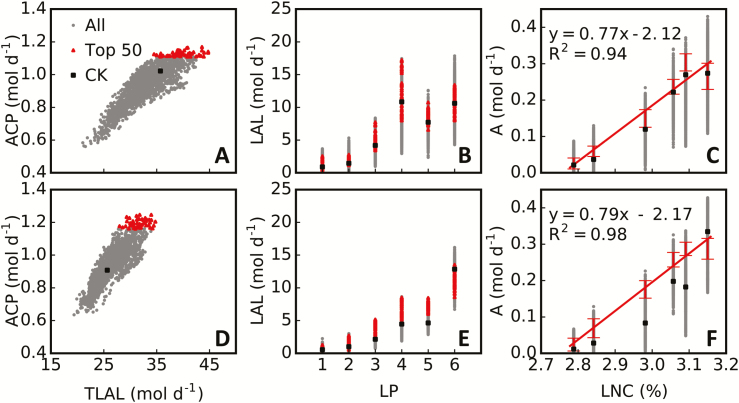
In current rice breeding programs, morphological parameters such as plant height, leaf length and width, leaf angle, panicle architecture, and tiller number during the grain filling stage are used as major selection targets. However, so far, there is no robust approach to quantitatively define the optimal combinations of parameters that can lead to increased canopy radiation use efficiency (RUE). Here we report the development of a three-dimensional canopy photosynthesis model (3dCAP), which effectively combines three-dimensional canopy architecture, canopy vertical nitrogen distribution, a ray-tracing algorithm, and a leaf photosynthesis model. Concurrently, we developed an efficient workflow for the parameterization of 3dCAP. 3dCAP predicted daily canopy RUE for different nitrogen treatments of a given rice cultivar under different weather conditions. Using 3dCAP, we explored the influence of three canopy architectural parameters-tiller number, tiller angle and leaf angle-on canopy RUE. Under different weather conditions and different nitrogen treatments, canopy architecture optimized by manipulating these parameters can increase daily net canopy photosynthetic CO2 uptake by 10-52%. Generally, a smaller tiller angle was predicted for most elite rice canopy architectures, especially under scattered light conditions. Results further show that similar canopy RUE can be obtained by multiple different parameter combinations; these combinations share two common features of high light absorption by leaves in the canopy and a high level of coordination between the nitrogen concentration and the light absorbed by each leaf within the canopy. Overall, this new model has potential to be used in rice ideotype design for improved canopy RUE.
在当前的水稻育种计划中,形态学参数,如株高、叶片长度和宽度、叶角、穗型和灌浆期分蘖数,被用作主要的选择目标。然而,到目前为止,还没有一种稳健的方法来定量定义可以提高冠层辐射利用效率(RUE)的最佳参数组合。在这里,我们报告了一个三维冠层光合作用模型(3dCAP)的开发,该模型有效地结合了三维冠层结构、冠层垂直氮分布、光线追踪算法和叶片光合作用模型。同时,我们开发了一种有效的 3dCAP 参数化工作流程。3dCAP 预测了不同氮处理下不同天气条件下给定水稻品种的每日冠层 RUE。利用 3dCAP,我们探讨了三个冠层结构参数——分蘖数、分蘖角和叶角——对冠层 RUE 的影响。在不同的天气条件和不同的氮处理下,通过操纵这些参数优化的冠层结构可以增加每日净冠层光合 CO2 吸收 10-52%。一般来说,在散射光条件下,大多数优质水稻冠层结构的分蘖角预测较小。结果进一步表明,通过多种不同的参数组合可以获得相似的冠层 RUE;这些组合具有两个共同的特征,即叶片在冠层中吸收更多的光,以及冠层中每个叶片的氮浓度和吸收的光之间的高度协调。总的来说,这个新模型有可能用于提高冠层 RUE 的水稻理想型设计。