Zhang Pengpeng, Huang Jingyao, Ma Yuntao, Wang Xiujuan, Kang Mengzhen, Song Youhong
School of Agronomy, Anhui Agricultural University, Hefei, Anhui Province 230036, China.
College of Land Science and Technology, China Agricultural University, Beijing 100094, China.
Plant Phenomics. 2023 Sep 28;5:0091. doi: 10.34133/plantphenomics.0091. eCollection 2023.
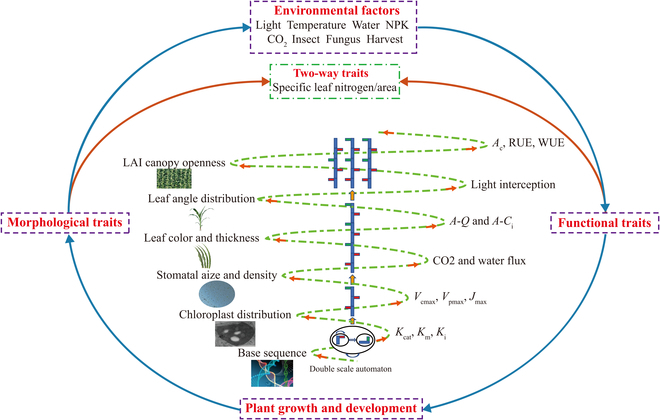
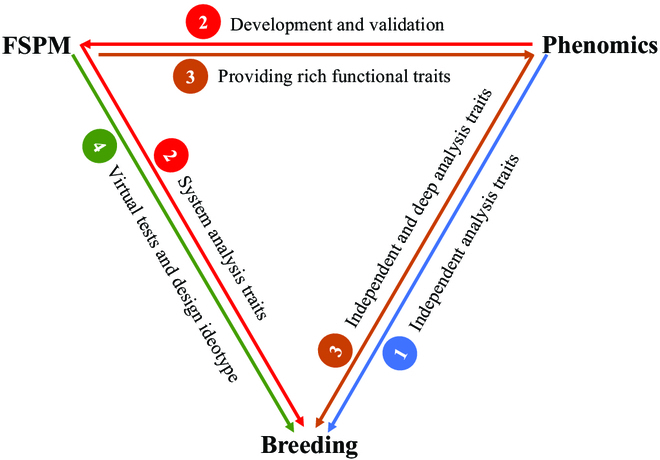
Observable morphological traits are widely employed in plant phenotyping for breeding use, which are often the external phenotypes driven by a chain of functional actions in plants. Identifying and phenotyping inherently functional traits for crop improvement toward high yields or adaptation to harsh environments remains a major challenge. Prediction of whole-plant performance in functional-structural plant models (FSPMs) is driven by plant growth algorithms based on organ scale wrapped up with micro-environments. In particular, the models are flexible for scaling down or up through specific functions at the organ nexus, allowing the prediction of crop system behaviors from the genome to the field. As such, by virtue of FSPMs, model parameters that determine organogenesis, development, biomass production, allocation, and morphogenesis from a molecular to the whole plant level can be profiled systematically and made readily available for phenotyping. FSPMs can provide rich functional traits representing biological regulatory mechanisms at various scales in a dynamic system, e.g., Rubisco carboxylation rate, mesophyll conductance, specific leaf nitrogen, radiation use efficiency, and source-sink ratio apart from morphological traits. High-throughput phenotyping such traits is also discussed, which provides an unprecedented opportunity to evolve FSPMs. This will accelerate the co-evolution of FSPMs and plant phenomics, and thus improving breeding efficiency. To expand the great promise of FSPMs in crop science, FSPMs still need more effort in multiscale, mechanistic, reproductive organ, and root system modeling. In summary, this study demonstrates that FSPMs are invaluable tools in guiding functional trait phenotyping at various scales and can thus provide abundant functional targets for phenotyping toward crop improvement.
可观察的形态特征在用于育种的植物表型分析中被广泛应用,这些特征通常是由植物中一系列功能作用驱动的外部表型。识别并对作物改良以实现高产或适应恶劣环境的内在功能性状进行表型分析仍然是一项重大挑战。功能 - 结构植物模型(FSPMs)中全株性能的预测是由基于器官尺度并结合微环境的植物生长算法驱动的。特别是,这些模型通过器官连接点处的特定功能能够灵活地进行尺度缩放,从而实现从基因组到田间的作物系统行为预测。因此,借助FSPMs,可以系统地剖析从分子到全株水平决定器官发生、发育、生物量生产、分配和形态发生的模型参数,并使其易于用于表型分析。FSPMs可以提供丰富的功能性状,这些性状代表了动态系统中不同尺度的生物调节机制,例如除形态特征外的 Rubisco 羧化率、叶肉导度、比叶氮、辐射利用效率和源 - 库比。本文还讨论了对这些性状进行高通量表型分析,这为FSPMs的发展提供了前所未有的机会。这将加速FSPMs与植物表型组学的共同进化,从而提高育种效率。为了扩大FSPMs在作物科学中的巨大前景,FSPMs在多尺度、机理、生殖器官和根系建模方面仍需付出更多努力。总之,本研究表明FSPMs是指导不同尺度功能性状表型分析的宝贵工具,因此可以为作物改良的表型分析提供丰富的功能靶点。