Magliulo Daniela, Bernardi Rosa
Laboratory of Preclinical Models of Cancer, Division of Experimental Oncology, San Raffaele Scientific Institute, Milan, Italy.
Front Oncol. 2022 Aug 18;12:973978. doi: 10.3389/fonc.2022.973978. eCollection 2022.
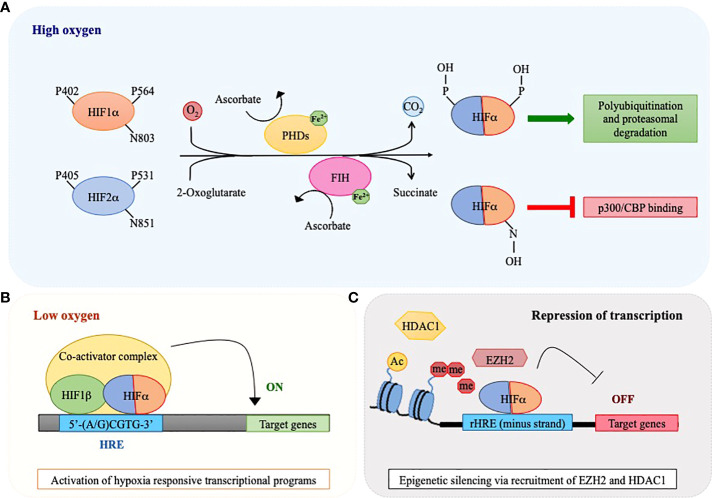
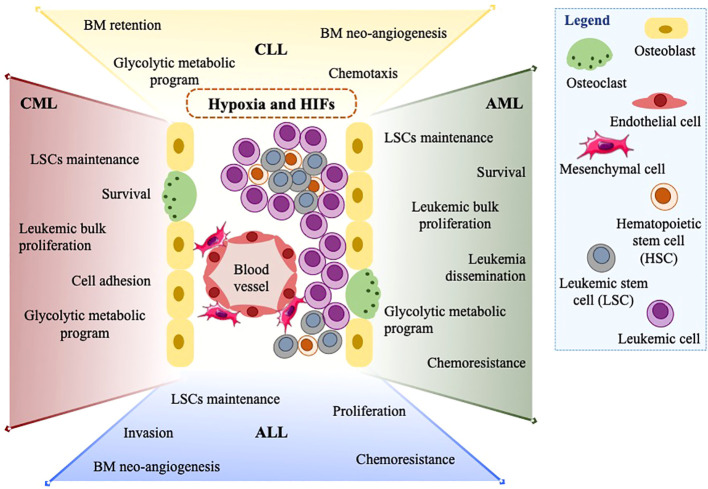
To cope with hypoxic stress, ancient organisms have developed evolutionally conserved programs centered on hypoxia-inducible transcriptional factors (HIFs). HIFs and their regulatory proteins have evolved as rheostats to adapt cellular metabolism to atmospheric oxygen fluctuations, but the amplitude of their transcriptional programs has tremendously increased along evolution to include a wide spectrum of physiological and pathological processes. The bone marrow represents a notable example of an organ that is physiologically exposed to low oxygen levels and where basal activation of hypoxia signaling appears to be intrinsically wired within normal and neoplastic hematopoietic cells. HIF-mediated responses are mainly piloted by the oxygen-labile α subunits HIF1α and HIF2α, and current literature suggests that these genes have a functional specification that remains to be fully defined. Since their identification in the mid 90s, HIF factors have been extensively studied in solid tumors, while their implication in leukemia has lagged behind. In the last decades however, many laboratories have addressed the function of hypoxia signaling in leukemia and obtained somewhat contradictory results. Suppression of HIFs expression in different types of leukemia has unveiled common leukemia-promoting functions such as stimulation of bone marrow neoangiogenesis, maintenance of leukemia stem cells and chemoresistance. However, genetic studies are revealing that a definition of HIF factors as bona fide tumor promoters is overly simplistic, and, depending on the leukemia subtype, the specific oncogenic event, or the stage of leukemia development, activation of hypoxia-inducible genes may lead to opposite consequences. With this article we will provide an updated summary of the studies describing the regulation and function of HIF1α and HIF2α in blood malignancies, spanning from acute to chronic, lymphoid to myeloid leukemias. In discussing these data, we will attempt to provide plausible explanations to contradictory findings and point at what we believe are areas of weakness in which further investigations are urgently needed. Gaining additional knowledge into the role of hypoxia signaling in leukemia appears especially timely nowadays, as new inhibitors of HIF factors are entering the clinical arena for specific types of solid tumors but their utility for patients with leukemia is yet to be determined.
为应对缺氧应激,古老生物进化出了以缺氧诱导转录因子(HIFs)为核心的保守程序。HIFs及其调控蛋白已演变成变阻器,使细胞代谢适应大气氧波动,但随着进化,其转录程序的幅度大幅增加,涵盖了广泛的生理和病理过程。骨髓就是一个显著的例子,该器官在生理上处于低氧水平,缺氧信号的基础激活似乎在正常和肿瘤造血细胞中固有存在。HIF介导的反应主要由氧不稳定的α亚基HIF1α和HIF2α驱动,目前的文献表明这些基因的功能特异性仍有待充分确定。自20世纪90年代中期被发现以来,HIF因子在实体瘤中得到了广泛研究,而它们在白血病中的作用研究相对滞后。然而,在过去几十年中,许多实验室研究了缺氧信号在白血病中的作用,并得出了一些相互矛盾的结果。在不同类型的白血病中抑制HIFs表达揭示了常见的白血病促进功能,如刺激骨髓新生血管生成、维持白血病干细胞和化疗耐药性。然而,遗传学研究表明,将HIF因子定义为真正的肿瘤促进因子过于简单化,并且根据白血病亚型、特定的致癌事件或白血病发展阶段,缺氧诱导基因的激活可能会导致相反的结果。在本文中,我们将提供一份最新综述,介绍描述HIF1α和HIF2α在血液恶性肿瘤(从急性到慢性,从淋巴样到髓样白血病)中的调控和功能的研究。在讨论这些数据时,我们将试图为相互矛盾的发现提供合理的解释,并指出我们认为急需进一步研究的薄弱领域。鉴于HIF因子的新型抑制剂正在进入特定类型实体瘤的临床领域,但其对白血病患者的效用尚未确定,如今深入了解缺氧信号在白血病中的作用显得尤为及时。