Ghobadi Hassan, Mohammadshahi Jafar, Javaheri Nazli, Fouladi Nasrin, Mirzazadeh Yasaman, Aslani Mohammad Reza
Lung Diseases Research Center, Ardabil University of Medical Sciences, Ardabil, Iran.
Department of Infectious Diseases and Tropical Medicine, School of Medicine, Ardabil University of Medical Sciences, Ardabil, Iran.
Front Med (Lausanne). 2022 Aug 18;9:916453. doi: 10.3389/fmed.2022.916453. eCollection 2022.
Systemic inflammation indices, including neutrophil/lymphocyte ratio (NLR), monocyte/lymphocyte ratio (MLR), platelet/lymphocyte ratio (PLR), derived neutrophil/lymphocyte ratio (dNLR), neutrophil/lymphocyteplatelet ratio (NLPR), aggregate index of systemic inflammation (AISI), systemic inflammation response index (SIR-I), and systemic inflammation index (SII) are well-expressed inflammatory indices that have been used to predict the severity and mortality of various inflammatory diseases. This study aimed to investigate the role of systemic inflammatory markers in predicting mortality in non-elderly and elderly COVID-19 patients.
In a retrospective study, laboratory parameters were examined for 1,792 COVID-19 patients (elderly = 710 and non-elderly = 1,082). The ability of inflammatory markers to distinguish the severity of COVID-19 was determined by receiver operating characteristic (ROC) analysis, and survival probability was determined by the mean of Kaplan-Meier curves, with the endpoint being death.
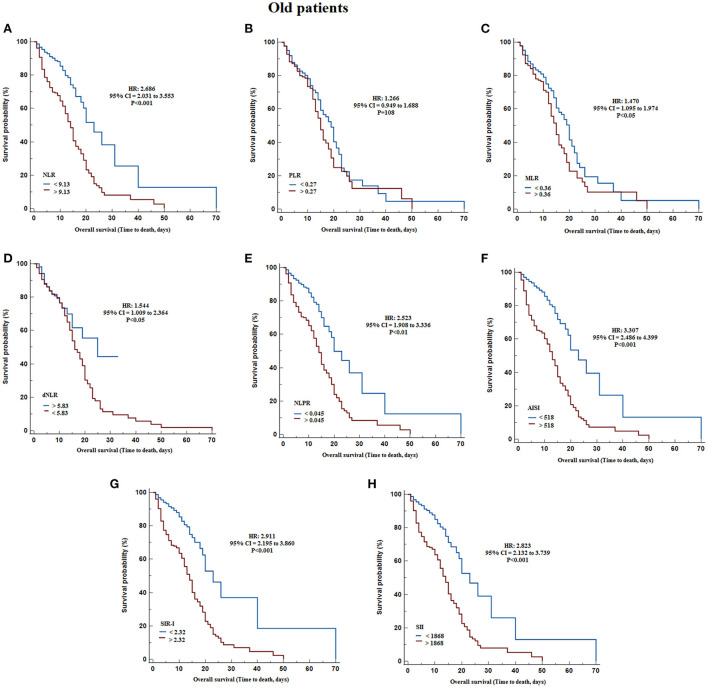
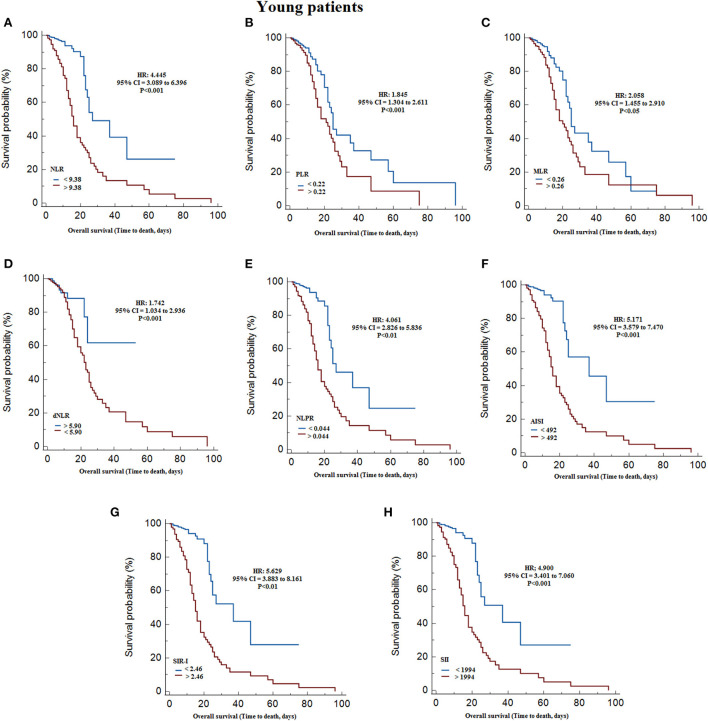
In the non-survivor non-elderly and elderly patients, the parameters PLR, MLR, dNLR, NLPR, AISI, SIR-I, and SII were significantly higher than in the surviving patients. WBC count (HR = 4.668, 95% CI = 1.624 to 13.413, < 0.01), neutrophil count (HR = 6.395, 95% CI = 2.070 to 19.760, < 0.01), dNLR (HR = 0.390, 95% CI = 0.182 to 0.835, < 0.05), and SII (HR = 10.725, 95% CI = 1.076 to 106.826, < 0.05) were significantly associated with survival. On the other hand, in elderly patients, it was found that WBC count (HR = 4.076, 95% CI = 2.176 to 7.637, < 0.001) and neutrophil count (HR = 2.412, 95% CI = 1.252 to 4.647, < 0.01) were significantly associated with survival.
WBC count and neutrophil count in non-elderly and elderly patients, were reliable predictors of mortality.
全身炎症指标,包括中性粒细胞/淋巴细胞比值(NLR)、单核细胞/淋巴细胞比值(MLR)、血小板/淋巴细胞比值(PLR)、衍生中性粒细胞/淋巴细胞比值(dNLR)、中性粒细胞/淋巴细胞血小板比值(NLPR)、全身炎症聚集指数(AISI)、全身炎症反应指数(SIR-I)和全身炎症指数(SII),是表达良好的炎症指标,已被用于预测各种炎症性疾病的严重程度和死亡率。本研究旨在探讨全身炎症标志物在预测非老年和老年COVID-19患者死亡率中的作用。
在一项回顾性研究中,对1792例COVID-19患者(老年患者710例,非老年患者1082例)的实验室参数进行了检查。通过受试者操作特征(ROC)分析确定炎症标志物区分COVID-19严重程度的能力,并通过Kaplan-Meier曲线的平均值确定生存概率,终点为死亡。
在非存活的非老年和老年患者中,PLR、MLR、dNLR、NLPR、AISI、SIR-I和SII参数显著高于存活患者。白细胞计数(HR = 4.668,95%CI = 1.624至13.413,P < 0.01)、中性粒细胞计数(HR = 6.395,95%CI = 2.070至19.760,P < 0.01)、dNLR(HR = 0.390,95%CI = 0.182至0.835,P < 0.05)和SII(HR = 10.725,95%CI = 1.076至106.826,P < 0.05)与生存显著相关。另一方面,在老年患者中,发现白细胞计数(HR = 4.076,95%CI = 2.176至7.637,P < 0.001)和中性粒细胞计数(HR = 2.412,95%CI = 1.252至4.647,P < 0.01)与生存显著相关。
非老年和老年患者的白细胞计数和中性粒细胞计数是死亡率的可靠预测指标。