Kentoffio Katherine, Durstenfeld Matthew S, Siedner Mark J, Kityo Cissy, Erem Geoffrey, Ssinabulya Isaac, Ghoshhajra Brian, Bittencourt Marcio S, Longenecker Chris T
Division of Cardiology, Department of Medicine, University of California, San Francisco, San Francisco, CA, USA.
Massachusetts General Hospital, Center for Global Health, Boston, MA, USA.
Int J Cardiol Cardiovasc Risk Prev. 2022 Jun 8;14:200136. doi: 10.1016/j.ijcrp.2022.200136. eCollection 2022 Sep.
The prevalence of cardiovascular disease (CVD) is rising in Sub-Saharan Africa, but it is not known whether current risk assessment tools predict coronary atherosclerosis in the region. Furthermore, sex-specific performance and interaction with HIV serostatus has not been well studied.
This cross-sectional study compared ASCVD risk scores and detectable coronary artery calcium (CAC>0) by sex in Kampala, Uganda (n = 200). The cohort was enriched for persons living with HIV, and all participants had at least one CVD risk factor. We fit log binomial regression models and constructed ROC curves to assess the correlation between ASCVD scores and CAC>0.
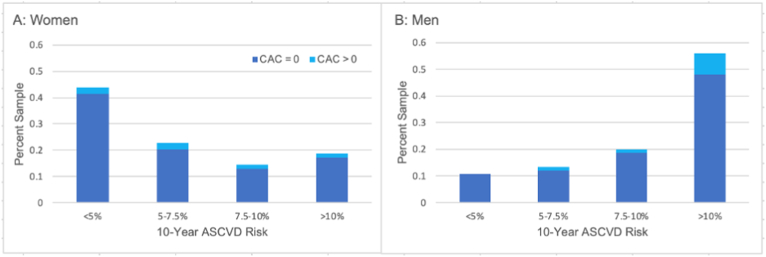
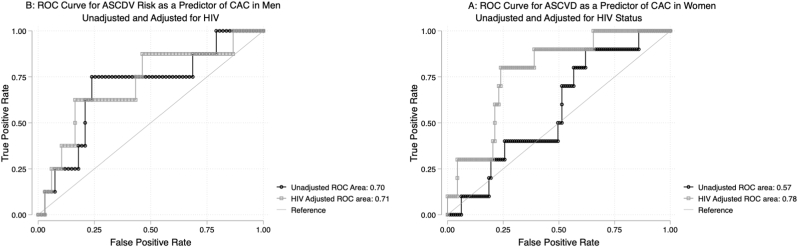
The mean age was 56. 62% were female and 50% of both men and women were living with HIV. The median 10-year ASCVD risk score was significantly higher in men (11.0%, IQR 7.6-19.4%) than in women (5.1%, IQR 3.2-8.7%), although the prevalence of CAC>0 was similar (8.1 vs 10.5%, p = 0.63). Each 10% increase in ASCVD risk was associated with increased risk of CAC>0 in men (PR 1.59, 95% CI 1.00-2.55, p = 0.05) but not women (PR 1.15, 95% CI 0.44-3.00, p = 0.77). ROC curves demonstrated an AUC of 0.57 for women vs 0.70 for men. Adjustment for HIV serostatus improved the predictive value of ASCVD in women only (AUC 0.78, p = 0.02).
ASCVD risk score did not correlate with the presence of CAC in women. When HIV status was added to the ASCVD risk score, correlation with CAC was improved in women but not in men.
撒哈拉以南非洲地区心血管疾病(CVD)的患病率正在上升,但目前尚不清楚现有的风险评估工具能否预测该地区的冠状动脉粥样硬化情况。此外,针对特定性别的表现以及与HIV血清学状态的相互作用尚未得到充分研究。
这项横断面研究比较了乌干达坎帕拉地区(n = 200)按性别划分的动脉粥样硬化性心血管疾病(ASCVD)风险评分和可检测到的冠状动脉钙化(CAC>0)情况。该队列中感染HIV的人群较多,且所有参与者至少有一项心血管疾病风险因素。我们拟合了对数二项回归模型并构建了ROC曲线,以评估ASCVD评分与CAC>0之间的相关性。
平均年龄为56岁。62%为女性,男性和女性中各有50%感染HIV。男性的10年ASCVD风险评分中位数(11.0%,四分位间距7.6 - 19.4%)显著高于女性(5.1%,四分位间距3.2 - 8.7%),尽管CAC>0的患病率相似(8.1%对10.5%,p = 0.63)。ASCVD风险每增加10%,男性患CAC>0的风险增加(PR 1.59,95% CI 1.00 - 2.55,p = 0.05),而女性则无此关联(PR 1.15,95% CI 0.44 - 3.00,p = 0.77)。ROC曲线显示,女性的AUC为0.57,男性为0.70。仅对女性调整HIV血清学状态可提高ASCVD的预测价值(AUC 0.78,p = 0.02)。
ASCVD风险评分与女性CAC的存在无相关性。当将HIV状态纳入ASCVD风险评分时,女性中与CAC的相关性得到改善,而男性则未改善。