Alvarez Villela Miguel, Dunworth Sophia A, Kraft Bryan D, Harlan Nicole P, Natoli Michael J, Suliman Hagir B, Moon Richard E
Center for Hyperbaric Medicine and Environmental Physiology, Duke University Medical Center, Durham, NC, United States.
Department of Anesthesiology, Duke University Medical Center, Durham, NC, United States.
Front Physiol. 2022 Aug 19;13:963799. doi: 10.3389/fphys.2022.963799. eCollection 2022.
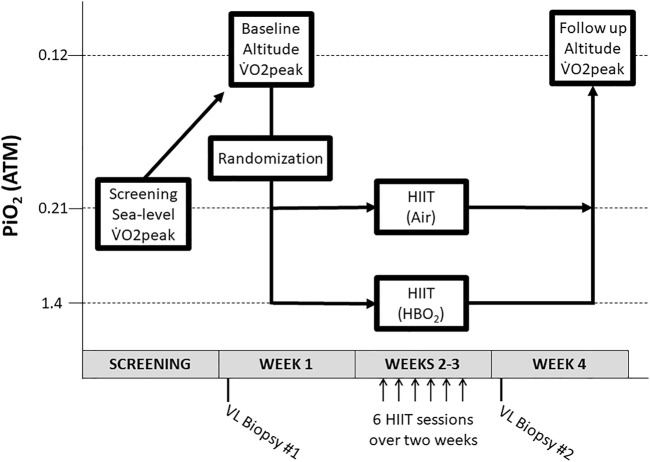
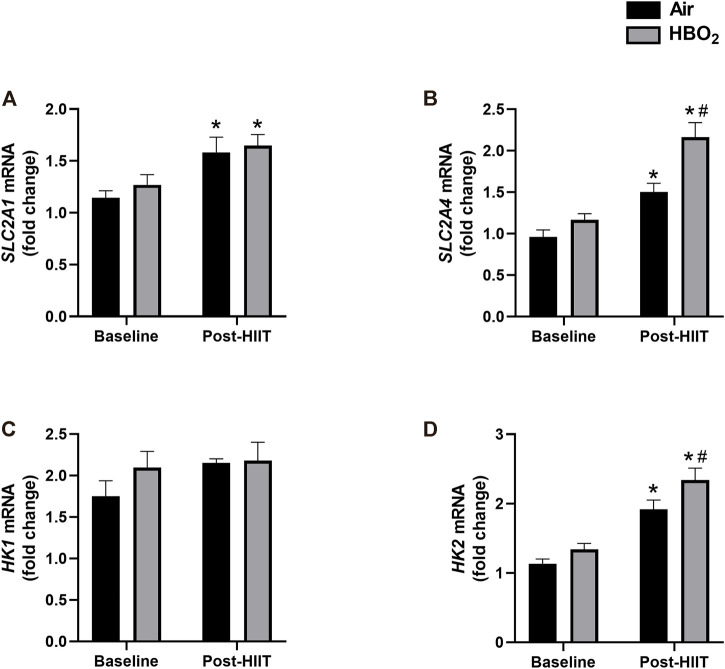
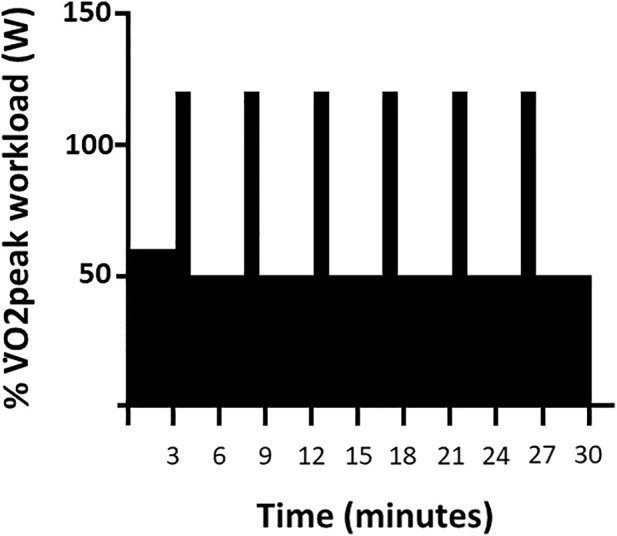
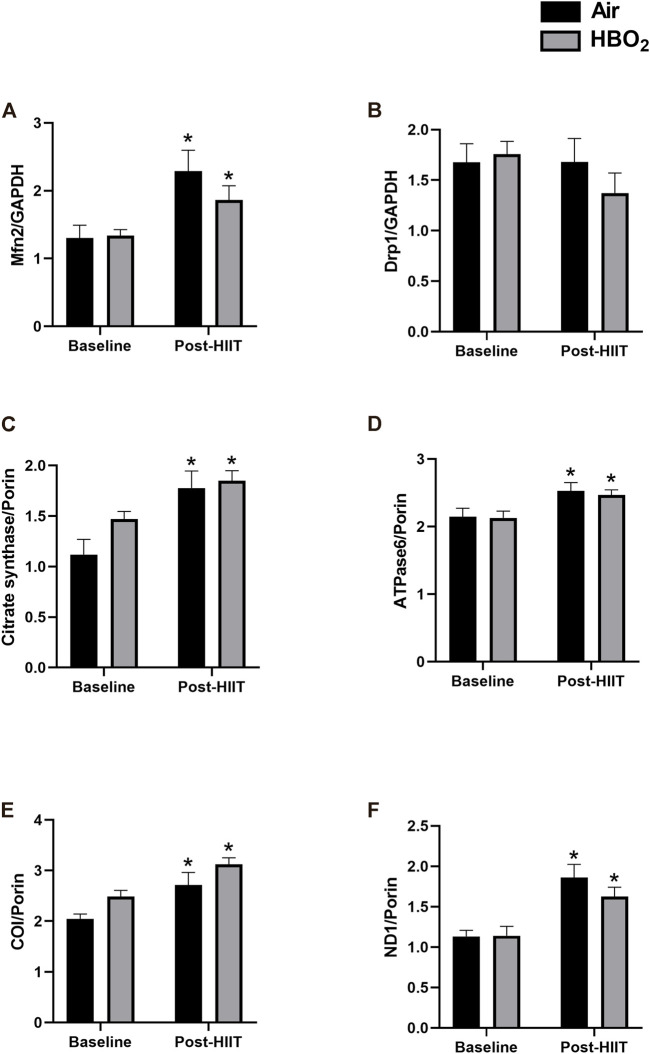
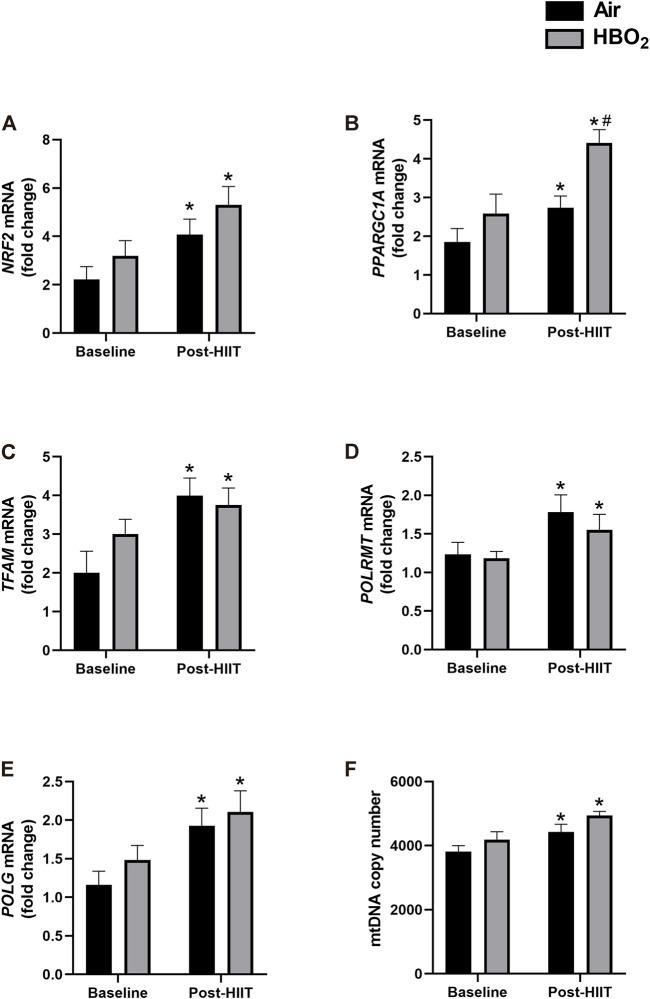
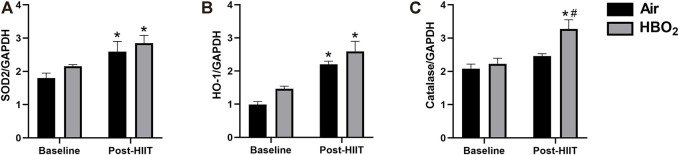
Hyperbaric Oxygen (HBO) has been proposed as a pre-conditioning method to enhance exercise performance. Most prior studies testing this effect have been limited by inadequate methodologies. Its potential efficacy and mechanism of action remain unknown. We hypothesized that HBO could enhance aerobic capacity by inducing mitochondrial biogenesis via redox signaling in skeletal muscle. HBO was administered in combination with high-intensity interval training (HIIT), a potent redox stimulus known to induce mitochondrial biogenesis. Aerobic capacity was tested during acute hypobaric hypoxia seeking to shift the limiting site of whole body V̇O2 from convection to diffusion, more closely isolating any effect of improved oxidative capacity. Healthy volunteers were screened with sea-level (SL) V̇Opeak testing. Seventeen subjects were enrolled (10 men, 7 women, ages 26.5±1.3 years, BMI 24.6±0.6 kg m, V̇Opeak SL = 43.4±2.1). Each completed 6 HIIT sessions over 2 weeks randomized to breathing normobaric air, "HIIT+Air" (PiO = 0.21 ATM) or HBO (PiO = 1.4 ATM) during training, "HIIT+HBO" group. Training workloads were individualized based on V̇Opeak SL test. Vastus Lateralis (VL) muscle biopsies were performed before and after HIIT in both groups. Baseline and post-training V̇Opeak tests were conducted in a hypobaric chamber at PiO2 = 0.12 ATM. HIIT significantly increased V̇Opeak in both groups: HIIT+HBO 31.4±1.5 to 35.2±1.2 ml kg·min and HIIT+Air 29.0±3.1 to 33.2±2.5 ml kg·min ( = 0.005) without an additional effect of HBO ( = 0.9 for interaction of HIIT x HBO). Subjects randomized to HIIT+HBO displayed higher skeletal muscle mRNA levels of , a regulator of mitochondrial biogenesis, and and , regulators of glucose utilization and storage. All other tested markers of mitochondrial biogenesis showed no additional effect of HBO to HIIT. When combined with HIIT, short-term modest HBO (1.4 ATA) has does not increase whole-body V̇Opeak during acute hypobaric hypoxia. (ClinicalTrials.gov Identifier: NCT02356900; https://clinicaltrials.gov/ct2/show/NCT02356900).
高压氧(HBO)已被提议作为一种预处理方法来提高运动表现。此前大多数测试这种效果的研究都受到方法不充分的限制。其潜在疗效和作用机制仍不清楚。我们假设HBO可以通过骨骼肌中的氧化还原信号诱导线粒体生物合成来提高有氧能力。HBO与高强度间歇训练(HIIT)联合使用,HIIT是一种已知可诱导线粒体生物合成的强效氧化还原刺激。在急性低压缺氧期间测试有氧能力,旨在将全身摄氧量(V̇O2)的限制部位从对流转移到扩散,从而更紧密地分离氧化能力改善的任何影响。通过海平面(SL)V̇Opeak测试对健康志愿者进行筛查。招募了17名受试者(10名男性,7名女性,年龄26.5±1.3岁,体重指数24.6±0.6 kg/m,SL处V̇Opeak = 43.4±2.1)。每个人在2周内完成6次HIIT训练,随机分为在训练期间呼吸常压空气,即“HIIT+空气”(吸入氧分压PiO = 0.21 ATM)或HBO(PiO = 1.4 ATM),即“HIIT+HBO”组。训练负荷根据SL处V̇Opeak测试进行个体化调整。两组在HIIT前后均进行股外侧肌(VL)肌肉活检。在低压舱中于PiO2 = 0.12 ATM进行基线和训练后V̇Opeak测试。HIIT在两组中均显著提高了V̇Opeak:HIIT+HBO组从31.4±1.5提高到35.2±1.2 ml/kg·min,HIIT+空气组从29.0±3.1提高到33.2±2.5 ml/kg·min(P = 0.005),HBO没有额外作用(HIIT×HBO交互作用的P = 0.9)。随机分配到HIIT+HBO组的受试者显示出线粒体生物合成调节因子、葡萄糖利用和储存调节因子以及的骨骼肌mRNA水平较高。所有其他测试的线粒体生物合成标志物显示HBO对HIIT没有额外作用。当与HIIT联合使用时,短期适度的HBO(1.4 ATA)在急性低压缺氧期间不会增加全身V̇Opeak。(ClinicalTrials.gov标识符:NCT02356900;https://clinicaltrials.gov/ct2/show/NCT02356900)