Pal Anirban, Mukhopadhyay Purnava, Datta Soma, Pal Nidhi Dawar
Department of Anaesthesia and Pain Medicine, Apollo Gleneagles Hospitals, Kolkata, West Bengal, India.
Department of Anaesthesia, Kalyani ESI Hospital, Kalyani, West Bengal, India.
Indian J Psychiatry. 2022 Jul-Aug;64(4):401-407. doi: 10.4103/indianjpsychiatry.indianjpsychiatry_4_21. Epub 2022 Jul 13.
The Indian population is suffering from a high prevalence of mental stress and the situation has been worsened by the COVID-19 pandemic. Mindfulness, which can also be conducted online, has been used as a stress-relieving therapy in the Western world. There is not much experience with mindfulness in the Indian population. The COVID-19 pandemic demands the development of alternative therapies which can reach out to the masses at a minimal cost, avoiding direct personal contact. The researchers wanted to explore the potential of mindfulness as a stress-relieving therapy.
To note any improvement in perceived stress of the participants compared to the controls.
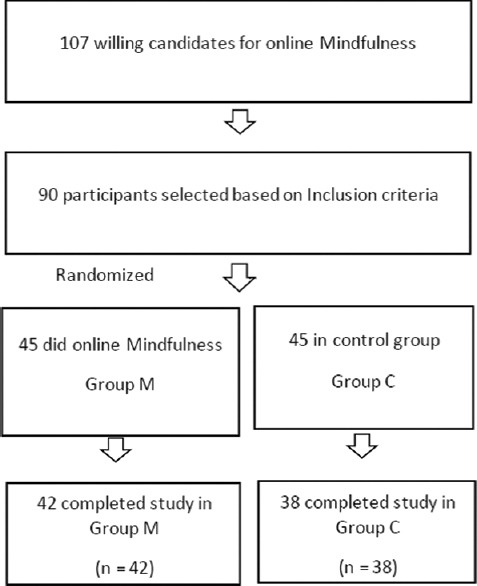
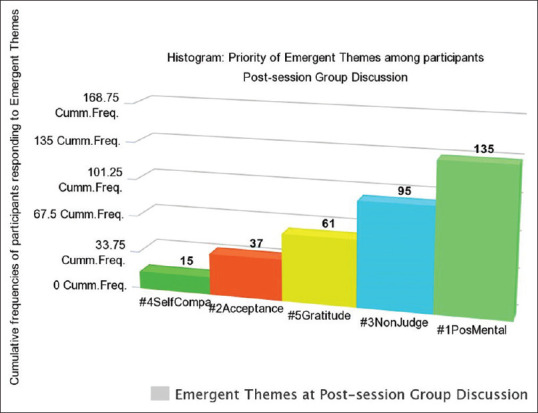
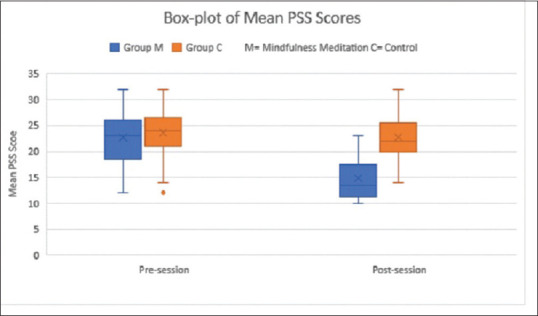
Ninety apparently healthy adults were randomized into group M (all of whom participated in an online mindfulness program) and group C (all of whom attended placebo sessions), with 45 participants each. Final sample size was = 42 (group M) and = 38 (group C). The perceived stress was measured using the perceived stress scale before and after the program. Qualitative data was collected in the form of written responses to the question "Which aspect of mindfulness meditation appealed to you the most for stress relief?" and some themes were formed.
There was a significant decrease in perceived stress scale scores on completion of the program in group M. "Positive mental state" and "non-judgmental" were the most prominent emergent themes suggested by the participants, as per the qualitative data analysis.
This preliminary study sees potential in an online mindfulness program as an alternative stress-relieving therapy. Further research is suggested to substantiate the results and optimize the implementation.
印度人口正遭受着高患病率的精神压力,而新冠疫情使这种情况更加恶化。正念疗法也可以在线进行,在西方世界已被用作一种缓解压力的疗法。在印度人群中,正念疗法的经验并不多。新冠疫情要求开发能够以最低成本惠及大众、避免直接人际接触的替代疗法。研究人员想要探索正念疗法作为一种缓解压力疗法的潜力。
与对照组相比,观察参与者感知压力的任何改善情况。
90名表面健康的成年人被随机分为M组(所有人都参加了在线正念课程)和C组(所有人都参加了安慰剂课程),每组45名参与者。最终样本量为M组 = 42人,C组 = 38人。在课程前后使用感知压力量表测量感知压力。以书面回答“正念冥想的哪个方面最吸引你用于缓解压力?”的形式收集定性数据,并形成了一些主题。
M组在课程结束时,感知压力量表得分显著降低。根据定性数据分析,参与者提出的最突出的新出现主题是“积极的心理状态”和“无评判”。
这项初步研究认为在线正念课程作为一种替代的缓解压力疗法具有潜力。建议进一步开展研究以证实结果并优化实施。