
一项为期8周的基于网络的正念虚拟社区干预对大学生压力、焦虑和抑郁症状的有效性:随机对照试验。
Effectiveness of an 8-Week Web-Based Mindfulness Virtual Community Intervention for University Students on Symptoms of Stress, Anxiety, and Depression: Randomized Controlled Trial.
作者信息
El Morr Christo, Ritvo Paul, Ahmad Farah, Moineddin Rahim
机构信息
School of Health Policy and Management, York University, Toronto, ON, Canada.
School of Kinesiology and Health Science, York University, Toronto, ON, Canada.
出版信息
JMIR Ment Health. 2020 Jul 17;7(7):e18595. doi: 10.2196/18595.
BACKGROUND
A student mental health crisis is increasingly acknowledged and will only intensify with the COVID-19 crisis. Given accessibility of methods with demonstrated efficacy in reducing depression and anxiety (eg, mindfulness meditation and cognitive behavioral therapy [CBT]) and limitations imposed by geographic obstructions and localized expertise, web-based alternatives have become vehicles for scaled-up delivery of benefits at modest cost. Mindfulness Virtual Community (MVC), a web-based program informed by CBT constructs and featuring online videos, discussion forums, and videoconferencing, was developed to target depression, anxiety, and experiences of excess stress among university students.
OBJECTIVE
The aim of this study was to assess the effectiveness of an 8-week web-based mindfulness and CBT program in reducing symptoms of depression, anxiety, and stress (primary outcomes) and increasing mindfulness (secondary outcome) within a randomized controlled trial (RCT) with undergraduate students at a large Canadian university.
METHODS
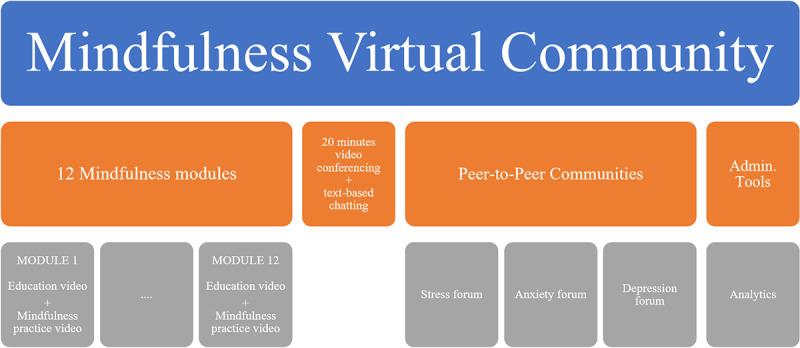
An RCT was designed to assess undergraduate students (n=160) who were randomly allocated to a web-based guided mindfulness-CBT condition (n=80) or to a waitlist control (WLC) condition (n=80). The 8-week intervention consisted of a web-based platform comprising (1) 12 video-based modules with psychoeducation on students' preidentified life challenges and applied mindfulness practice; (2) anonymous peer-to-peer discussion forums; and (3) anonymous, group-based, professionally guided 20-minute live videoconferences. The outcomes (depression, anxiety, stress, and mindfulness) were measured via an online survey at baseline and at 8 weeks postintervention using the Patient Health Questionnaire-9 (PHQ9), the Beck Anxiety Inventory (BAI), the Perceived Stress Scale (PSS), and the Five Facets Mindfulness Questionnaire Short Form (FFMQ-SF). Analyses employed generalized estimation equation methods with AR(1) covariance structures and were adjusted for possible covariates (gender, age, country of birth, ethnicity, English as first language, paid work, unpaid work, relationship status, physical exercise, self-rated health, and access to private mental health counseling).
RESULTS
Of the 159 students who provided T1 data, 32 were males and 125 were females with a mean age of 22.55 years. Participants in the MVC (n=79) and WLC (n=80) groups were similar in sociodemographic characteristics at T1 with the exception of gender and weekly hours of unpaid volunteer work. At postintervention follow-up, according to the adjusted comparisons, there were statistically significant between-group reductions in depression scores (β=-2.21, P=.01) and anxiety scores (β=-4.82, P=.006), and a significant increase in mindfulness scores (β=4.84, P=.02) compared with the WLC group. There were no statistically significant differences in perceived stress for MVC (β=.64, P=.48) compared with WLC.
CONCLUSIONS
With the MVC intervention, there were significantly reduced depression and anxiety symptoms but no significant effect on perceived stress. Online mindfulness interventions can be effective in addressing common mental health conditions among postsecondary populations on a large scale, simultaneously reducing the current burden on traditional counseling services.
TRIAL REGISTRATION
ISRCTN Registry ISRCTN12249616; http://www.isrctn.com/ISRCTN12249616.
背景
学生心理健康危机日益受到关注,且在新冠疫情危机下只会加剧。鉴于有已证明在减轻抑郁和焦虑方面有效的方法(如正念冥想和认知行为疗法[CBT])可供使用,同时考虑到地理障碍和本地专业知识的限制,基于网络的替代方案已成为以适度成本扩大效益交付的手段。正念虚拟社区(MVC)是一个基于网络的项目,以CBT结构为依据,设有在线视频、讨论论坛和视频会议,旨在针对大学生的抑郁、焦虑和过度压力体验。
目的
本研究的目的是在一项针对加拿大一所大型大学本科生的随机对照试验(RCT)中,评估一个为期8周的基于网络的正念和CBT项目在减轻抑郁、焦虑和压力症状(主要结果)以及提高正念(次要结果)方面的有效性。
方法
设计了一项RCT,以评估本科生(n = 160),他们被随机分配到基于网络的引导式正念 - CBT组(n = 80)或等待名单对照组(WLC,n = 80)。为期8周的干预由一个基于网络的平台组成,该平台包括:(1)12个基于视频的模块,内容为针对学生预先确定的生活挑战的心理教育和应用正念练习;(2)匿名的 peer - to - peer讨论论坛;(3)匿名的、基于小组的、由专业人员指导的20分钟现场视频会议。通过在线调查在基线和干预后8周使用患者健康问卷 - 9(PHQ9)、贝克焦虑量表(BAI)、感知压力量表(PSS)和五因素正念问卷简表(FFMQ - SF)测量结果(抑郁、焦虑、压力和正念)。分析采用具有AR(1)协方差结构的广义估计方程方法,并针对可能的协变量(性别、年龄、出生国家、种族、英语作为第一语言、有偿工作、无偿工作、恋爱状况、体育锻炼、自评健康状况以及是否能获得私人心理健康咨询)进行了调整。
结果
在提供T1数据的159名学生中,32名是男性,125名是女性,平均年龄为22.55岁。MVC组(n = 79)和WLC组(n = 80)的参与者在T1时的社会人口学特征相似,但性别和每周无偿志愿工作时长除外。在干预后随访时,根据调整后的比较,与WLC组相比,抑郁得分(β = -2.21,P = 0.01)和焦虑得分(β = -4.82,P = 0.006)在组间有统计学显著降低,正念得分有显著提高(β = 4.84,P = 0.02)。与WLC组相比MVC组的感知压力无统计学显著差异(β = 0.64,P = 0.48)。
结论
通过MVC干预,抑郁和焦虑症状显著减轻,但对感知压力无显著影响。在线正念干预可以有效地大规模解决高等教育人群中的常见心理健康问题,同时减轻传统咨询服务当前的负担。
试验注册
ISRCTN注册库ISRCTN12249616;http://www.isrctn.com/ISRCTN12249616

 Zotero 插件