Gok Hasya Nazli, Pekacar Sultan, Deliorman Orhan Didem
Department of Pharmacognosy, Faculty of Pharmacy, Gazi University, Ankara, Turkey.
Iran J Pharm Res. 2022 May 10;21(1):e127033. doi: 10.5812/ijpr-127033. eCollection 2022 Dec.
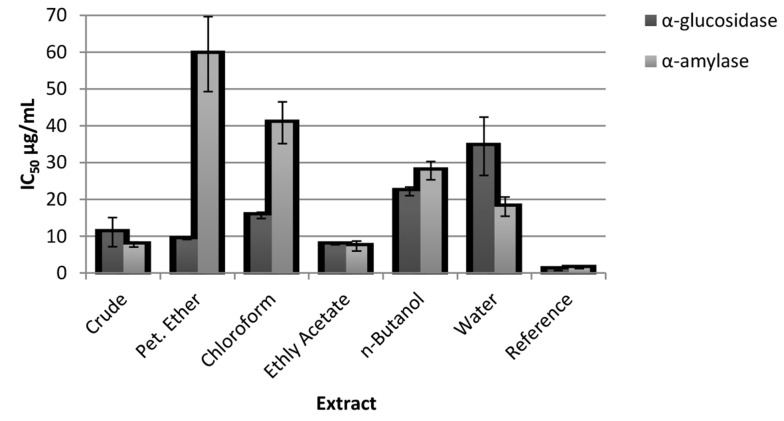
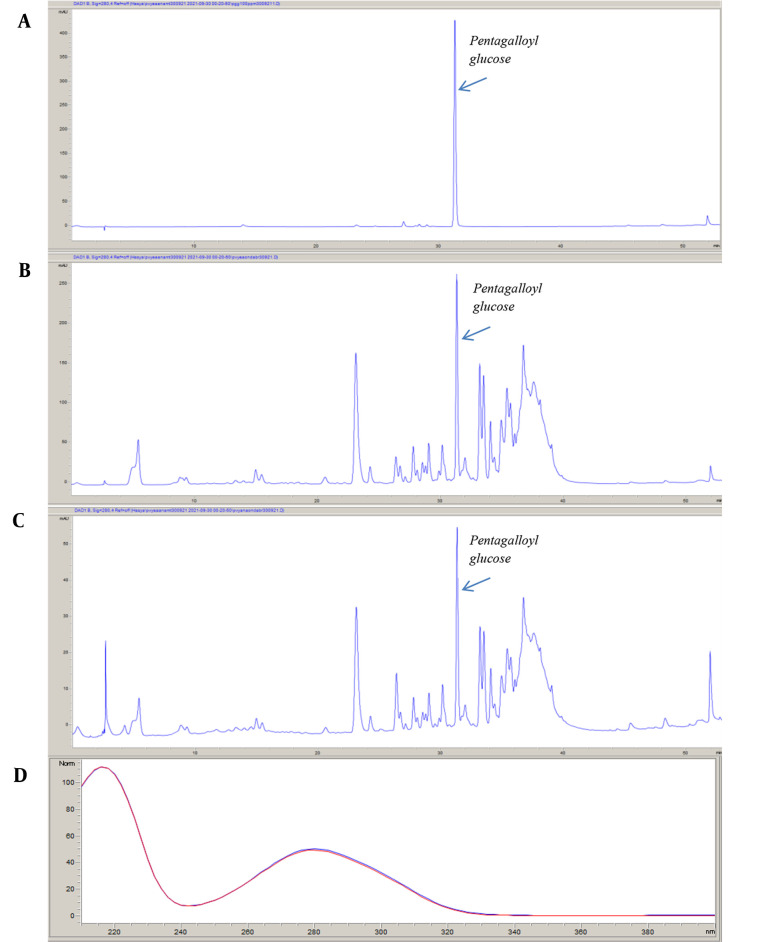
Since the leaves of some species are used in traditional folk medicine for diabetes, this study investigated the in vitro antidiabetic effect (α-glucosidase and α-amylase) of leaves. Additionally, the current study investigated the antihypercholesterolemic (cholesterol esterase), antiobesity (pancreatic lipase), and antioxidant activities (i.e., total antioxidant capacity, DPPH (2,2-Diphenyl-1-picrylhydrazyl) radical scavenging activity, metal chelating activity, and ferric-reducing antioxidant power) of leaves. The aqueous-alcoholic leaf extract inhibited α-amylase, α-glucosidase, and pancreatic lipase with the half-maximal inhibitory concentration values of 7.74 ± 0.72, 11.08 ± 3.96, and 168.43 ± 26.10 µg/mL, respectively. It was determined that the crude extract had high DPPH radical scavenging activity, ferric-reducing power, and moderate metal chelating activity. The ethyl acetate (EtOAc) subextract obtained by the liquid-liquid fractionation of the crude extract showed potent α-amylase and α-glucosidase inhibitory activities. The EtOAc subextract (5.794 ± 0.027 g/100 g subextract) was standardized by reversed-phase high-performance liquid chromatography based on β-pentagalloyl glucose, which showed inhibitory effects on both amylase and glucosidase enzymes. Fifteen compounds, seven of which are organic acid derivatives and eight of which are flavonoids, were identified by liquid chromatography quadrupole time-of-flight mass spectrometry (LC-QTOF-MS) analysis in the crude extract of leaves. Seven of the fifteen phenolic compounds detected in the crude extract by LC-QTOF-MS have both glucosidase and amylase inhibitory effects. As a result, leaves can be a potential source for compounds with high antioxidant effects that show inhibitory effects on enzymes involved in carbohydrate digestion in the prevention and treatment of diabetes or can be evaluated as a standardized extract.
由于某些物种的叶子在传统民间医学中被用于治疗糖尿病,本研究调查了叶子的体外抗糖尿病作用(α-葡萄糖苷酶和α-淀粉酶)。此外,本研究还调查了叶子的抗高胆固醇血症(胆固醇酯酶)、抗肥胖(胰脂肪酶)和抗氧化活性(即总抗氧化能力、DPPH(2,2-二苯基-1-苦基肼)自由基清除活性、金属螯合活性和铁还原抗氧化能力)。水醇叶提取物对α-淀粉酶、α-葡萄糖苷酶和胰脂肪酶有抑制作用,其半数抑制浓度值分别为7.74±0.72、11.08±3.96和168.43±26.10μg/mL。结果表明,粗提取物具有较高的DPPH自由基清除活性、铁还原能力和中等的金属螯合活性。通过粗提取物的液-液分级分离得到的乙酸乙酯(EtOAc)亚提取物显示出强大的α-淀粉酶和α-葡萄糖苷酶抑制活性。基于β-五没食子酰葡萄糖,通过反相高效液相色谱法对EtOAc亚提取物(5.794±0.027 g/100 g亚提取物)进行了标准化,该提取物对淀粉酶和葡萄糖苷酶均有抑制作用。通过液相色谱四极杆飞行时间质谱(LC-QTOF-MS)分析,在叶子的粗提取物中鉴定出15种化合物,其中7种是有机酸衍生物,8种是黄酮类化合物。通过LC-QTOF-MS在粗提取物中检测到的15种酚类化合物中有7种对葡萄糖苷酶和淀粉酶均有抑制作用。因此,叶子可能是具有高抗氧化作用的化合物的潜在来源,这些化合物对参与碳水化合物消化的酶具有抑制作用,可用于糖尿病的预防和治疗,或者可作为标准化提取物进行评估。