Chinese Academy of Sciences (CAS) Key Laboratory of Separation Sciences for Analytical Chemistry, Dalian Institute of Chemical Physics, Chinese Academy of Sciences, Dalian, China.
Department of Endocrinology, Shandong Provincial Hospital, Shandong University, Jinan, China.
Front Endocrinol (Lausanne). 2022 Aug 15;13:966823. doi: 10.3389/fendo.2022.966823. eCollection 2022.
Dyslipidemia is a hallmark of diabetes mellitus (DM). However, specific lipid molecules closely associated with the initiation and progression of diabetes remain unclear. We used a pseudotargeted lipidomics approach to evaluate the complex lipid changes that occurred long before the diagnosis of type 2 diabetes mellitus (T2DM) and to identify novel lipid markers for screening prediabetes mellitus (PreDM) and T2DM in patients from multiple communities.
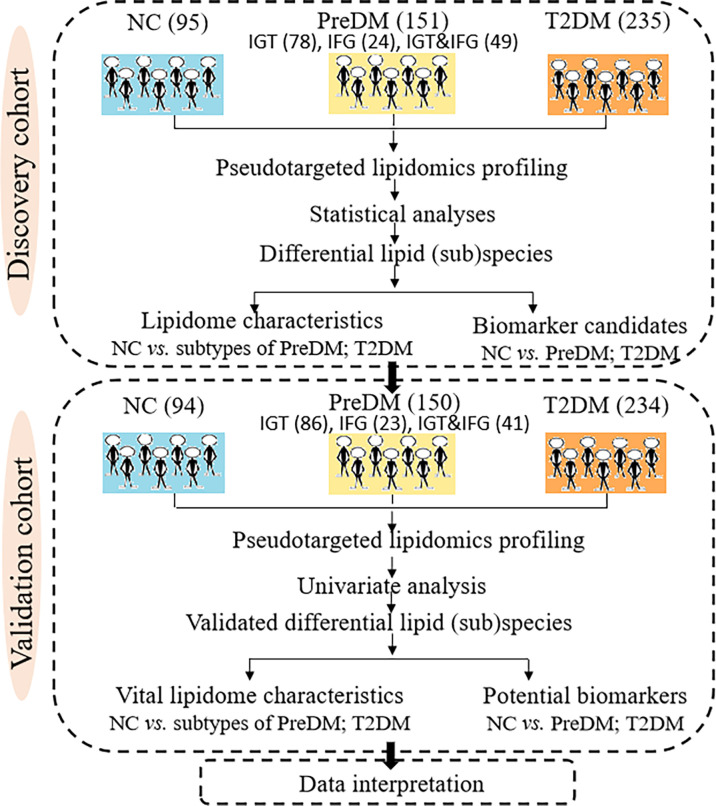
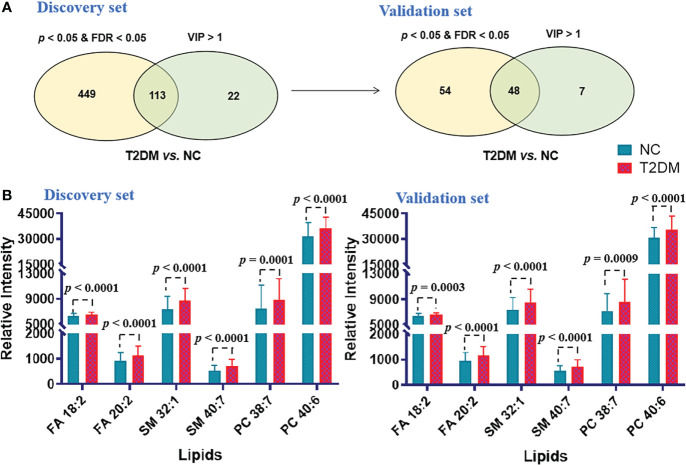
Four hundred and eighty-one subjects consisting of T2DM, three subtypes of PreDM, and normal controls (NC) were enrolled as discovery cohort. Serum lipidomic profiles of 481 subjects were analyzed using an ultrahigh performance liquid chromatography-triple quadrupole mass spectrometry (UHPLC-QqQ-MS)-based pseudotargeted lipidomics method. The differential lipid molecules were further validated in an independent case-control study consisting of 150 PreDM, 234 T2DM and 94 NC.
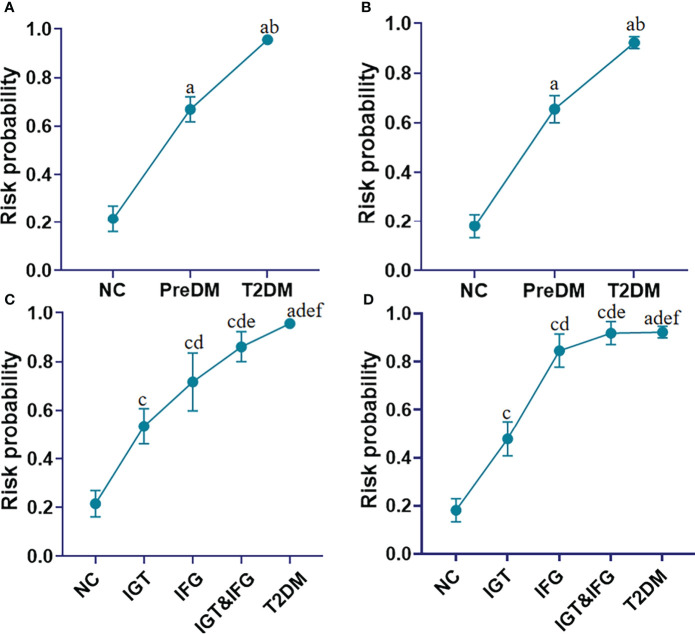
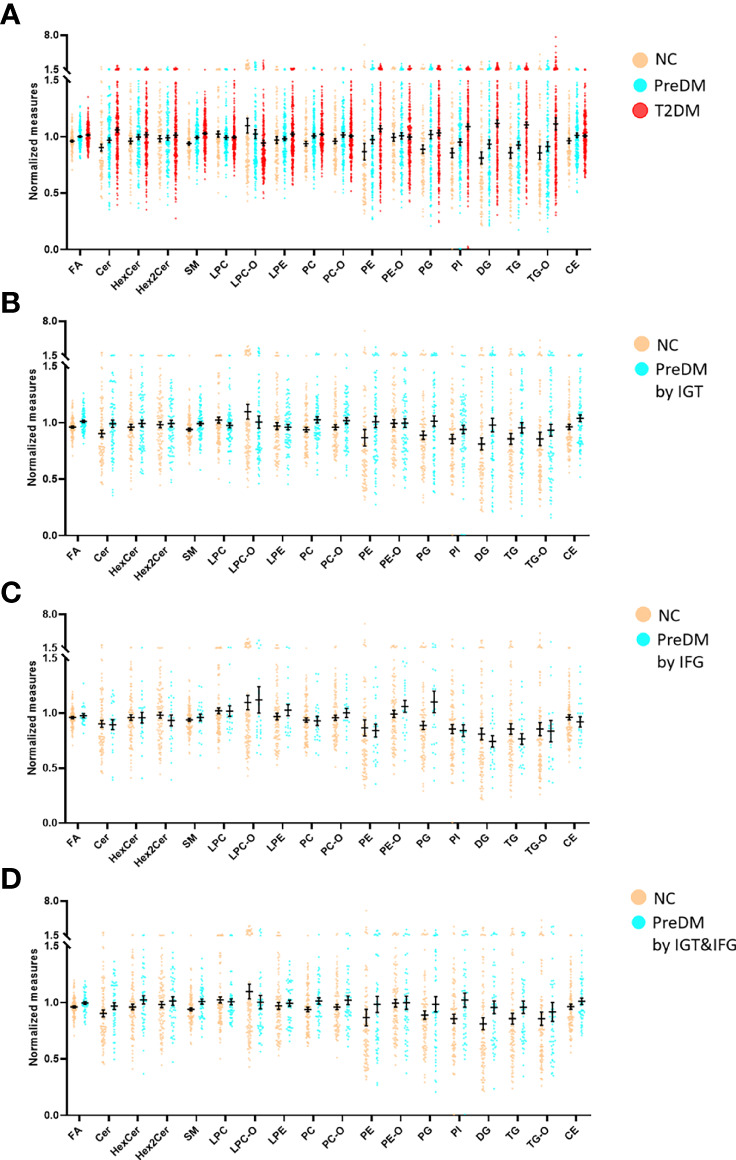
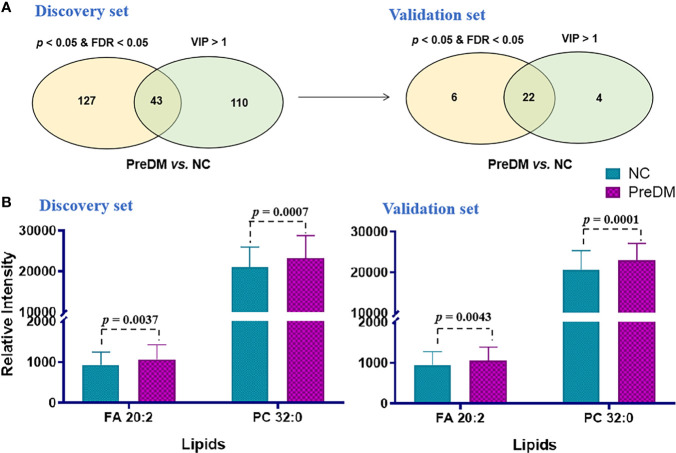
Multivariate discriminative analyses show that lipidomics data have considerable potential for identifying lipidome differences among T2DM, subtypes of PreDM and NC. Statistical associations of lipid (sub)species display significant variations in 11 lipid (sub)species levels for T2DM and distinctive differences in 8 lipid (sub)species levels between prediabetic and normoglycemic individuals, with further differences in 8 lipid (sub)species levels among subtypes of PreDM. Adjusted for sex, age and BMI, only two lipid (sub)species of fatty acid (FA) and phosphatidylcholine (PC) were associated at < 0.05 for PreDM (all) and subtypes of PreDM. The defined lipid markers not only significantly improve the diagnostic accuracy of PreDM and T2DM but also effectively evaluating the risk of developing into each subtype of PreDM and T2DM when addition of age, sex, BMI, and FPG, respectively.
Our findings improve insights into the lipid metabolic complexity and interindividual variations among subtypes of PreDM and T2DM, beyond the well-known differences in dyslipidemia in clinic.
血脂异常是糖尿病(DM)的标志。然而,与糖尿病的发生和发展密切相关的特定脂质分子尚不清楚。我们使用伪靶向脂质组学方法来评估 2 型糖尿病(T2DM)诊断前发生的复杂脂质变化,并鉴定用于筛选糖尿病前期(PreDM)和 T2DM 的新型脂质标志物。
纳入了 481 例 T2DM、3 种亚型 PreDM 和正常对照(NC)患者作为发现队列。采用超高效液相色谱-三重四级杆质谱(UHPLC-QqQ-MS)-基于伪靶向脂质组学方法分析 481 例患者的血清脂质组学谱。在包括 150 例 PreDM、234 例 T2DM 和 94 例 NC 的独立病例对照研究中进一步验证了差异脂质分子。
多元判别分析显示,脂质组学数据在识别 T2DM、PreDM 亚型和 NC 之间的脂质组差异方面具有相当大的潜力。脂质(亚)种的统计关联显示,T2DM 的 11 种脂质(亚)种水平存在显著差异,糖尿病前期和正常血糖个体之间存在 8 种脂质(亚)种水平的独特差异,PreDM 亚型之间存在 8 种脂质(亚)种水平的进一步差异。调整性别、年龄和 BMI 后,仅两种脂肪酸(FA)和磷脂酰胆碱(PC)的脂质(亚)种与 PreDM(全部)和 PreDM 亚型相关(均 P<0.05)。定义的脂质标志物不仅显著提高了 PreDM 和 T2DM 的诊断准确性,而且在分别加入年龄、性别、BMI 和 FPG 时,还能有效地评估发展为每种 PreDM 和 T2DM 亚型的风险。
我们的研究结果提高了对 PreDM 和 T2DM 亚组之间脂质代谢复杂性和个体间差异的认识,超出了临床血脂异常的已知差异。