Bian Guang-Li, Hu Ya-Lin, Yan Kai, Li De-Qiang
Department of Pharmacy, The Second Hospital of Hebei Medical University, No.215, Heping West Road, Shijiazhuang 050000, Hebei province, People's Republic of China.
Hebei Institute for Drug and Medical Device Control, No.215, Yuquan Road, Shijiazhuang 050299, Hebei Province, People's Republic of China.
Heliyon. 2022 Aug 18;8(8):e10332. doi: 10.1016/j.heliyon.2022.e10332. eCollection 2022 Aug.
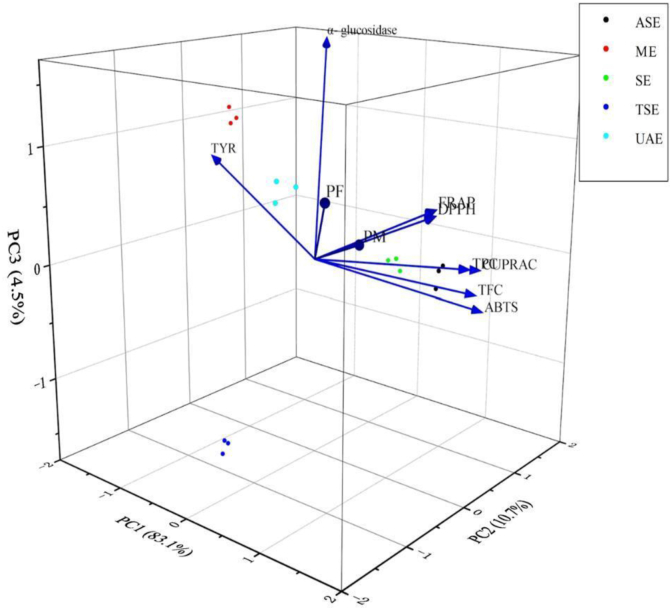
Willd (VA) is a popular medicinal plant used in local and traditional medicine to manage various disorders. In order to explore the phytochemical profile, antioxidant and enzyme modulatory activities of extracts prepared from the seeds of VA, different extraction methodologies, including modern (accelerated-ASE, ultrasound-UAE, and tissue smashing-TSE extractions) and traditional (maceration and Soxhlet) extractions, were employed and their effects on the activities of the extracts were investigated. The chemical compounds of the extracts were qualitatively analyzed by ultra-high-pressure liquid chromatography-tandem mass spectrometry (UPLC-Orbitrap-MS) technique. Among them, 11 compounds were undoubtedly identified by comparison with reference substance, while 13 compounds were tentatively identified by comparison with literature data, including 8 phenolic acids, 14 flavonoids and 2 esters were identified in the extracts. Additionally, the quantitative analysis found that ASE showed the highest extraction efficiency. The antioxidant activity was determined via six standard assays. Two key enzymes related to the diseases of vitiligo (tyrosinase) and type II diabetes (α-glucosidase) were adopted to assess the activity of VA extracts against them. All extracts showed potent antioxidant ability with a predominance for that obtained by ASE, which corroborated with the high phenolic (22.62 ± 0.23 mg gallic acid equivalent (GAE)/g extract) and flavonoid contents (68.85 ± 0.25 mg rutin equivalent (RE)/g extract). The extracts obtained by ASE, UAE and SE could increase the tyrosinase activity and all the extracts displayed remarkable inhibitory activity against α-glucosidase. This study demonstrated that the VA extracts obtained by novel extraction techniques such as ASE, could be considered as a positive candidate to be utilized by the food and medical industries, not only for obtaining bioactive compounds to be used as natural antioxidants, but possibly also for its health benefits for therapeutic bio-product development.
威尔德(VA)是一种在当地和传统医学中用于治疗各种疾病的常用药用植物。为了探究VA种子提取物的植物化学特征、抗氧化和酶调节活性,采用了不同的提取方法,包括现代方法(加速溶剂萃取法-ASE、超声辅助萃取法-UAE和组织捣碎法-TSE)和传统方法(浸渍法和索氏提取法),并研究了它们对提取物活性的影响。通过超高压液相色谱-串联质谱(UPLC-Orbitrap-MS)技术对提取物的化学成分进行了定性分析。其中,通过与参考物质比较明确鉴定出11种化合物,同时通过与文献数据比较初步鉴定出13种化合物,提取物中鉴定出8种酚酸、14种黄酮类化合物和2种酯类化合物。此外,定量分析发现ASE的提取效率最高。通过六种标准测定法测定了抗氧化活性。采用与白癜风(酪氨酸酶)和II型糖尿病(α-葡萄糖苷酶)疾病相关的两种关键酶来评估VA提取物对它们的活性。所有提取物均表现出较强的抗氧化能力,其中ASE提取物的抗氧化能力最强,这与高酚类含量(22.62±0.23毫克没食子酸当量(GAE)/克提取物)和黄酮类含量(68.85±0.25毫克芦丁当量(RE)/克提取物)相符。ASE、UAE和SE法获得的提取物可提高酪氨酸酶活性,所有提取物对α-葡萄糖苷酶均表现出显著的抑制活性。本研究表明,通过ASE等新型提取技术获得的VA提取物可被视为食品和医药行业利用的积极候选物,不仅可用于获取用作天然抗氧化剂的生物活性化合物,还可能因其对治疗性生物产品开发的健康益处而被利用。