Department of Molecular Biotechnology and Health Sciences, University of Turin, via Pietro Giuria 5, 10125, Turin, Italy.
University Lille, Inserm, CHU Lille, Laboratory of Development and Plasticity of the Neuroendocrine Brain, Lille Neuroscience & Cognition, Inserm UMR-S1172, 59000, Lille, France.
Anal Bioanal Chem. 2022 Nov;414(26):7623-7634. doi: 10.1007/s00216-022-04293-z. Epub 2022 Sep 5.
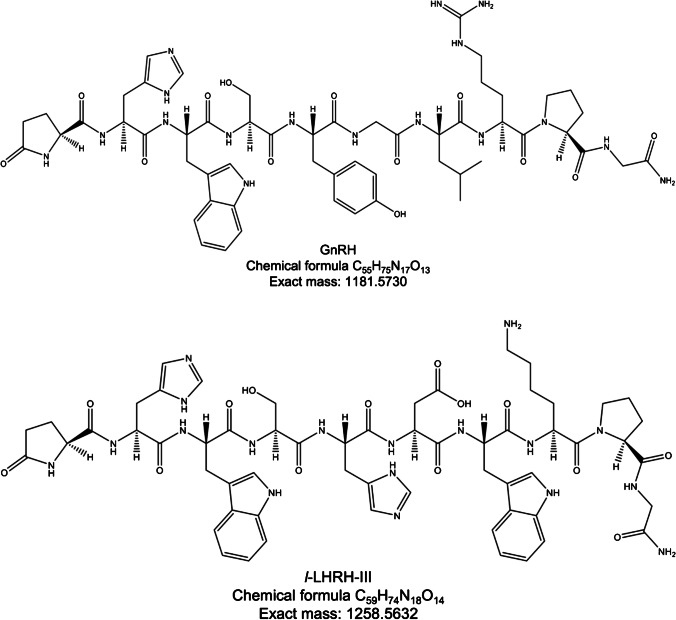
Gonadotropin-releasing hormone isoform I (GnRH), a neuro-deca-peptide, plays a fundamental role in development and maintenance of the reproductive system in vertebrates. The anomalous release of GnRH is observed in reproductive disorder such as hypogonadotropic hypogonadism, polycystic ovary syndrome (PCOS), or following prenatal exposure to elevated androgen levels. Quantitation of GnRH plasma levels could help to diagnose and better understand these pathologies. Here, a validated nano-high-performance liquid chromatography-high-resolution mass spectrometry (HPLC-HRMS) method to quantify GnRH in ewe plasma samples is presented. Protein precipitation and solid-phase extraction (SPE) pre-treatment steps were required to purify and enrich GnRH and internal standard (lamprey-luteinizing hormone-releasing hormone-III, l-LHRH-III). For the validation process, a surrogate matrix approach was chosen following the International Council for Harmonisation (ICH) and FDA guidelines. Before the validation study, the validation model using the surrogate matrix was compared with those using a real matrix such as human plasma. All the tested parameters were analogous confirming the use of the surrogate matrix as a standard calibration medium. From the validation study, limit of detection (LOD) and limit of quantitation (LOQ) values of 0.008 and 0.024 ng/mL were obtained, respectively. Selectivity, accuracy, precision, recovery, and matrix effect were assessed with quality control samples in human plasma and all values were acceptable. Sixteen samples belonging to healthy and prenatal androgen (PNA) exposed ewes were collected and analyzed, and the GnRH levels ranged between 0.05 and 3.26 ng/mL. The nano-HPLC-HRMS developed here was successful in measuring GnRH, representing therefore a suitable technique to quantify GnRH in ewe plasma and to detect it in other matrices and species.
促性腺激素释放激素同工型 I(GnRH),一种神经十肽,在脊椎动物的生殖系统发育和维持中起着至关重要的作用。在生殖障碍如低促性腺激素性性腺功能减退症、多囊卵巢综合征(PCOS)或产前暴露于升高的雄激素水平等情况下,会观察到 GnRH 的异常释放。GnRH 血浆水平的定量检测有助于诊断和更好地理解这些病理。本文介绍了一种已验证的用于检测绵羊血浆样品中 GnRH 的纳升级高效液相色谱-高分辨率质谱(HPLC-HRMS)方法。需要进行蛋白沉淀和固相萃取(SPE)预处理步骤来纯化和富集 GnRH 和内标(七鳃鳗促黄体激素释放激素-III,l-LHRH-III)。在验证过程中,根据国际协调会议(ICH)和 FDA 指南选择了替代基质方法。在验证研究之前,使用替代基质的验证模型与使用真实基质(如人血浆)的模型进行了比较。所有测试参数均相似,证实了替代基质可作为标准校准介质使用。通过验证研究,获得了 0.008 和 0.024ng/mL 的检测限(LOD)和定量限(LOQ)值。在人血浆中的质控样品中评估了选择性、准确性、精密度、回收率和基质效应,所有值均可接受。收集并分析了 16 份来自健康和产前雄激素(PNA)暴露的绵羊样品,GnRH 水平在 0.05 至 3.26ng/mL 之间。这里开发的纳升 HPLC-HRMS 成功地测量了 GnRH,因此代表了一种适用于定量绵羊血浆中 GnRH 并在其他基质和物种中检测 GnRH 的技术。