Instituto Maimónides de Investigación Biomédica de Cordoba (IMIBIC), Spain; Department of Cell Biology, Physiology, and Immunology, University of Cordoba, Spain; Hospital Universitario Reina Sofia, Cordoba, Spain; CIBER Fisiopatología de la Obesidad y Nutrición, Instituto de Salud Carlos III Cordoba, Spain.
Instituto Maimónides de Investigación Biomédica de Cordoba (IMIBIC), Spain; Department of Cell Biology, Physiology, and Immunology, University of Cordoba, Spain; Hospital Universitario Reina Sofia, Cordoba, Spain; CIBER Fisiopatología de la Obesidad y Nutrición, Instituto de Salud Carlos III Cordoba, Spain; FiDiPro Program, Institute of Biomedicine, University of Turku, FIN-20520 Turku, Finland.
Mol Metab. 2020 May;35:100937. doi: 10.1016/j.molmet.2020.01.001. Epub 2020 Feb 5.
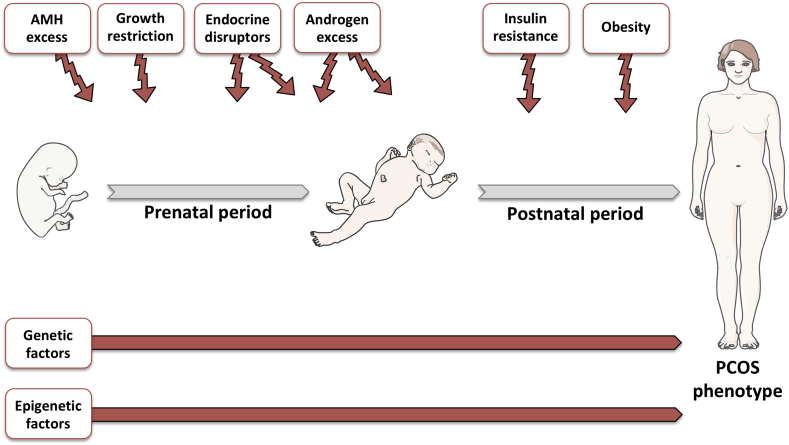
Polycystic ovary syndrome (PCOS) is the most common endocrinopathy among reproductive age women. Although its cardinal manifestations include hyperandrogenism, oligo/anovulation, and/or polycystic ovarian morphology, PCOS women often display also notable metabolic comorbidities. An array of pathogenic mechanisms have been implicated in the etiology of this heterogeneous endocrine disorder; hyperandrogenism at various developmental periods is proposed as a major driver of the metabolic and reproductive perturbations associated with PCOS. However, the current understanding of the pathophysiology of PCOS-associated metabolic disease is incomplete, and therapeutic strategies used to manage this syndrome's metabolic complications remain limited.
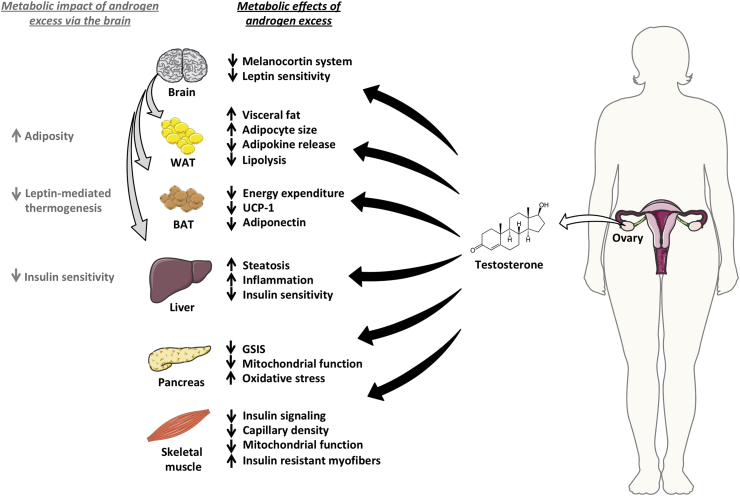
This study is a systematic review of the potential etiopathogenic mechanisms of metabolic dysfunction frequently associated with PCOS, with special emphasis on the metabolic impact of androgen excess on different metabolic tissues and the brain. We also briefly summarize the therapeutic approaches currently available to manage metabolic perturbations linked to PCOS, highlighting current weaknesses and future directions.
Androgen excess plays a prominent role in the development of metabolic disturbances associated with PCOS, with a discernible impact on key peripheral metabolic tissues, including the adipose, liver, pancreas, and muscle, and very prominently the brain, contributing to the constellation of metabolic complications of PCOS, from obesity to insulin resistance. However, the current understanding of the pathogenic roles of hyperandrogenism in metabolic dysfunction of PCOS and the underlying mechanisms remain largely incomplete. In addition, the development of more efficient, even personalized therapeutic strategies for the metabolic management of PCOS patients persists as an unmet need that will certainly benefit from a better comprehension of the molecular basis of this heterogeneous syndrome.
多囊卵巢综合征(PCOS)是育龄妇女中最常见的内分泌疾病。尽管其主要表现包括高雄激素血症、排卵障碍和/或多囊卵巢形态,但 PCOS 患者通常还表现出显著的代谢合并症。一系列发病机制与这种异质性内分泌紊乱有关;在不同的发育时期出现的高雄激素血症被认为是与 PCOS 相关的代谢和生殖紊乱的主要驱动因素。然而,目前对 PCOS 相关代谢疾病的病理生理学的理解并不完整,用于管理该综合征代谢并发症的治疗策略仍然有限。
本研究是对与 PCOS 相关的代谢功能障碍的潜在病因发病机制的系统综述,特别强调雄激素过多对不同代谢组织和大脑的代谢影响。我们还简要总结了目前用于管理与 PCOS 相关代谢紊乱的治疗方法,强调了当前的弱点和未来的方向。
雄激素过多在 PCOS 相关代谢紊乱的发展中起着重要作用,对包括脂肪、肝脏、胰腺和肌肉在内的关键外周代谢组织,以及非常显著的大脑,都有明显的影响,导致 PCOS 的代谢并发症的发生,从肥胖到胰岛素抵抗。然而,目前对高雄激素血症在 PCOS 代谢功能障碍中的致病作用及其潜在机制的理解仍在很大程度上不完整。此外,开发更有效、甚至个性化的治疗策略来管理 PCOS 患者的代谢,仍然是一个未满足的需求,这肯定将受益于对这种异质性综合征的分子基础的更好理解。