T. Denny Sanford School of Social and Family Dynamics, Arizona State University, Tempe, USA.
T. Denny Sanford School of Social and Family Dynamics, Arizona State University, Tempe, USA.
J Sch Psychol. 2022 Oct;94:15-27. doi: 10.1016/j.jsp.2022.08.001. Epub 2022 Aug 13.
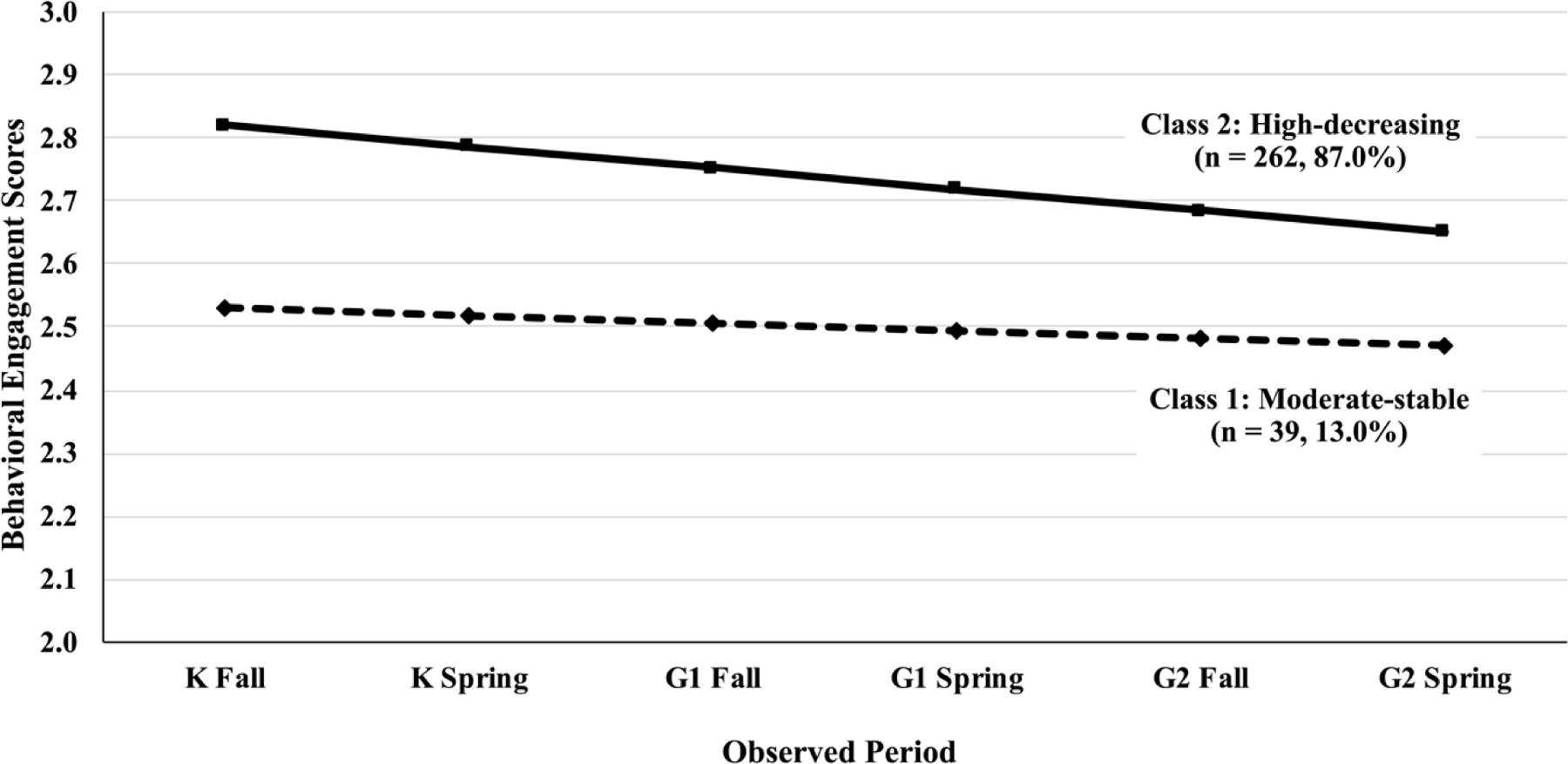
This study investigated developmental trajectories of observationally coded engagement across the early elementary years and whether these trajectories were associated with children's academic achievement. Furthermore, we evaluated if these relations varied as a function of children's family socio-economic status and early reading and math skills. Data were collected from 301 children who were studied from kindergarten (M = 65.74 months; 49% boys) to 2nd grade. Children's behavioral engagement was observed in kindergarten, 1st, and 2nd grade. Reading and math skills were assessed via standardized tests in kindergarten and 2nd grade. Growth mixture models identified two classes of behavioral engagement: most children (87.0%) displayed relatively high behavioral engagement in the fall of kindergarten and decreased significantly across time (referred to below as high-decreasing class), and other children (13.0%) exhibited moderate behavioral engagement in the fall of kindergarten that was stable across time (referred to below as moderate-stable class). After controlling for academic skills in kindergarten and demographic variables (i.e., child age, sex, ethnicity, and family socio-economic status), children in the high-decreasing class displayed higher reading skills, but not math skills, than children in the moderate-stable class. Additional analyses revealed that differences in reading skills between the two classes were present only for children from low socio-economic status families or for children low in kindergarten reading skills. The findings suggest that economically or academically at-risk students might benefit more than their peers from high behavioral engagement.
本研究调查了儿童在整个小学早期观察编码的参与发展轨迹,以及这些轨迹是否与儿童的学业成绩有关。此外,我们评估了这些关系是否因儿童的家庭社会经济地位以及早期阅读和数学技能的不同而有所变化。研究数据来自 301 名儿童,他们从幼儿园(M=65.74 个月;49%为男孩)一直被研究到 2 年级。在幼儿园、1 年级和 2 年级观察了儿童的行为参与度。通过幼儿园和 2 年级的标准化测试评估了阅读和数学技能。增长混合物模型确定了两种行为参与类型:大多数儿童(87.0%)在幼儿园秋季表现出相对较高的行为参与度,并且随着时间的推移显著下降(下文称为高下降类),而其他儿童(13.0%)在幼儿园秋季表现出稳定的中等行为参与度(下文称为中稳定类)。在控制了幼儿园的学术技能和人口统计学变量(即儿童年龄、性别、种族和家庭社会经济地位)后,高下降类的儿童在阅读技能方面表现优于中稳定类的儿童,但在数学技能方面没有优势。进一步的分析表明,只有在社会经济地位较低的家庭中或在幼儿园阅读技能较低的儿童中,这两个类别的阅读技能差异才存在。研究结果表明,在经济或学业上处于风险中的学生可能比他们的同龄人从高行为参与中获益更多。