Department of Renal Medicine, Aarhus University Hospital, Aarhus, Denmark.
Department of Biomedicine, Aarhus University Health, Aarhus, Denmark.
BMC Nephrol. 2022 Sep 5;23(1):305. doi: 10.1186/s12882-022-02929-x.
Nephrotic syndrome (NS) is associated with increased risk of thromboembolic events (TE) adding to the morbidity and mortality. International guidelines recommend prophylactic anticoagulation in patients with NS and high risk of TE, but no studies have identified the optimal type of anticoagulation in NS. We aimed to assess the effectiveness and safety of direct oral anticoagulant (DOAC) by analyzing the thromboembolic and bleeding events in NS patients prescribed DOAC as primary prophylaxis to prevent TE or as treatment for TE occurring in relation to NS.
We performed a single-center, retrospective study including patients with NS, a plasma albumin less than 25 g/L and prophylactic anticoagulation treatment with DOAC at the Department of Renal Medicine at Aarhus University Hospital, Denmark from July 2016 to June 2021. Patients treated with DOAC as thromboprophylaxis for other indications than NS were excluded. Baseline characteristics and outcomes, including TE, bleeding and other adverse effects associated with DOAC were obtained from medical records.
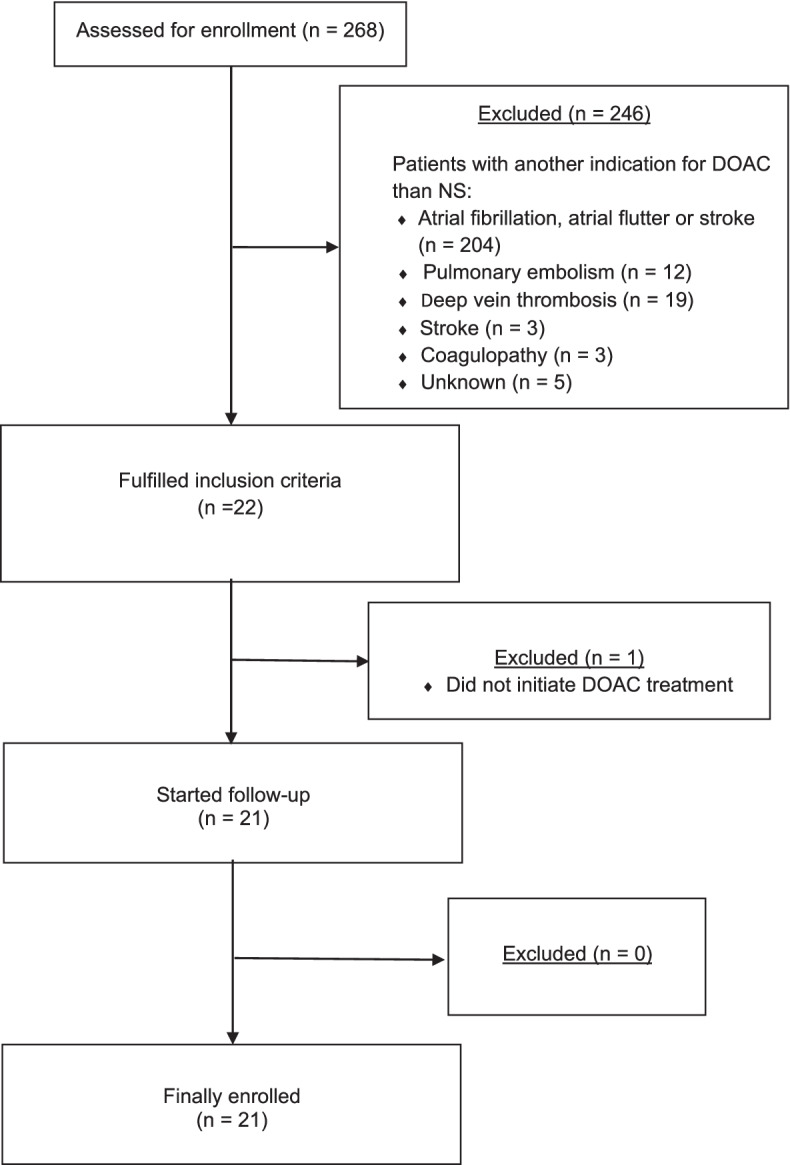
We identified 268 patients treated with DOAC of which 21 patients with NS were included in the study. Nineteen patients were prescribed DOAC as thromboprophylaxis and two patients received DOAC due to previous TE, which was considered associated with the NS. The type of DOAC prescribed was apixaban (n = 10) and rivaroxaban (n = 11). No patients experienced TE during DOAC treatment, while five patients had a minor bleeding episode. Patients who experienced bleeding episodes were older (median 62 vs 51 years), more often female (80%) and had been on DOAC for a longer period (204 days vs 47 days). Neither the HAS-BLED score nor GN-risk-score predicted the risk of minor bleedings in this population.
In this case series, no new TE and only minor bleeding complications were observed among adult NS patients treated with DOAC.
肾病综合征(NS)与血栓栓塞事件(TE)的风险增加有关,增加了发病率和死亡率。国际指南建议对 NS 伴 TE 高危患者进行预防性抗凝治疗,但尚无研究确定 NS 患者的最佳抗凝类型。我们旨在通过分析 NS 患者接受 DOAC 作为预防 TE 的一线预防或治疗与 NS 相关的 TE 时的血栓栓塞和出血事件,评估直接口服抗凝剂(DOAC)的有效性和安全性。
我们进行了一项单中心回顾性研究,纳入了 2016 年 7 月至 2021 年 6 月期间在丹麦奥胡斯大学医院肾内科接受 NS、血浆白蛋白<25g/L 和 DOAC 预防性抗凝治疗的患者。排除了因 NS 以外的其他原因接受 DOAC 治疗的患者。从病历中获得了基线特征和结局,包括 TE、出血和与 DOAC 相关的其他不良事件。
我们确定了 268 例接受 DOAC 治疗的患者,其中 21 例 NS 患者纳入研究。19 例患者因 NS 接受 DOAC 预防性治疗,2 例患者因之前与 NS 相关的 TE 接受 DOAC 治疗。处方的 DOAC 类型为阿哌沙班(n=10)和利伐沙班(n=11)。在 DOAC 治疗期间,没有患者发生 TE,而 5 例患者发生了轻微出血事件。发生出血事件的患者年龄较大(中位数 62 岁 vs 51 岁),女性比例较高(80%),DOAC 治疗时间较长(204 天 vs 47 天)。在该人群中,HAS-BLED 评分和 GN-risk-score 均不能预测轻微出血的风险。
在本病例系列中,接受 DOAC 治疗的成年 NS 患者未发生新的 TE,仅发生轻微出血并发症。