Department of Industrial Engineering, Alma Mater Studiorum - University of Bologna (IT), Bologna, Italy.
Medical Technology Lab, IRCCS Istituto Ortopedico Rizzoli, Via di Barbiano 1/10, 40136, Bologna, Italy.
Ann Biomed Eng. 2023 Jan;51(1):117-124. doi: 10.1007/s10439-022-03050-8. Epub 2022 Sep 6.
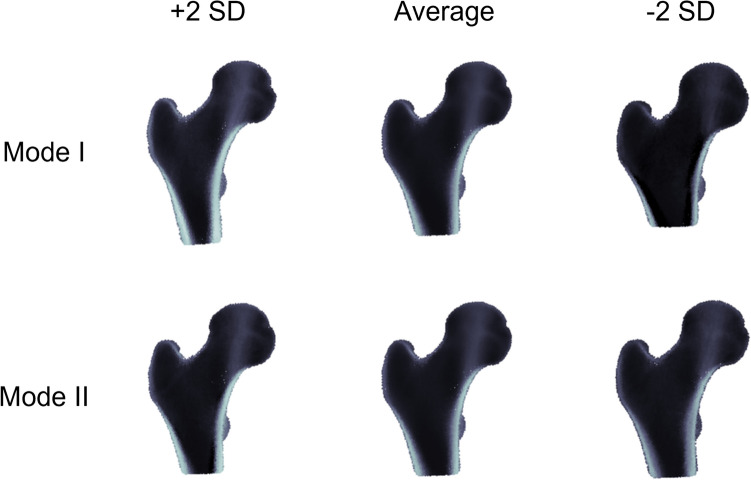
Osteoporosis-related hip fragility fractures are a catastrophic event for patient lives but are not frequently observed in prospective studies, and therefore phase III clinical trials using fractures as primary clinical endpoint require thousands of patients enrolled for several years to reach statistical significance. A novel answer to the large number of subjects needed to reach the desired evidence level is offered by In Silico Trials, that is, the simulation of a clinical trial on a large cohort of virtual patients, monitoring the biomarkers of interest. In this work we investigated if statistical aliasing from a custom anatomy atlas could be used to expand the patient cohort while retaining the original biomechanical characteristics. We used a pair-matched cohort of 94 post-menopausal women (at the time of the CT scan, 47 fractured and 47 not fractured) to create a statistical anatomy atlas through principal component analysis, and up-sampled the atlas in order to obtain over 1000 synthetic patient models. We applied the biomechanical computed tomography pipeline to the resulting virtual cohort and compared its fracture risk distribution with that of the original physical cohort. While the distribution of femoral strength values in the non-fractured sub-group was nearly identical to that of the original physical cohort, that of the fractured sub-group was lower than in the physical cohort. Nonetheless, by using the classification threshold used for the original population, the synthetic population was still divided into two parts of approximatively equal number.
与骨质疏松症相关的髋部脆性骨折对患者的生命来说是灾难性的事件,但在前瞻性研究中并不常见,因此,使用骨折作为主要临床终点的 III 期临床试验需要数千名患者入组数年才能达到统计学意义。一种新的方法是使用计算机模拟试验(In Silico Trials)来解决需要大量受试者才能达到预期证据水平的问题,即对大量虚拟患者进行临床试验模拟,监测感兴趣的生物标志物。在这项工作中,我们研究了从定制解剖图谱中进行统计混淆是否可以用于在保留原始生物力学特征的情况下扩展患者队列。我们使用了一组配对的 94 名绝经后女性(在 CT 扫描时,47 名骨折,47 名未骨折)的队列来通过主成分分析创建一个统计解剖图谱,并对图谱进行上采样,以获得超过 1000 个合成患者模型。我们将生物力学 CT 分析管道应用于得到的虚拟队列,并将其骨折风险分布与原始物理队列进行比较。虽然未骨折亚组的股骨强度值分布与原始物理队列几乎相同,但骨折亚组的分布低于物理队列。尽管如此,通过使用原始人群的分类阈值,合成人群仍然被分为近似相等数量的两部分。