Second Affiliated Hospital, and School of Public Health, The Key Laboratory of Intelligent Preventive Medicine of Zhejiang Province, Zhejiang University School of Medicine, Hangzhou, Zhejiang, China.
School of Economics and Management, Southeast University, Nanjing, Jiangsu, China.
JAMA Netw Open. 2022 Sep 1;5(9):e2230690. doi: 10.1001/jamanetworkopen.2022.30690.
Accelerated aging makes adults more vulnerable to chronic diseases and death. Whether childhood adversity is associated with accelerated aging processes, and to what extent lifestyle mediates the association, remain unknown.
To examine the associations of childhood adversity with a phenotypic aging measure and the role of unhealthy lifestyle in mediating these associations.
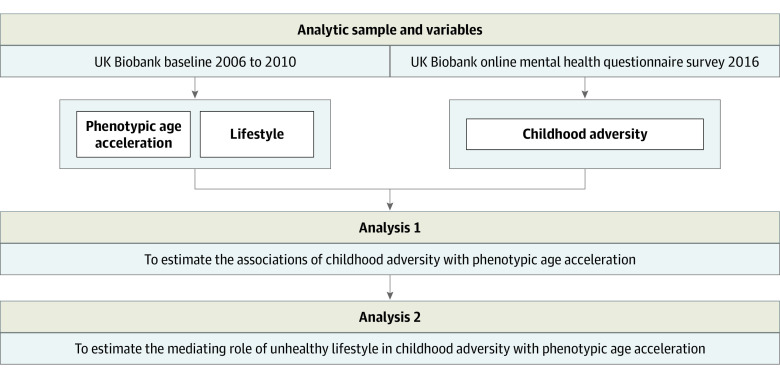
DESIGN, SETTING, AND PARTICIPANTS: A retrospective cohort analysis was conducted using data from adult participants in the UK Biobank baseline survey (2006-2010) and online mental health survey (2016). Data analysis was performed from September 1, 2021, to February 28, 2022.
Childhood adversity, including physical neglect, emotional neglect, sexual abuse, physical abuse, and emotional abuse, was assessed retrospectively through the online mental health survey (2016).
A phenotypic aging measure, phenotypic age acceleration, was calculated, with higher values indicating accelerated aging. Body mass index, smoking status, alcohol consumption, physical activity, and diet were combined to construct an unhealthy lifestyle score (range, 0-5, with higher scores denoting a more unhealthy lifestyle).
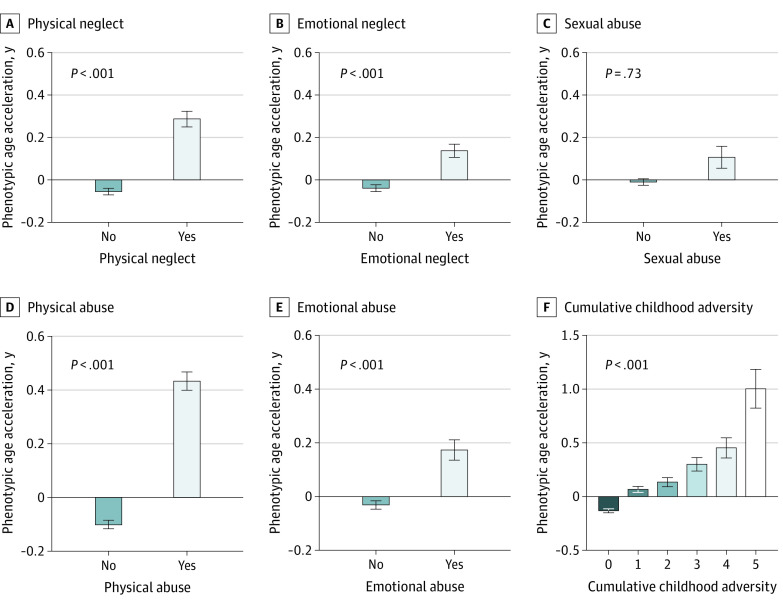
A total of 127 495 participants aged 40 to 69 years (mean [SD] chronological age at baseline, 56.4 [7.7] years; 70 979 women [55.7%]; 123 987 White participants [97.2%]) were included. Each individual type of childhood adversity and cumulative childhood adversity score were associated with phenotypic age acceleration. For instance, compared with participants who did not experience childhood adversity, those who experienced 4 (β = 0.296, 95% CI, 0.130-0.462) or 5 (β = 0.833; 95% CI, 0.537-1.129) childhood adversities had higher phenotypic age acceleration in fully adjusted models. The formal mediation analysis revealed that unhealthy lifestyle partially mediated the associations of childhood adversity with phenotypic age acceleration by 11.8% to 42.1%.
In this retrospective cohort study, childhood adversity was significantly associated with acceleration of aging and, more importantly, unhealthy lifestyle partially mediated these associations. These findings reveal a pathway from childhood adversity to health in middle and early older adulthood through lifestyle and underscore the potential of more psychological strategies beyond lifestyle interventions to promote healthy aging.
重要的是,加速衰老使成年人更容易患上慢性疾病和死亡。目前尚不清楚童年逆境是否与加速衰老过程有关,以及生活方式在多大程度上可以调节这种关联。
本研究旨在研究童年逆境与表型衰老指标的关联,以及不健康的生活方式在调节这种关联中的作用。
设计、地点和参与者:本回顾性队列分析使用了英国生物库基线调查(2006-2010 年)和在线心理健康调查(2016 年)中成年参与者的数据。数据分析于 2021 年 9 月 1 日至 2022 年 2 月 28 日进行。
童年逆境包括身体忽视、情感忽视、性虐待、身体虐待和情感虐待,通过在线心理健康调查(2016 年)进行回顾性评估。
计算了表型衰老指标,表型年龄加速,数值越高表示衰老加速。体重指数、吸烟状况、饮酒量、身体活动和饮食结合起来构建了一个不健康的生活方式评分(范围为 0-5,得分越高表示生活方式越不健康)。
共纳入 127495 名 40 至 69 岁的参与者(基线时的平均(SD)年龄为 56.4[7.7]岁;70979 名女性[55.7%];123987 名白人参与者[97.2%])。每一种类型的童年逆境和累积童年逆境评分都与表型年龄加速有关。例如,与没有经历过童年逆境的参与者相比,经历过 4 种(β=0.296,95%置信区间:0.130-0.462)或 5 种(β=0.833;95%置信区间:0.537-1.129)童年逆境的参与者,在完全调整的模型中,表型年龄加速更高。正式的中介分析显示,不健康的生活方式部分介导了童年逆境与表型年龄加速之间的关联,占 11.8%至 42.1%。
在这项回顾性队列研究中,童年逆境与衰老加速显著相关,更重要的是,不健康的生活方式部分介导了这种关联。这些发现揭示了从中年到早期老年,童年逆境通过生活方式对健康的影响途径,并强调了除生活方式干预之外,更需要采用更多的心理策略来促进健康衰老。