Department of Chemistry, University of Wisconsin-Madison, 1101 University Avenue, Madison, WI, 53706, USA.
Nat Commun. 2022 Sep 6;13(1):5242. doi: 10.1038/s41467-022-32789-w.
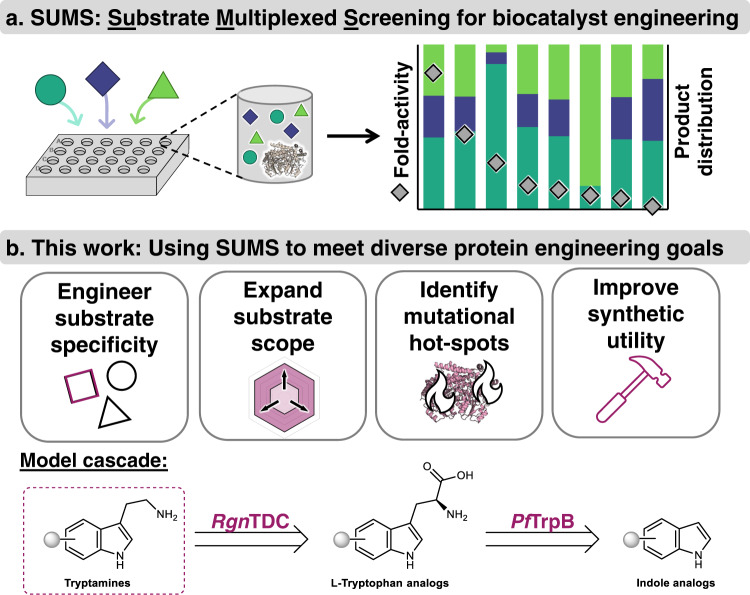
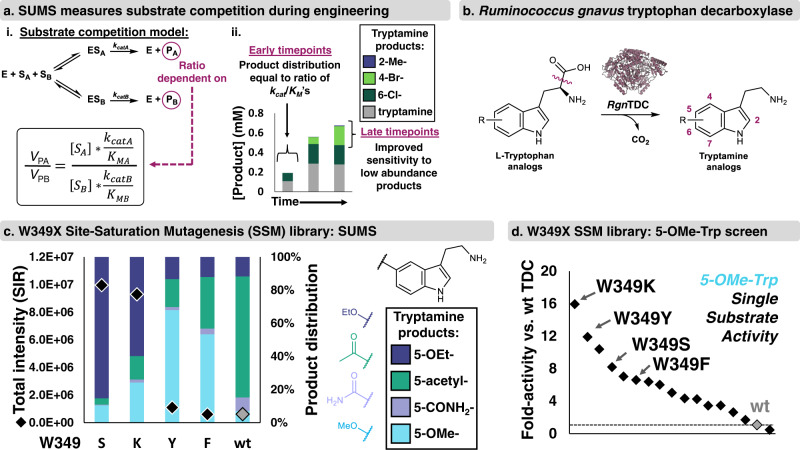
Enzymes with high activity are readily produced through protein engineering, but intentionally and efficiently engineering enzymes for an expanded substrate scope is a contemporary challenge. One approach to address this challenge is Substrate Multiplexed Screening (SUMS), where enzyme activity is measured on competing substrates. SUMS has long been used to rigorously quantitate native enzyme specificity, primarily for in vivo settings. SUMS has more recently found sporadic use as a protein engineering approach but has not been widely adopted by the field, despite its potential utility. Here, we develop principles of how to design and interpret SUMS assays to guide protein engineering. This rich information enables improving activity with multiple substrates simultaneously, identifies enzyme variants with altered scope, and indicates potential mutational hot-spots as sites for further engineering. These advances leverage common laboratory equipment and represent a highly accessible and customizable method for enzyme engineering.
通过蛋白质工程可以轻松产生高活性的酶,但有目的地、有效地针对扩展的底物范围进行酶工程设计仍然是一个当代的挑战。解决这一挑战的一种方法是底物多重筛选 (SUMS),其中在竞争底物上测量酶活性。SUMS 长期以来一直被用于严格定量天然酶的特异性,主要用于体内环境。SUMS 最近作为一种蛋白质工程方法被零星地使用,但尽管具有潜在的用途,它并没有被该领域广泛采用。在这里,我们开发了设计和解释 SUMS 测定以指导蛋白质工程的原理。这些丰富的信息可以同时提高对多种底物的活性,识别具有改变范围的酶变体,并指出潜在的突变热点作为进一步工程设计的位点。这些进展利用了常见的实验室设备,代表了一种高度可访问和可定制的酶工程方法。