Faculty of Medicine, King Abdulaziz University, Jeddah, Saudi Arabia.
Obstetrics and Gynecology Department, King Abdulaziz University, Jeddah, Saudi Arabia.
BMC Womens Health. 2022 Sep 6;22(1):367. doi: 10.1186/s12905-022-01952-2.
Menstrual irregularity is defined as any differences in the frequency, irregularity of onset, duration of flow, or volume of blood from the regular menstrual cycle. It is an important medical issue that many medical students suffer from. The study aimed to determine the menstrual cycle abnormalities women experienced during exams and to investigate the most common types of irregularities among female medical students at King Abdulaziz University in Jeddah, Saudi Arabia.
A cross-sectional study was conducted among female medical students between September and October 2021 at King Abdulaziz University in Jeddah, Saudi Arabia. For this study, the estimated sample size (n = 450) was derived from the online Raosoft sample size calculator. Thus, 450 female medical students from second to sixth year were selected through stratified random sampling. A validated online questionnaire collected data about demographics, menstrual irregularities during exams, type of irregularities, menstrual history, family history of menstrual irregularities, premenstrual symptoms, medication use, medical and family consultations, and absenteeism. The chi-squared test (χ) was used to analyze the associations between variables.
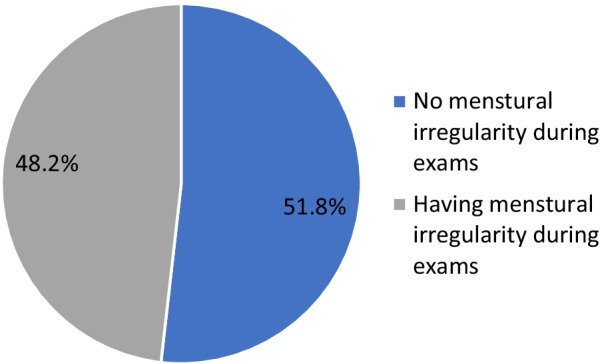
A total of 48.2% of participants had menstrual irregularities during exams. The most common irregularity was dysmenorrhea (70.9%), followed by a lengthened cycle (45.6%), and heavy bleeding (41.9%). A total of 93% of medical students suffered from premenstrual symptoms and 60.4% used medication such as herbal medication and home remedies to relieve menstrual irregularities, and 12.1% of the students missed classes due to menstrual irregularities. A non-significant relationship was found between menstrual irregularities during exams and students' demographics, academic year, and age at menarche, while oligomenorrhea, a heavier than normal bleed, a longer than normal cycle, and missing classes due to menstrual irregularities were significantly higher among single students as opposed to married students.
The results showed that female medical students have a significant frequency of menstruation abnormalities during exams period. Colleges should raise awareness among medical students about coping with examination stress and seeking medical care for menstrual abnormalities.
月经不规律是指月经周期的频率、起始不规则、持续时间、流量或血量与正常月经周期相比存在差异。这是一个许多医学生都面临的重要医学问题。本研究旨在确定女性在考试期间经历的月经周期异常,并调查沙特阿拉伯吉达阿卜杜勒阿齐兹国王大学的女医学生中最常见的不规则类型。
这是一项在 2021 年 9 月至 10 月期间在沙特阿拉伯吉达的阿卜杜勒阿齐兹国王大学进行的横断面研究。本研究中,根据在线 Raosoft 样本量计算器得出的估计样本量(n=450)。因此,通过分层随机抽样选择了 450 名来自第二至第六年的女医学生。一份经过验证的在线问卷收集了关于人口统计学、考试期间月经不规律、不规则类型、月经史、月经不规则家族史、经前期症状、药物使用、医疗和家庭咨询以及缺勤情况的数据。采用卡方检验(χ)分析变量之间的关联。
共有 48.2%的参与者在考试期间出现月经不规律。最常见的不规律是痛经(70.9%),其次是周期延长(45.6%)和出血量过多(41.9%)。93%的医学生有经前期症状,60.4%的学生使用草药和家庭疗法等药物来缓解月经不规律,12.1%的学生因月经不规律而缺课。考试期间月经不规律与学生的人口统计学特征、年级和初潮年龄之间没有显著关系,而寡经期、比正常出血量多、比正常周期长以及因月经不规律而缺课的情况在单身学生中明显高于已婚学生。
研究结果表明,女医学生在考试期间出现月经异常的频率较高。高校应提高医学生对应对考试压力和寻求医疗护理的认识,以解决月经异常问题。