Department of Obstetrics, Gynecology and Reproductive Sciences, University of California, San Francisco, CA, USA.
Advancing New Standards in Reproductive Health (ANSIRH), University of California, San Francisco, CA, USA.
J Gen Intern Med. 2023 May;38(6):1366-1374. doi: 10.1007/s11606-022-07774-0. Epub 2022 Sep 7.
Patient agency in contraceptive decision-making is an essential component of reproductive autonomy.
We aimed to develop a psychometrically robust measure of patient contraceptive agency in the clinic visit, as a measure does not yet exist.
For scale development, we generated and field tested 54 questionnaire items, grounded in qualitative research. We used item response theory-based methods to select and evaluate scale items for psychometric performance. We iteratively examined model fit, dimensionality, internal consistency, internal structure validity, and differential item functioning to arrive at a final scale.
A racially/ethnically diverse sample of 338 individuals, aged 15-34 years, receiving contraceptive care across nine California clinics in 2019-2020.
Contraceptive Agency Scale (CAS) of patient agency in preventive care.
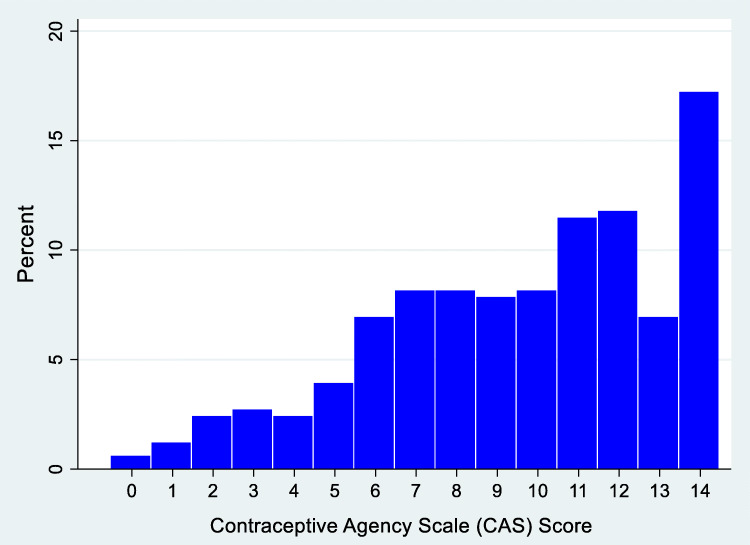
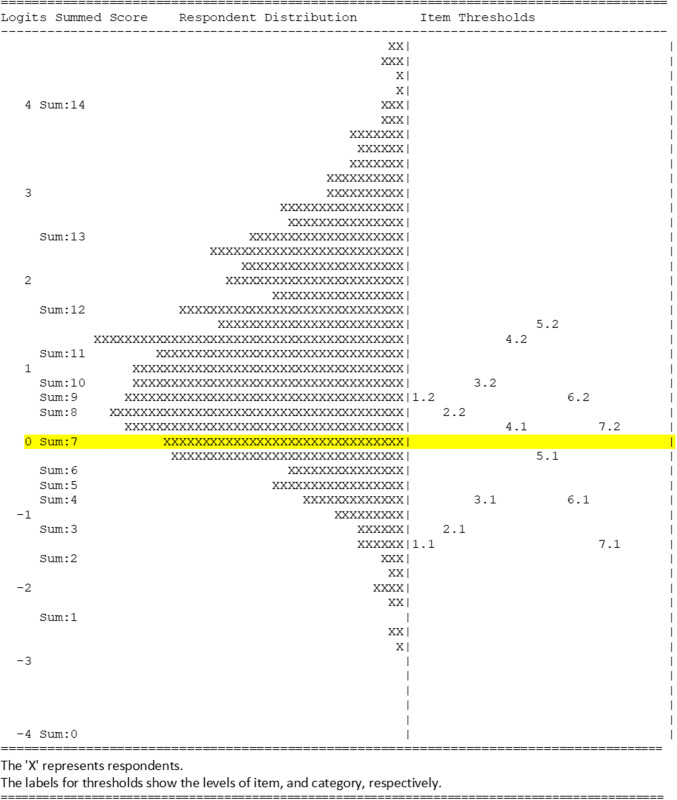
Participants were 20.5 mean years, with 36% identifying as Latinx, 26% White, 20% Black, 10% Asian/Native Hawaiian/Pacific Islander. Scale items covered the domains of freedom from coercion, non-judgmental care, and active decision-making, and loaded on to a single factor, with a Cronbach's α of 0.80. Item responses fit a unidimensional partial credit item response model (weighted mean square statistic within 0.75-1.33 for each item), met criteria for internal structure validity, and showed no meaningful differential item functioning. Most participants expressed high agency in their contraceptive visit (mean score 9.6 out of 14). One-fifth, however, experienced low agency or coercion, with the provider wanting them to use a specific method or to make decisions for them. Agency scores were lowest among Asian/Native Hawaiian/Pacific Islander participants (adjusted coefficient: -1.5 [-2.9, -0.1] vs. White) and among those whose mothers had less than a high school education (adjusted coefficient; -2.1 [-3.3, -0.8] vs. college degree or more).
The Contraceptive Agency Scale can be used in research and clinical care to reinforce non-coercive service provision as a standard of care.
患者在避孕决策中的自主性是生殖自主权的重要组成部分。
我们旨在开发一种在临床就诊中测量患者避孕自主性的心理测量学上可靠的工具,因为目前还没有这样的工具。
为了进行量表开发,我们生成并在实地测试了 54 个问卷项目,这些项目基于定性研究。我们使用基于项目反应理论的方法来选择和评估量表项目的心理测量性能。我们反复检查模型拟合度、维度、内部一致性、内部结构有效性和不同项目功能,以得出最终的量表。
2019 年至 2020 年期间,在加利福尼亚州的 9 家诊所接受避孕护理的 338 名年龄在 15 至 34 岁之间的不同种族/族裔的个体。
预防保健中的患者代理避孕机构量表(CAS)。
参与者的平均年龄为 20.5 岁,其中 36%是拉丁裔,26%是白人,20%是黑人,10%是亚洲/夏威夷原住民/太平洋岛民。量表项目涵盖了不受胁迫、非评判性护理和积极决策的领域,并归属于一个单一因素,Cronbach's α 为 0.80。项目反应符合单维部分信用项目反应模型(每个项目的加权均方根统计值在 0.75 到 1.33 之间),符合内部结构有效性标准,并且没有明显的不同项目功能。大多数参与者在避孕就诊中表现出高度的自主性(14 分中平均得分为 9.6 分)。然而,五分之一的参与者经历了低度的自主性或胁迫,提供者希望他们使用特定的方法或为他们做出决定。在亚洲/夏威夷原住民/太平洋岛民参与者(调整后的系数:-1.5[-2.9,-0.1]与白人)和母亲受教育程度低于高中的参与者(调整后的系数:-2.1[-3.3,-0.8]与大学学位或更高)中,代理评分最低。
避孕代理量表可用于研究和临床护理,以加强非胁迫性服务提供,作为护理标准。