Integrative Multisensory Perception Action & Cognition Team-ImpAct, Lyon Neuroscience Research Center, INSERM U1028, CNRS U5292, 16 Av. Doyen Lépine, BRON cedex, 69500, Lyon, France.
University of Lyon 1, Lyon, France.
Exp Brain Res. 2022 Nov;240(11):2817-2833. doi: 10.1007/s00221-022-06456-x. Epub 2022 Sep 7.
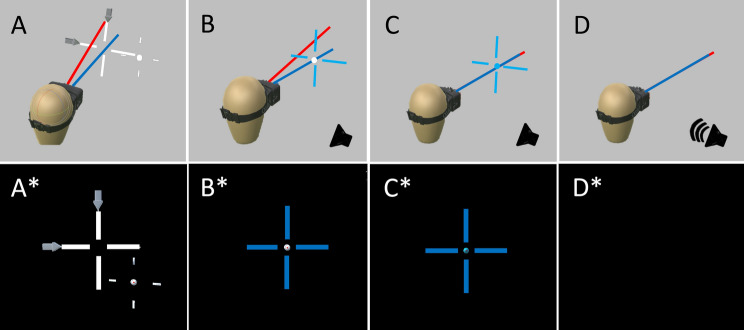
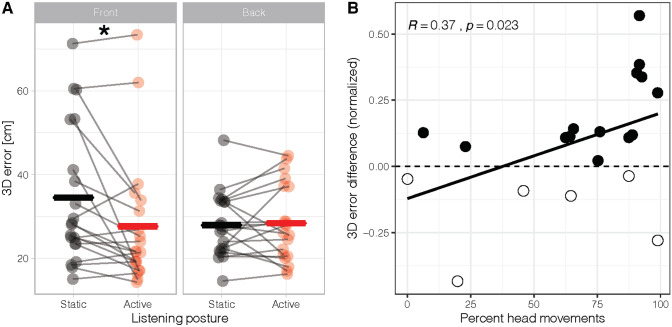
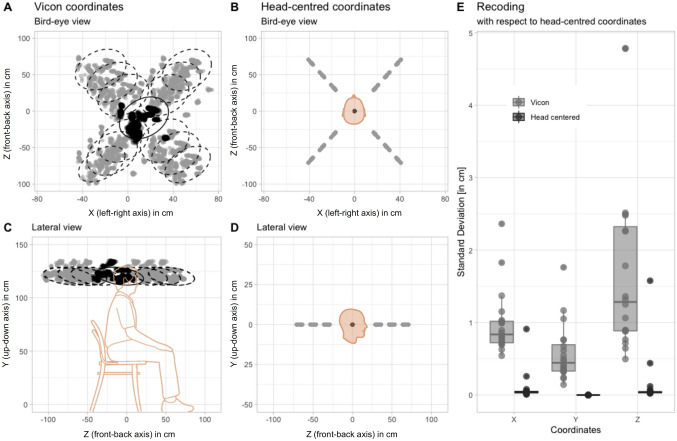
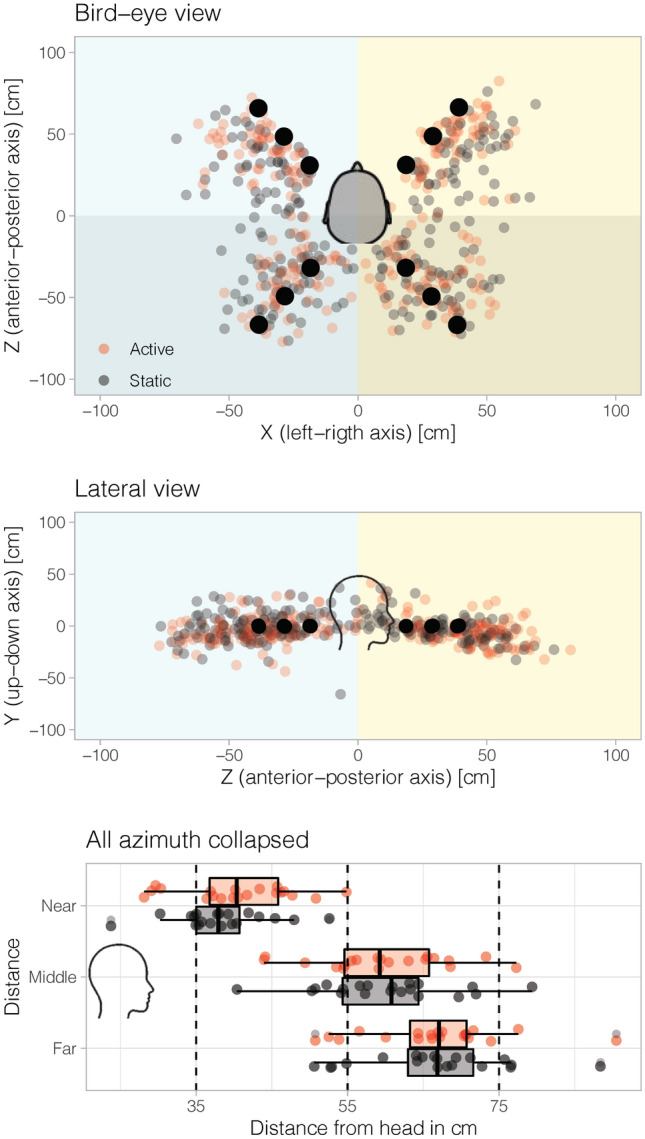
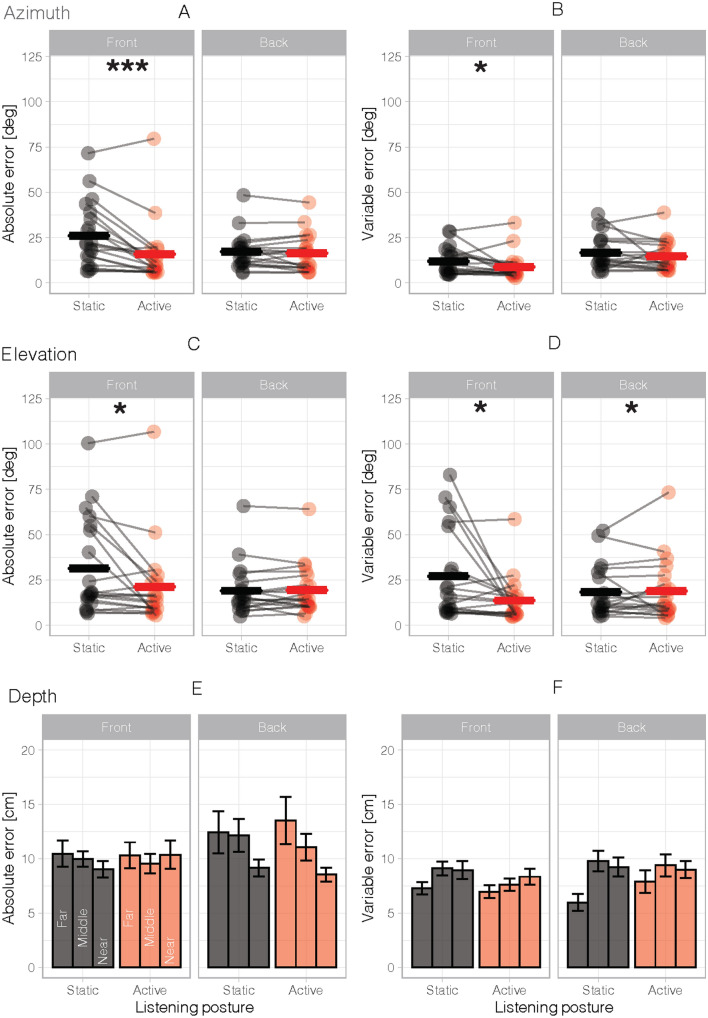
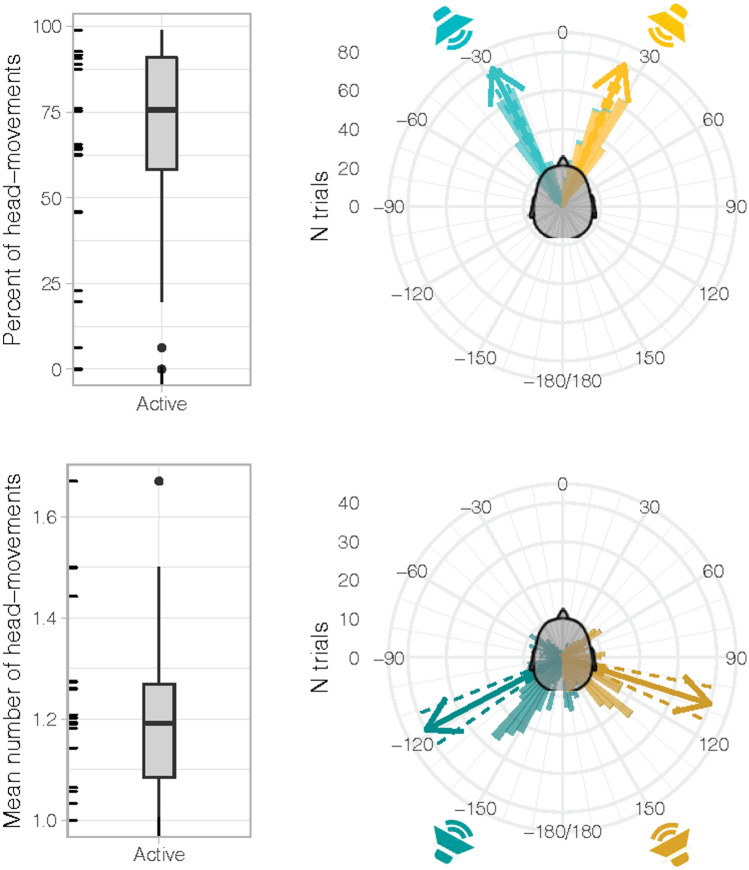
In everyday life, sound localization entails more than just the extraction and processing of auditory cues. When determining sound position in three dimensions, the brain also considers the available visual information (e.g., visual cues to sound position) and resolves perceptual ambiguities through active listening behavior (e.g., spontaneous head movements while listening). Here, we examined to what extent spontaneous head movements improve sound localization in 3D-azimuth, elevation, and depth-by comparing static vs. active listening postures. To this aim, we developed a novel approach to sound localization based on sounds delivered in the environment, brought into alignment thanks to a VR system. Our system proved effective for the delivery of sounds at predetermined and repeatable positions in 3D space, without imposing a physically constrained posture, and with minimal training. In addition, it allowed measuring participant behavior (hand, head and eye position) in real time. We report that active listening improved 3D sound localization, primarily by ameliorating accuracy and variability of responses in azimuth and elevation. The more participants made spontaneous head movements, the better was their 3D sound localization performance. Thus, we provide proof of concept of a novel approach to the study of spatial hearing, with potentials for clinical and industrial applications.
在日常生活中,声音定位不仅仅涉及听觉线索的提取和处理。当确定三维空间中的声音位置时,大脑还会考虑到可用的视觉信息(例如,声音位置的视觉线索),并通过主动聆听行为(例如,聆听时自发的头部运动)来解决感知上的歧义。在这里,我们通过比较静态和主动聆听姿势,研究了自发头部运动在多大程度上可以改善三维方位、仰角和深度的声音定位。为此,我们开发了一种基于环境中发出的声音的新的声音定位方法,该方法得益于 VR 系统得以实现。我们的系统被证明可以有效地在三维空间中预定和可重复的位置传递声音,而不会强制采用受物理限制的姿势,并且只需要很少的训练。此外,它还允许实时测量参与者的行为(手、头和眼的位置)。我们报告说,主动聆听可以改善三维声音定位,主要是通过改善方位和仰角响应的准确性和可变性。参与者自发头部运动越多,他们的三维声音定位表现就越好。因此,我们为空间听觉研究提供了一种新方法的概念验证,具有临床和工业应用的潜力。