Center for Mind/Brain Sciences (CIMeC), University of Trento, Corso Bettini, 31 Rovereto, Trento, Italy.
Integrative, Multisensory, Perception, Action and Cognition Team (IMPACT), Lyon Neuroscience Research Center, University of Lyon 1, Lyon, France.
Eur Arch Otorhinolaryngol. 2023 Aug;280(8):3661-3672. doi: 10.1007/s00405-023-07886-1. Epub 2023 Mar 11.
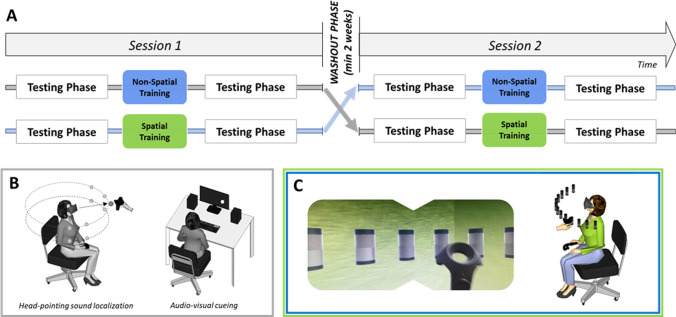
Use of unilateral cochlear implant (UCI) is associated with limited spatial hearing skills. Evidence that training these abilities in UCI user is possible remains limited. In this study, we assessed whether a Spatial training based on hand-reaching to sounds performed in virtual reality improves spatial hearing abilities in UCI users METHODS: Using a crossover randomized clinical trial, we compared the effects of a Spatial training protocol with those of a Non-Spatial control training. We tested 17 UCI users in a head-pointing to sound task and in an audio-visual attention orienting task, before and after each training.
Study is recorded in clinicaltrials.gov (NCT04183348).
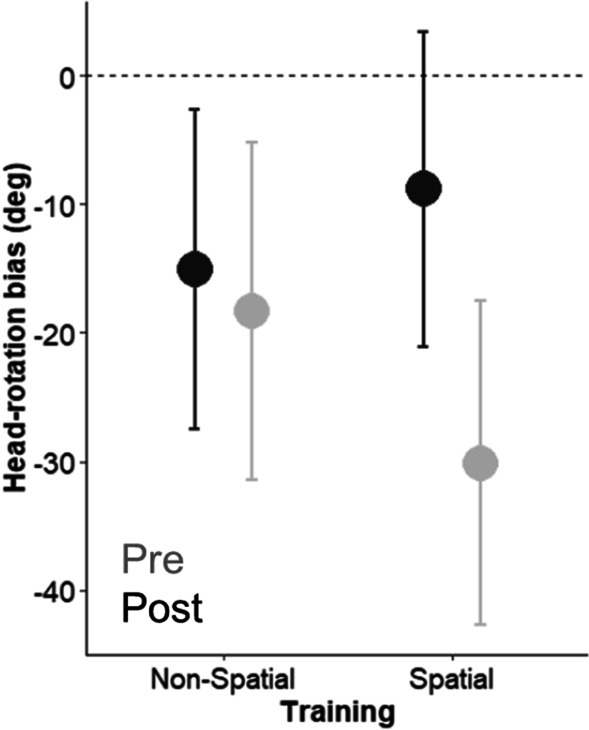
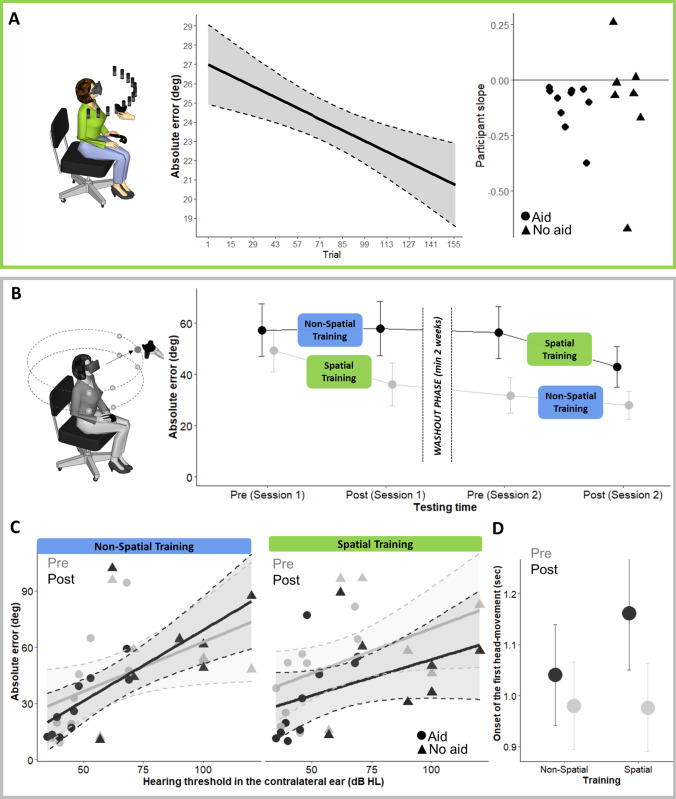
During the Spatial VR training, sound localization errors in azimuth decreased. Moreover, when comparing head-pointing to sounds before vs. after training, localization errors decreased after the Spatial more than the control training. No training effects emerged in the audio-visual attention orienting task.
Our results showed that sound localization in UCI users improves during a Spatial training, with benefits that extend also to a non-trained sound localization task (generalization). These findings have potentials for novel rehabilitation procedures in clinical contexts.
单侧人工耳蜗植入(UCI)的使用与有限的空间听觉技能相关。有证据表明,在 UCI 用户中训练这些能力是可能的,但证据仍然有限。在这项研究中,我们评估了基于虚拟现实中的手伸向声音的空间训练是否可以改善 UCI 用户的空间听觉能力。
方法:我们使用交叉随机临床试验,比较了空间训练方案与非空间对照训练的效果。在每次训练前后,我们使用头部指向声音任务和视听注意力定向任务对 17 名 UCI 用户进行了测试。
该研究已在 clinicaltrials.gov(NCT04183348)注册。
在空间 VR 训练期间,方位角的声音定位误差减小。此外,当比较训练前后的头部指向声音时,空间训练后的定位误差比对照训练后的定位误差减小得更多。在视听注意力定向任务中没有出现训练效果。
我们的结果表明,在 UCI 用户中,声音定位在空间训练期间得到改善,并且这种收益还扩展到未训练的声音定位任务(泛化)。这些发现为临床环境中的新型康复程序提供了潜力。