Departments of Psychiatry and Behavioral Sciences, Boston Children's Hospital and Harvard Medical School, 300 Longwood Ave, Boston, MA, 02115, USA.
Department of Cardiology, Boston Children's Hospital, Boston, MA, USA.
BMC Pediatr. 2022 Sep 7;22(1):531. doi: 10.1186/s12887-022-03556-z.
Studies examining the impact of randomization As per standard instruction, city is required for affiliations; however, this information is missing in affiliation 6. Please check if the provided city is correct and amend if necessary. to tight glycemic control (TGC) and resultant hypoglycemia on later neurodevelopmental outcomes have produced mixed results. Our study examined this association in children undergoing cardiac surgery.
Participants who were enrolled in the Safe Pediatric Euglycemia after Cardiac Surgery (SPECS) trial returned for neurodevelopmental (ND) follow-up between 30 to 42.5 months of age. ND outcomes were assessed using the Bayley Scales of Infant and Toddler Development, Third Edition. ND scores were compared between the TGC and standard care treatment groups and between patients with moderate to severe and no to mild hypoglycemia. As a secondary analysis, to increase sample size and power, we combined the three-year-old assessments with previously collected assessments done at < 30 months of age to further examine differences between groups longitudinally.
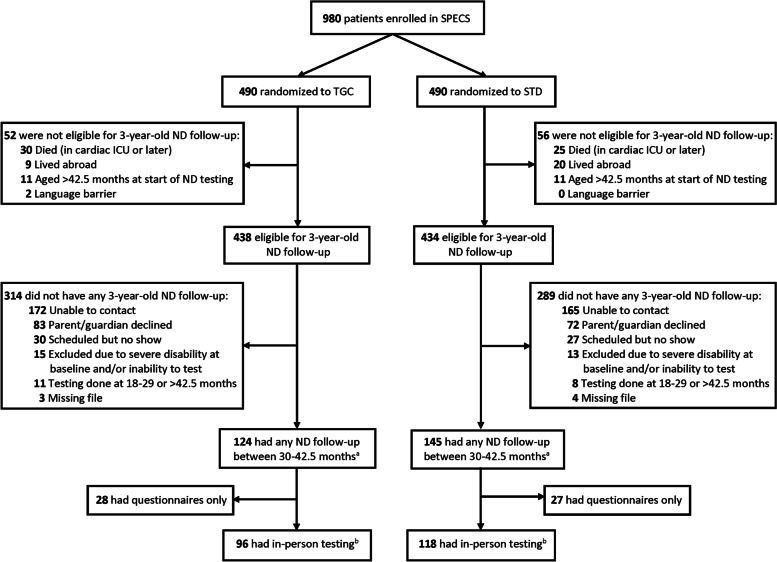
Among the 269 participants who completed neurodevelopmental evaluation (in-person testing or questionnaires) at three years of age (follow-up rate, 31%), there were no statistically significant differences in ND outcomes according to treatment group or hypoglycemia status. In the combined analysis of all evaluations (from 9 to 42.5 months of age), we found no treatment group differences. However, in these longitudinal analyses, children who experienced moderate to severe hypoglycemia had lower scores on the Bayley-III cognitive and motor domains compared to children with no to mild hypoglycemia.
For infants undergoing cardiac surgery, there was no impact of tight glycemic control on neurodevelopmental outcomes. Moderate to severe hypoglycemia was associated with worse ND outcomes in longitudinal analyses.
ClinicalTrials.gov NCT00443599. Registered: November 2016.
研究随机分组对严格血糖控制(TGC)和由此导致的低血糖对后期神经发育结果的影响产生了混合结果。我们的研究检查了正在接受心脏手术的儿童中这种关联。
参加 Safe Pediatric Euglycemia after Cardiac Surgery(SPECS)试验的参与者在 30 至 42.5 个月龄之间进行神经发育(ND)随访时返回。使用贝利婴幼儿发育量表第三版评估 ND 结果。在 TGC 和标准护理治疗组之间以及在中度至重度和无至轻度低血糖患者之间比较 ND 评分。作为二次分析,为了增加样本量和提高统计效力,我们将 3 岁评估与之前在<30 个月龄时收集的评估相结合,以进一步纵向检查组间差异。
在 269 名完成神经发育评估(亲自测试或问卷调查)的 3 岁参与者(随访率为 31%)中,根据治疗组或低血糖状态,ND 结果没有统计学上的显著差异。在所有评估(从 9 到 42.5 个月龄)的综合分析中,我们没有发现治疗组差异。然而,在这些纵向分析中,与无至轻度低血糖的儿童相比,经历中度至重度低血糖的儿童在贝利-III 认知和运动领域的得分较低。
对于接受心脏手术的婴儿,严格血糖控制对神经发育结果没有影响。中度至重度低血糖与纵向分析中较差的 ND 结果相关。
ClinicalTrials.gov NCT00443599。注册:2016 年 11 月。