GCC-Early Warning Center, PAAFR, Postal code, 1307, Rabyia, Kuwait.
Department of Medicine and Infectious Diseases, Faculty of Veterinary Medicine, Cairo University, Post code 12211, Giza, Egypt.
BMC Vet Res. 2022 Sep 7;18(1):336. doi: 10.1186/s12917-022-03435-w.
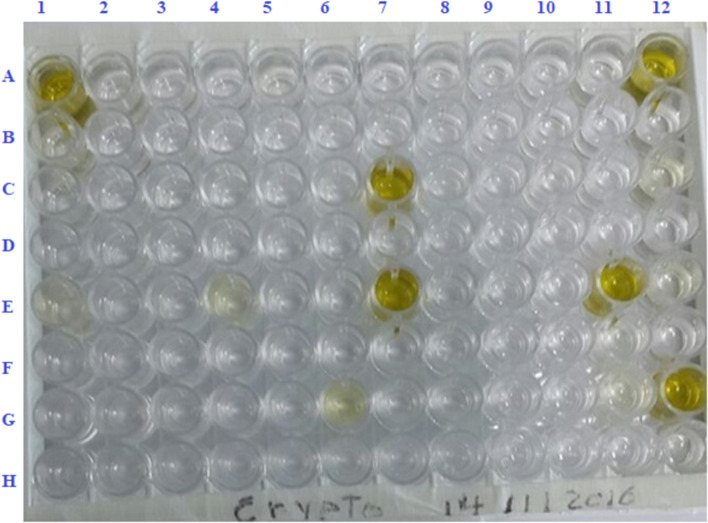
Cryptosporidium species are zoonotic protozoan parasites responsible for gastroenteritis in various animals and humans. The diagnosis of Cryptosporidium presents many challenges. This research attempted to match the diagnostic efficiency of the modified Ziehl-Neelsen technique (mZN), immunochromatographic assays (IC), and enzyme-linked immunosorbent assay (ELISA) for the detection of Cryptosporidium in faecal samples of cattle in Kuwait. In addition, polymerase chain reaction (PCR) was utilised to determine the predominant species infecting cattle in Kuwait and correlating the detected species with the results of different diagnostic tests used, the presence or absence of clinical signs, and the age group of the infected cattle.
Of 400 analysed faecal samples, Cryptosporidium positive samples were 23%, 15.25%, and 14% using IC, ELISA, and mZN. IC had the highest sensitivity (74.07%), and mZN had the highest specificity (98.29%) using a composite reference standard (CRS) as a gold standard. The rapid IC test results in high false-positive results of cryptosporidiosis, whereas using mZN alone is insufficient to declare a negative faecal sample. Only 74.5% (35/47) of Cryptosporidium-positive samples by the three assays could be amplified by PCR. This study was the first to genotype Cryptosporidium in Kuwait. Cryptosporidium parvum (n = 26) was the dominant species detected from cattle samples, followed by C. andersoni (n = 6), C. bovis (n = 2), and C. raynae (n = 1). The findings showed a statistically relevant relationship between diarrhoea and the detection of Cryptosporidium spp. in faecal samples of cattle (p-value = 0.0003). Pre-weaned calves were the most vulnerable age group to Cryptosporidium spp. infection (p-value = 0.0007).
For screening of Cryptosporidium infection in faecal samples, antigen detection or PCR methods combined with one of the microscopy techniques should be used. Cryptosporidium parvum was the prepoderant Cryptosporidium spp. recovered from cattle samples in Kuwait followed by C. andersoni. Cryptosporidium parvum is a significant risk factor for diarrhoea in pre-weaned calves. However, further study is needed as many other causes of diarrhoea in calves must be ruled out before a diagnosis of Cryptosporidium diarrhoea can be made.
隐孢子虫是一种动物和人类胃肠道疾病的人畜共患的原生动物寄生虫。隐孢子虫的诊断存在许多挑战。本研究试图比较改良齐氏染色(mZN)、免疫层析检测(IC)和酶联免疫吸附试验(ELISA)在科威特牛粪便样本中检测隐孢子虫的诊断效率。此外,还利用聚合酶链反应(PCR)确定了感染科威特牛的主要种属,并将检测到的种属与使用的不同诊断试验的结果、临床症状的存在与否以及感染牛的年龄组进行相关联。
在分析的 400 份粪便样本中,IC、ELISA 和 mZN 检测到的隐孢子虫阳性样本分别为 23%、15.25%和 14%。使用复合参考标准(CRS)作为金标准时,IC 的敏感性最高(74.07%),mZN 的特异性最高(98.29%)。快速 IC 试验结果导致隐孢子虫病的假阳性结果较高,而单独使用 mZN 不足以宣布粪便样本为阴性。三种检测方法中,只有 74.5%(35/47)的隐孢子虫阳性样本可通过 PCR 扩增。本研究首次对科威特的隐孢子虫进行了基因分型。从牛样本中检测到的优势种属是微小隐孢子虫(n=26),其次是牛隐孢子虫(n=6)、牛贝氏隐孢子虫(n=2)和射线隐孢子虫(n=1)。结果表明,牛粪便样本中隐孢子虫的检测与腹泻之间存在统计学上的相关性(p 值=0.0003)。未断奶小牛是最易感染隐孢子虫的脆弱年龄组(p 值=0.0007)。
对于粪便样本中隐孢子虫感染的筛查,应使用抗原检测或 PCR 方法结合一种显微镜技术。从科威特牛样本中分离到的优势隐孢子虫种属是微小隐孢子虫,其次是牛隐孢子虫。微小隐孢子虫是未断奶小牛腹泻的重要危险因素。然而,在做出隐孢子虫腹泻的诊断之前,还需要进一步研究,因为还必须排除许多其他导致小牛腹泻的原因。