52950Department of Electrical-Electronics Engineering, Çanakkale Onsekiz Mart University, Çanakkale, Turkey.
Institute of Sound and Vibration Research, 7423University of Southampton, Southampton, UK.
Technol Cancer Res Treat. 2022 Jan-Dec;21:15330338221104567. doi: 10.1177/15330338221104567.
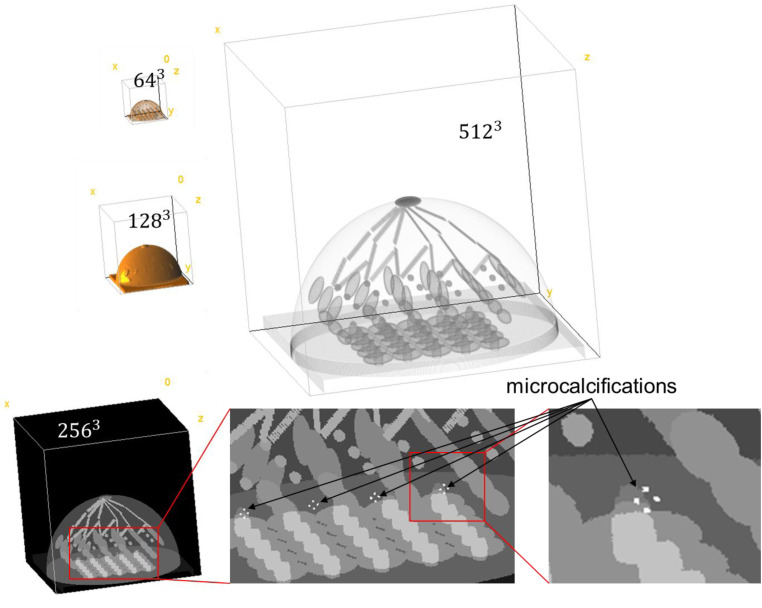
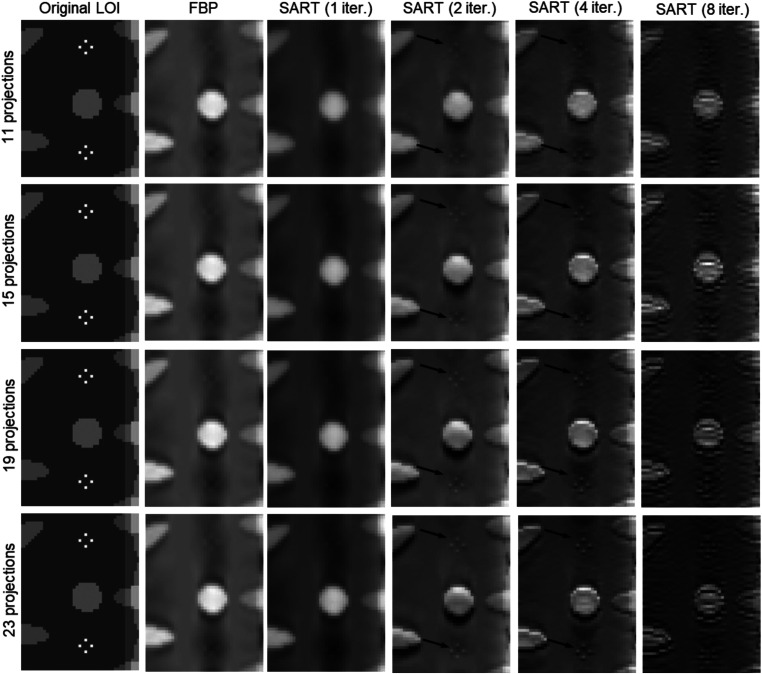
Iterative (eg, simultaneous algebraic reconstruction technique [SART]) and analytical (eg, filtered back projection [FBP]) image reconstruction techniques have been suggested to provide adequate three-dimensional (3D) images of the breast for capturing microcalcifications in digital breast tomosynthesis (DBT). To decide on the reconstruction method in clinical DBT, it must first be tested in a simulation resembling the real clinical environment. The purpose of this study is to introduce a 3D realistic breast phantom for determining the reconstruction method in clinical applications. We designed a 3D realistic breast phantom with varying dimensions (64-512) mimicking some structures of a real breast such as milk ducts, lobules, and ribs using TomoPhantom software. We generated microcalcifications, which mimic cancerous cells, with a separate MATLAB code and embedded them into the phantom for testing and benchmark studies in DBT. To validate the characterization of the phantom, we tested the distinguishability of microcalcifications by performing 3D image reconstruction methods (SART and FBP) using Laboratory of Computer Vision (LAVI) open-source reconstruction toolbox. The creation times of the proposed realistic breast phantom were seconds of 2.5916, 8.4626, 57.6858, and 472.1734 for 64, 128, 256, and 512, respectively. We presented reconstructed images and quantitative results of the phantom for SART (1-2-4-8 iterations) and FBP, with 11 to 23 projections. We determined qualitatively and quantitatively that SART (2-4 iter.) yields better results than FBP. For example, for 23 projections, the contrast-to-noise ratio (CNR) values of SART (2 iter.) and FBP were 2.871 and 0.497, respectively. We created a computationally efficient realistic breast phantom that is eligible for reconstruction and includes anatomical structures and microcalcifications, successfully. By proposing this breast phantom, we provided the opportunity to test which reconstruction methods can be used in clinical applications vary according to various parameters such as the No. of iterations and projections in DBT.
迭代(例如,同时代数重建技术[SART])和分析(例如,滤波反投影[FBP])图像重建技术已被建议用于提供数字乳腺断层合成术(DBT)中捕获微钙化的充分的三维(3D)乳房图像。为了在临床 DBT 中决定重建方法,必须首先在类似于实际临床环境的模拟中进行测试。本研究的目的是引入一种用于确定临床应用中重建方法的 3D 逼真乳房体模。我们使用 TomoPhantom 软件设计了一种具有不同尺寸(64-512)的 3D 逼真乳房体模,模拟了真实乳房的一些结构,如乳腺导管、小叶和肋骨。我们使用单独的 MATLAB 代码生成微钙化,模拟癌细胞,并将其嵌入体模中,用于 DBT 中的测试和基准研究。为了验证体模的特征描述,我们使用实验室计算机视觉(LAVI)开源重建工具箱测试了通过执行 SART 和 FBP 等 3D 图像重建方法的微钙化的可区分性。对于 64、128、256 和 512,提出的逼真乳房体模的创建时间分别为 2.5916、8.4626、57.6858 和 472.1734 秒。我们为 SART(1-2-4-8 次迭代)和 FBP 呈现了体模的重建图像和定量结果,投影数为 11 到 23。我们定性和定量地确定了 SART(2-4 次迭代)比 FBP 产生更好的结果。例如,对于 23 个投影,SART(2 次迭代)和 FBP 的对比度噪声比(CNR)值分别为 2.871 和 0.497。我们成功创建了一种计算效率高的逼真乳房体模,该体模适合重建,并且包含解剖结构和微钙化。通过提出这种乳房体模,我们提供了机会来测试在 DBT 中根据迭代次数和投影数等各种参数,哪些重建方法可用于临床应用。