Zuo Yifan, Xing Yun, Wang Zhiwei, Wu Zhiyong, Hu Zhipeng, Hu Rui, Shi Feng, Liu Tianyu, Liu Liang
Department of Cardiovascular Surgery, Renmin Hospital of Wuhan University, Wuhan, China.
Department of Cardiology, Renmin Hospital of Wuhan University, Wuhan, China.
J Thorac Dis. 2022 Aug;14(8):2927-2942. doi: 10.21037/jtd-22-193.
Left ventricular hypertrophy (LVH) is common in hypertension patients. Hypertension is a recognized risk factor of acute aortic dissection. This study aimed to explore the prognostic value of LVH in predicting postoperative outcomes in acute type A aortic dissection (ATAAD) patients.
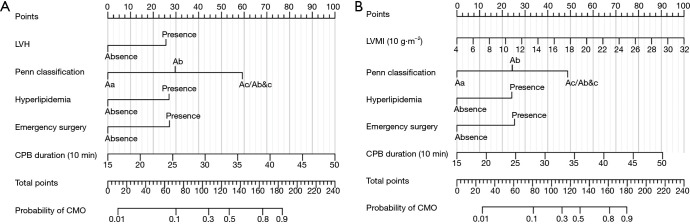
This was a single-central retrospectively designed study. One hundred and ninety-three ATAAD patients who underwent surgical repair at Renmin Hospital of Wuhan University from January 2018 to November 2021 were enrolled. Patients were divided based on their left ventricular mass index (LVMI). We compared their baseline characteristics, perioperative data, and in-hospital outcome. Then nomogram models were developed based on logistic regression to predict the postoperative outcomes.
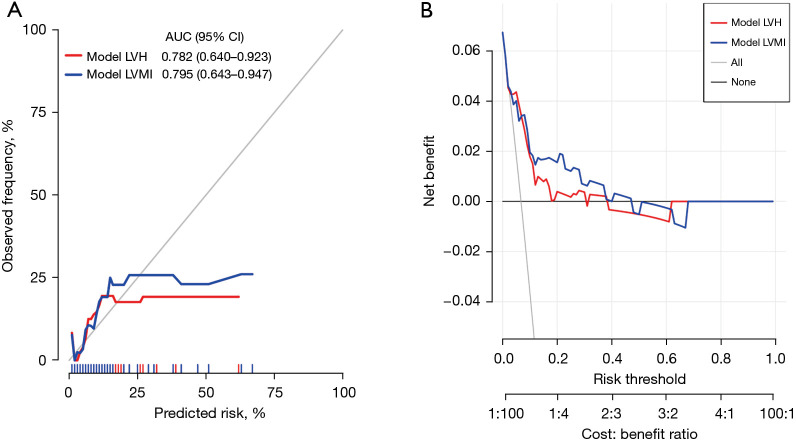
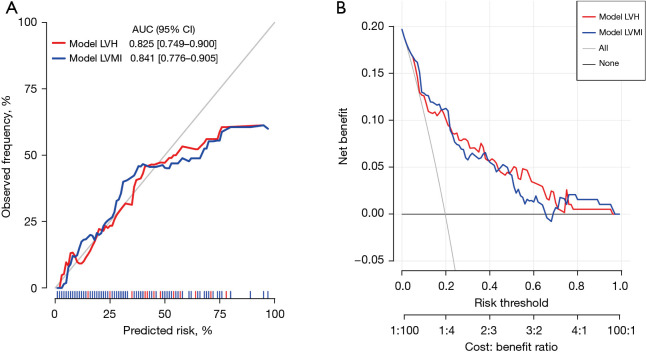
LVH presented in 28.5% (55 in 193) patients. LVH group had a higher proportion of female patients compared with the non-LVH group (32.7% 17.4%, P=0.03). Decreased left ventricular ejection fraction and cardiac tamponade were more prevalent in patients with LVH. LVH group had a higher risk of postoperative composite major outcomes (CMO) and operative mortality. Based on multivariable logistic regression, LVH/LVMI, Penn classification, hyperlipidemia, emergency surgery and cardiopulmonary bypass duration were applied to develop nomogram models for predicting postoperative CMO. The area under curve was 0.825 (95% CI: 0.749-0.900) for Model LVH and 0.841 (95% CI: 0.776-0.905) for Model LVMI. Nomogram models for predicting postoperative cardiac were developed based on LVH/LVMI and cardiopulmonary bypass duration. The area under curves for the models involving LVH or LVMI were 0.782 (95% CI: 0.640-0.923) and 0.795 (95% CI: 0.643-0.947), respectively.
LVH and increased LVMI was associated with increased risk of postoperative CMO and cardiac events in ATAAD patients. The nomogram models based on LVH or LVMI might help predict postoperative CMO. Future research would be necessary to investigate prognostic value of LVH for long-term outcomes in ATAAD patients.
左心室肥厚(LVH)在高血压患者中很常见。高血压是公认的急性主动脉夹层风险因素。本研究旨在探讨LVH对预测急性A型主动脉夹层(ATAAD)患者术后结局的预后价值。
这是一项单中心回顾性设计研究。纳入了2018年1月至2021年11月在武汉大学人民医院接受手术修复的193例ATAAD患者。根据左心室质量指数(LVMI)对患者进行分组。比较了他们的基线特征、围手术期数据和院内结局。然后基于逻辑回归建立列线图模型以预测术后结局。
28.5%(193例中的55例)患者存在LVH。与非LVH组相比,LVH组女性患者比例更高(32.7%对17.4%,P = 0.03)。LVH患者左心室射血分数降低和心脏压塞更为常见。LVH组术后复合主要结局(CMO)和手术死亡率风险更高。基于多变量逻辑回归,应用LVH/LVMI、Penn分级、高脂血症、急诊手术和体外循环持续时间建立预测术后CMO的列线图模型。LVH模型的曲线下面积为0.825(95%CI:0.749 - 0.900),LVMI模型的曲线下面积为0.841(95%CI:0.776 - 0.905)。基于LVH/LVMI和体外循环持续时间建立了预测术后心脏事件的列线图模型。涉及LVH或LVMI的模型曲线下面积分别为0.782(95%CI:0.640 - 0.923)和0.795(95%CI:0.643 - 0.947)。
LVH和LVMI升高与ATAAD患者术后CMO和心脏事件风险增加相关。基于LVH或LVMI的列线图模型可能有助于预测术后CMO。未来有必要研究LVH对ATAAD患者长期结局的预后价值。