Perez Loida M, Mauleon Ramil, Arick Mark A, Magbanua Zenaida V, Peterson Daniel G, Dean Jeffrey F D, Tseng Te Ming
Department of Biochemistry, Molecular Biology, Entomology & Plant Pathology, Mississippi State University, Starkville, MS, United States.
Faculty of Science and Engineering, Southern Cross University, East Lismore, NSW, Australia.
Front Plant Sci. 2022 Aug 22;13:910369. doi: 10.3389/fpls.2022.910369. eCollection 2022.
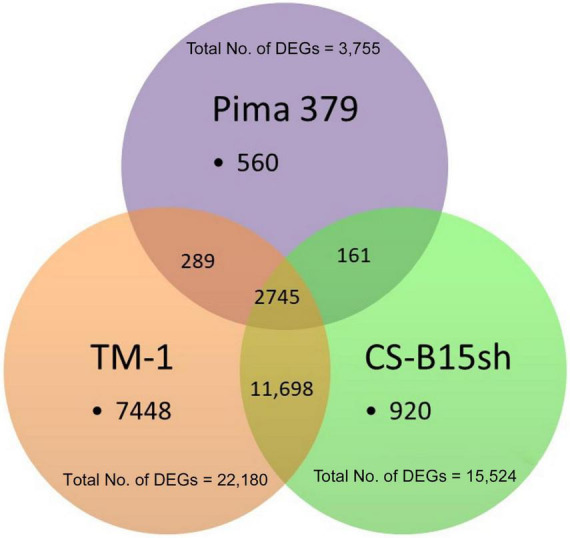
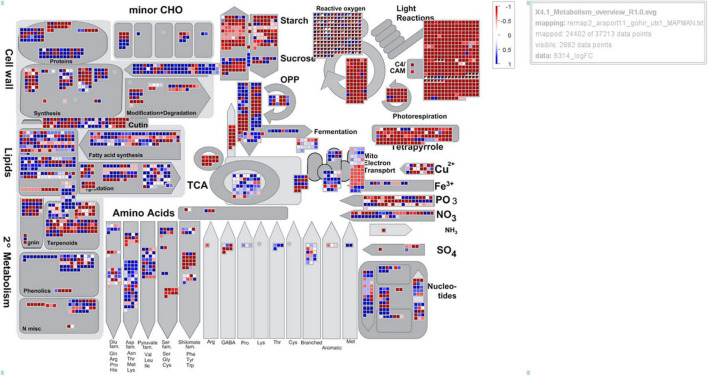
The cotton chromosome substitution line, CS-B15sh, exhibits 41% lower injury from 2,4-D when applied at the field recommended rate of 1.12 kg ae ha (1×) than does Texas Marker-1 (TM-1). CS-B15sh was developed in the genetic background of L. cv TM-1 and has chromosome introgression on the short arm of chromosome 15 from L. cv. Pima 379. In a previous experiment, we observed reduced translocation of [C]2,4-D outside the treated leaf tissue in CS-B15sh, which contrasted with an increased translocation of the herbicide in the tissues above and below the treated leaf in TM-1. Our results indicate a potential 2,4-D tolerance mechanism in CS-B15sh involving altered movement of 2,4-D. Here, we used RNA sequencing (RNA-seq) to determine the differential expression of genes between 2,4-D-challenged and control plants of the tolerant (CS-B15sh) and susceptible lines (TM-1 and Pima 379). Several components of the 2,4-D/auxin-response pathway-including ubiquitin E3 ligase, PB1|AUX/IAA, ARF transcription factors, and F-box proteins of the SCF complex-were upregulated with at least threefold higher expression in TM-1 compared with CS-B15sh, while both Pima 379 and TM-1 showed the same fold change expression for PB1|AUX/IAA mRNA. Some genes associated with herbicide metabolism, including flavin monooxygenase (Gohir.A01G174100) and FAD-linked oxidase (Gohir.D06G002600), exhibited at least a twofold increase in CS-B15sh than in TM-1 (the gene was not expressed in Pima 379), suggesting a potential relationship between the gene's expression and 2,4-D tolerance. It is interesting to note that glutathione S-transferase was differentially expressed in both CS-B15sh and Pima 379 but not in TM-1, while cytochrome P450 and other genes involved in the oxidation-reduction process were significantly expressed only in CS-B15sh in response to 2,4-D. Gene set enrichment analysis on the union DEGs of the three cotton genotypes revealed the depletion of transcripts involved in photosynthesis and enrichment of transcripts involved in ABA response and signaling.
棉花染色体代换系CS-B15sh在按照1.12千克酸当量/公顷(1倍)的田间推荐剂量施用2,4-D时,其受到的损伤比德州标记1号(TM-1)低41%。CS-B15sh是在陆地棉品种TM-1的遗传背景下培育而成的,其15号染色体短臂上有来自海岛棉品种皮马379的染色体渗入片段。在之前的一项实验中,我们观察到CS-B15sh中[C]2,4-D在处理叶片组织外的转运减少了,这与TM-1中除草剂在处理叶片上方和下方组织中的转运增加形成了对比。我们的结果表明CS-B15sh中存在一种潜在的2,4-D耐受机制,涉及2,4-D转运的改变。在此,我们使用RNA测序(RNA-seq)来确定耐受系(CS-B15sh)和敏感系(TM-1和皮马379)中2,4-D处理植株与对照植株之间基因的差异表达。2,4-D/生长素响应途径的几个组分,包括泛素E3连接酶、PB1|AUX/IAA、ARF转录因子和SCF复合体的F-box蛋白,与CS-B15sh相比,在TM-1中的上调表达至少高出三倍,而皮马379和TM-1中PB1|AUX/IAA mRNA的表达倍数变化相同。一些与除草剂代谢相关的基因,包括黄素单加氧酶(Gohir.A01G174100)和FAD连接氧化酶(Gohir.D06G002600),在CS-B15sh中的表达比在TM-1中至少增加了两倍(该基因在皮马379中未表达),这表明该基因的表达与2,4-D耐受性之间可能存在关联。值得注意的是,谷胱甘肽S-转移酶在CS-B15sh和皮马379中均有差异表达,但在TM-1中没有,而细胞色素P450和其他参与氧化还原过程的基因仅在CS-B15sh中对2,4-D有显著表达。对这三种棉花基因型的联合差异表达基因进行基因集富集分析,结果显示参与光合作用的转录本减少,而参与脱落酸响应和信号传导的转录本增加。