Institute of Psychology, Decision Lab: Center for Behavioral Research in Decision Making, SWPS University of Social Sciences and Humanities, Warsaw, Poland.
Department of Behavioural Sciences, OsloMet - Oslo Metropolitan University, Oslo, Norway.
Front Public Health. 2022 Aug 22;10:953743. doi: 10.3389/fpubh.2022.953743. eCollection 2022.
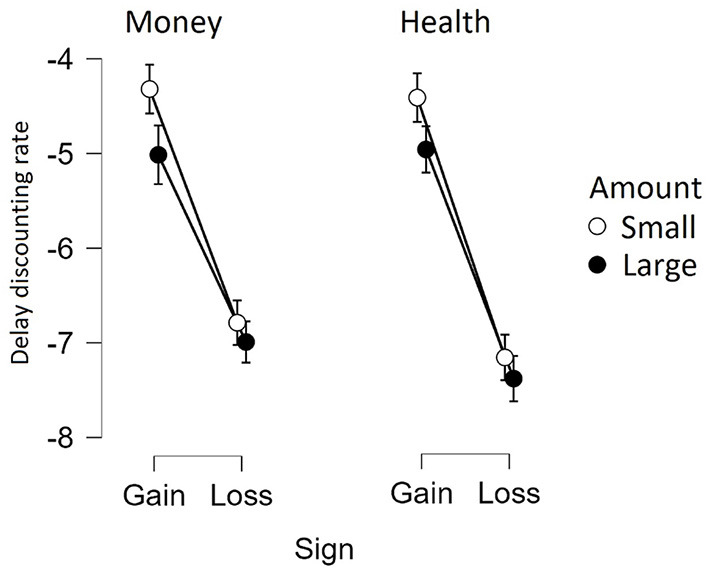
Delay discounting refers to the observation that the subjective value of an outcome decreases as the delay to its receipt increases. It is well-established that steep delay discounting is related to various maladaptive behaviors, including poorer health-related choices. One of the current challenges of public health policies that emerged during the COVID-19 pandemic is to encourage preventive behaviors against infectious diseases. In this study, we aimed to explore possible underpinnings of adherence to COVID-19 related public health policy guidelines such as disinfection, distancing, and masks (DDM). Participants completed monetary and health discounting tasks across two outcome amounts in gain and loss conditions, and they provided self-report measures of adherence to the DDM policy. Contrary to the theoretically plausible prediction that higher discounting rates would be negatively associated with adherence to health-related public policy guidelines, we found no compelling evidence to support such statement. We discuss the potential weaknesses of declarative measurements of attitudes toward COVID-19 and consider using behavioral interventions for influencing discounting rates for complementing and enhancing current policy guidelines.
延迟折扣是指随着获得结果的时间延迟增加,结果的主观价值降低的现象。已经证实,陡峭的延迟折扣与各种适应不良的行为有关,包括更差的与健康相关的选择。在 COVID-19 大流行期间出现的公共卫生政策的当前挑战之一是鼓励针对传染病的预防行为。在这项研究中,我们旨在探索与 COVID-19 相关的公共卫生政策指南(如消毒、保持距离和戴口罩)的依从性的潜在基础。参与者在收益和损失条件下完成了货币和健康折扣任务,并提供了对 DDM 政策的依从性的自我报告测量。与理论上合理的预测相反,即更高的折扣率与对与健康相关的公共政策指南的依从性呈负相关,我们没有发现有力的证据支持这种说法。我们讨论了对 COVID-19 的态度的声明性测量的潜在弱点,并考虑使用行为干预措施来影响折扣率,以补充和增强当前的政策指南。