Rong Weiwei, Li Jiejia, Wang Lifeng, Luo Shanshan, Liang Tulu, Qian Xunjia, Zhang Xiaodan, Zhou Qinbei, Zhu Yizhun, Zhu Qing
School of Pharmacy, Nantong University, Nantong, China.
Provincial Key Laboratory of Inflammation and Molecular Drug Target, Nantong, China.
Front Cardiovasc Med. 2022 Aug 22;9:969553. doi: 10.3389/fcvm.2022.969553. eCollection 2022.
Leonurus japonicus Houtt has an obvious efficacy on cardiovascular diseases. As the most representative component in the herb, leonurine has attracted increasing attention for its potential in myocardial ischemia. However, its protective mechanism against myocardial ischemia remains incompletely elucidated.
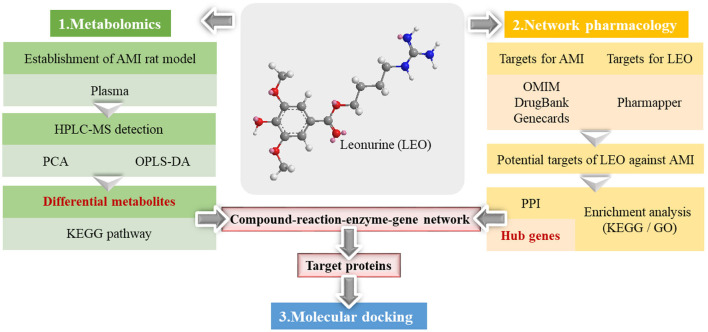
The present study aimed to reveal the potential mechanism of leonurine in acute myocardial ischemia using a strategy combining metabolomics and network pharmacology.
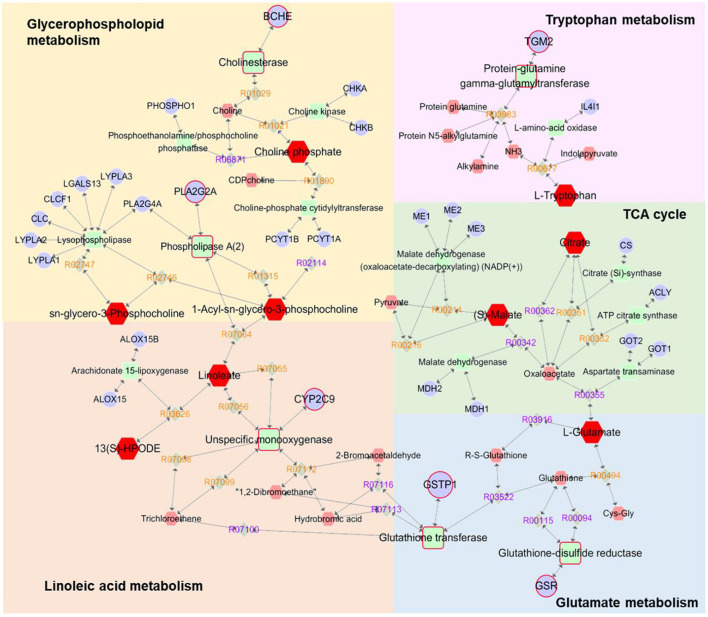
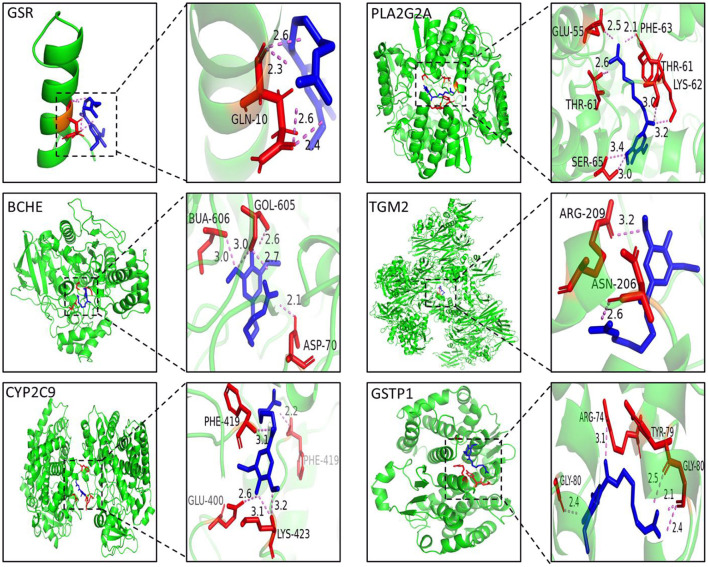
First, a metabolomics method was proposed to identify the differential metabolites of plasma in rats. Then, network pharmacology was performed to screen candidate targets of leonurine against acute myocardial ischemia. A compound-reaction-enzyme-gene network was thus constructed with the differential metabolites and targets. Finally, molecular docking was carried out to predict the binding capability of leonurine with key targets.
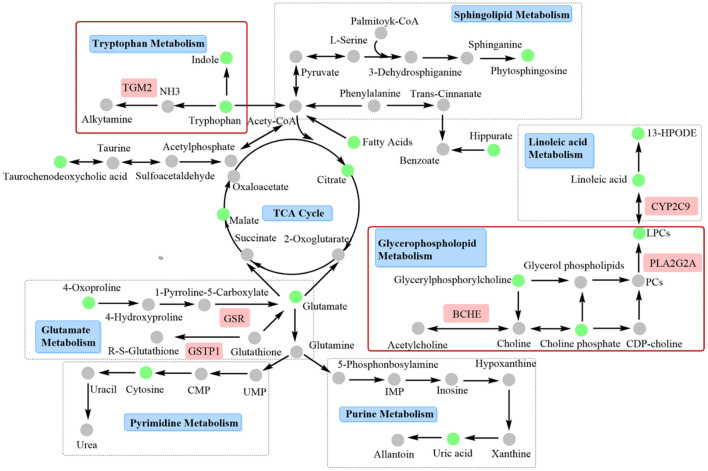
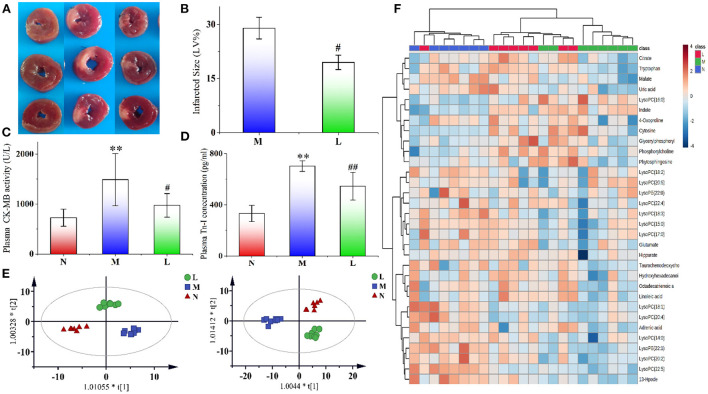
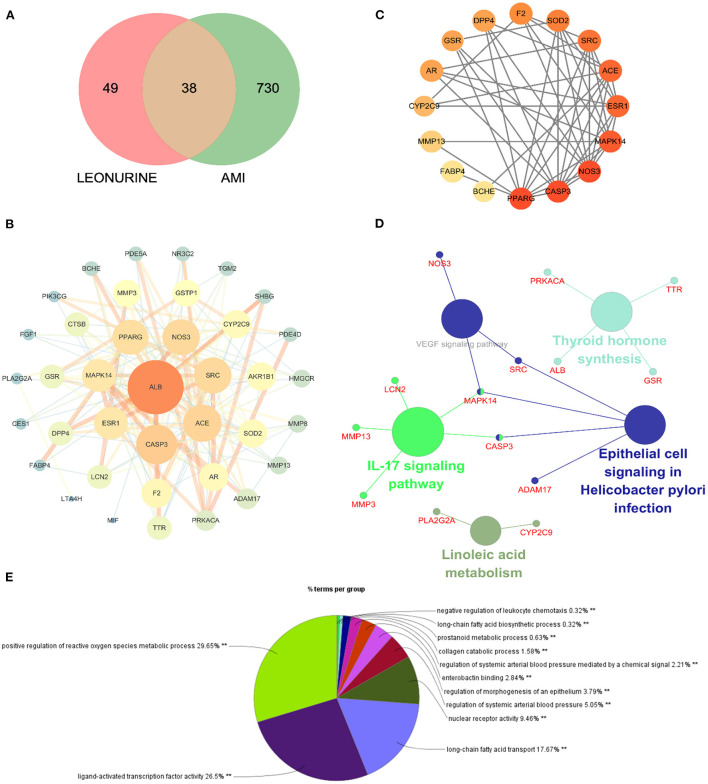
A total of 32 differential metabolites were identified in rat plasma, and 16 hub genes were detected through network pharmacology. According to the results of compound-reaction-enzyme-gene network and molecular docking, what was screened included six key targets (GSR, CYP2C9, BCHE, GSTP1, TGM2, and PLA2G2A) and seven differential metabolites (glycerylphosphorylcholine, lysophosphatidylcholine, choline phosphate, linoleic acid, 13-HpODE, tryptophan and glutamate) with four important metabolic pathways involved: glycerophospholopid metabolism, linoleic acid metabolism, tryptophan metabolism and glutamate metabolism. Among them, glycerophospholipid and tryptophan metabolism were shown to be important, since the regulation of leonurine on these two pathways was also observed in our previous metabolomics study conducted on clinical hyperlipidemia patients.
This is the first study of its kind to reveal the underlying mechanism of leonurine against acute myocardial ischemia through a strategy combining metabolomics and network pharmacology, which provides a valuable reference for the research on its future application.
益母草对心血管疾病具有显著疗效。作为该草药中最具代表性的成分,益母草碱因其在心肌缺血方面的潜在作用而受到越来越多的关注。然而,其对心肌缺血的保护机制仍未完全阐明。
本研究旨在采用代谢组学和网络药理学相结合的策略,揭示益母草碱在急性心肌缺血中的潜在作用机制。
首先,采用代谢组学方法鉴定大鼠血浆中的差异代谢物。然后,运用网络药理学筛选益母草碱抗急性心肌缺血的候选靶点。由此构建了差异代谢物与靶点的化合物-反应-酶-基因网络。最后,进行分子对接以预测益母草碱与关键靶点的结合能力。
在大鼠血浆中共鉴定出32种差异代谢物,并通过网络药理学检测到16个核心基因。根据化合物-反应-酶-基因网络和分子对接的结果,筛选出6个关键靶点(谷胱甘肽还原酶、细胞色素P450 2C9、丁酰胆碱酯酶、谷胱甘肽S-转移酶P1、转谷氨酰胺酶2和磷脂酶A2G2A)和7种差异代谢物(甘油磷酰胆碱、溶血磷脂酰胆碱、磷酸胆碱、亚油酸、13-氢过氧十八碳二烯酸、色氨酸和谷氨酸),涉及4条重要代谢途径:甘油磷脂代谢、亚油酸代谢、色氨酸代谢和谷氨酸代谢。其中,甘油磷脂和色氨酸代谢被证明是重要的,因为在我们之前对临床高脂血症患者进行的代谢组学研究中也观察到益母草碱对这两条途径的调节作用。
这是首次通过代谢组学和网络药理学相结合的策略揭示益母草碱抗急性心肌缺血潜在机制的研究,为其未来应用研究提供了有价值的参考。