Department of Cardiology, Hillel Yaffe Medical Center, Technion-Faculty of Medicine, Hadera, Israel.
Department of Cardiology, Jeroen Bosch Ziekenhuis, 's Hertogenbosch, The Netherlands.
Clin Cardiol. 2022 Dec;45(12):1211-1219. doi: 10.1002/clc.23902. Epub 2022 Sep 7.
Elderly patients with ST-elevation myocardial infarction (STEMI) who undergo percutaneous coronary intervention (PCI) are usually excluded from major trials.
This study sought to assess 1-year clinical outcomes following PCI with a drug-eluting stent in patients older than 80 years old with STEMI.
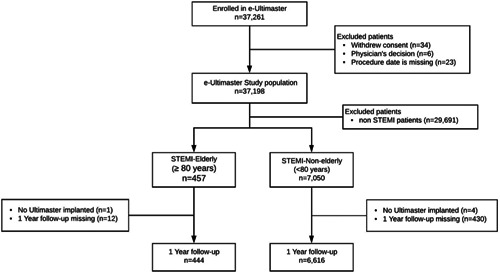
The large all-comer, multicontinental e-ULTIMASTER registry included 7507 patients with STEMI who underwent PCI using the Ultimaster stent. The primary clinical endpoint was 1-year target lesion failure, a composite of cardiac death (CD), target vessel-related myocardial infarction (TV-MI), or clinically driven target lesion revascularization (CD-TLR).
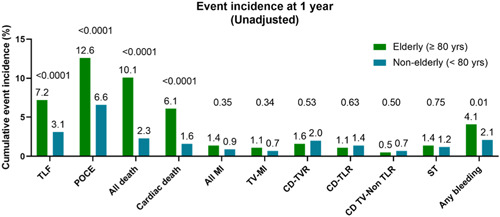
There were 457 (6.1%) patients in the elderly group (≥80 years old) that were compared to 7050 (93.9%) patients <80 years. The elderly patients included more female patients and had significantly more comorbidities and had more complex coronary anatomy. The primary endpoint occurred in 7.2% of the elderly, compared to 3.1% of the younger group (p < .001). All-cause mortality was significantly higher among the elderly group compared to the younger group (10.1% vs. 2.3%, p < .0001), as well as CD (6.1% vs. 1.6%, p < .0001), but not TV-MI (1.1% vs. 0.7%, p = .34) or CD-TLR (1.1% vs. 1.4%, p = .63).
Elderly patients with STEMI presentation had a higher incidence of the composite endpoint than younger patients. All-cause and CD were higher for elderly patients compared to patients younger than 80 years old. However, there was no difference in the incidence of TV-MI or target lesion revascularizations. These findings suggest that PCI for STEMI in elderly patients is relatively safe.
接受经皮冠状动脉介入治疗(PCI)的 ST 段抬高型心肌梗死(STEMI)老年患者通常被排除在主要临床试验之外。
本研究旨在评估年龄大于 80 岁的 STEMI 患者接受药物洗脱支架 PCI 后 1 年的临床结局。
这项大型、多地区、多中心的 e-ULTIMASTER 注册研究纳入了 7507 例接受 Ultimaster 支架 PCI 的 STEMI 患者。主要临床终点是 1 年时的靶病变失败,复合终点包括心源性死亡(CD)、靶血管相关心肌梗死(TV-MI)或临床驱动的靶病变血运重建(CD-TLR)。
年龄≥80 岁的老年组有 457 例(6.1%)患者,与年龄<80 岁的 7050 例患者进行比较。老年患者中女性患者更多,合并症更多,冠状动脉解剖结构更复杂。老年组的主要终点发生率为 7.2%,年轻组为 3.1%(p<0.001)。老年组的全因死亡率明显高于年轻组(10.1% vs. 2.3%,p<0.0001),CD 发生率也更高(6.1% vs. 1.6%,p<0.0001),但 TV-MI 发生率(1.1% vs. 0.7%,p=0.34)和 CD-TLR 发生率(1.1% vs. 1.4%,p=0.63)无差异。
STEMI 发作的老年患者的复合终点发生率高于年轻患者。与年龄<80 岁的患者相比,老年患者的全因死亡率和 CD 发生率更高。然而,TV-MI 或靶病变血运重建的发生率没有差异。这些发现表明,老年 STEMI 患者的 PCI 相对安全。