Division of Family Medicine, School of Public Health and Family Medicine, Faculty of Health Sciences, University of Cape Town, Cape Town, South Africa; and, Metro District Health Services, Western Cape Department of Health, Cape Town.
S Afr Fam Pract (2004). 2022 Aug 18;64(1):e1-e9. doi: 10.4102/safp.v64i1.5558.
The coronavirus disease 2019 (COVID-19) pandemic exposed the risks of poorly controlled noncommunicable diseases, especially in persons with diabetes. The pandemic outbreak in Cape Town, South Africa, required a rapid reorganisation of primary care services. Community-based measures were activated to ensure continuity of care by implementing home delivery of medication by community health workers. After five months of de-escalated chronic care, observations at an urban primary care facility suggested that noncommunicable disease patients had not overtly decompensated despite suspending regular in-facility services. This study attempted to understand what impact de-escalation of regular care and escalation of community-based interventions had on type 2 diabetes patients at this primary care facility.
A mixed methods study design was used, consisting of data captured prospectively from diabetic patients who returned to the facility for routine care post-lockdown, as well as qualitative interviews to ascertain patients' experiences of the home delivery service.
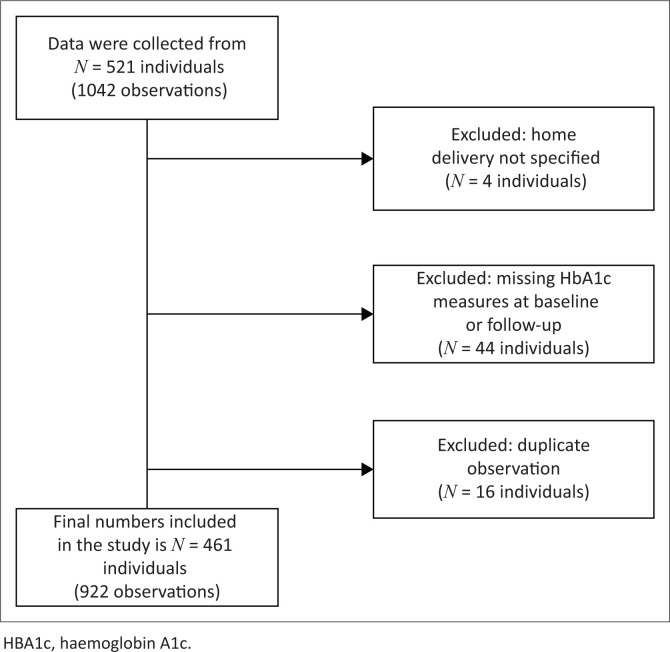
The data set included 331 (72%) patients in the home delivery group and 130 (28%) in the non-home delivery group. Regression analysis demonstrated a statistically significant relationship between home delivery and improved diabetic control (p 0.01), although this may be because of confounding factors. The mean glycaemic control was suboptimal both at baseline and post-lockdown in both groups. Interviews with 83 study patients confirmed the acceptability of the home delivery intervention.
The rapid reorganisation of primary care services illustrates the versatility of a functional community-oriented primary care service, although not fully developed yet, to adapt to emerging community healthcare needs in the pandemic era.
2019 年冠状病毒病(COVID-19)大流行暴露了控制不佳的非传染性疾病的风险,尤其是在糖尿病患者中。南非开普敦的大流行爆发要求迅速重组初级保健服务。启动了以社区为基础的措施,通过社区卫生工作者为患者提供药物上门配送服务,以确保护理的连续性。在慢性护理降级五个月后,在一个城市初级保健机构的观察结果表明,尽管暂停了常规院内服务,但非传染性疾病患者并未明显恶化。本研究试图了解常规护理降级和以社区为基础的干预措施升级对该初级保健机构 2 型糖尿病患者的影响。
使用混合方法研究设计,包括从大流行封锁后返回常规护理的糖尿病患者前瞻性采集的数据,以及定性访谈以确定患者对药物上门配送服务的体验。
数据集包括 331 名(72%)接受药物上门配送组和 130 名(28%)未接受药物上门配送组的患者。回归分析表明,药物上门配送与改善糖尿病控制之间存在统计学显著关系(p 0.01),尽管这可能是由于混杂因素所致。两组患者的平均血糖控制在基线和封锁后均不理想。对 83 名研究患者的访谈证实了药物上门配送干预措施的可接受性。
初级保健服务的快速重组说明了功能齐全的以社区为导向的初级保健服务的多功能性,尽管该服务尚未完全发展,但在大流行时代能够适应新出现的社区医疗保健需求。