Department of Surgical Sciences, Uppsala University, Uppsala, Sweden.
Institute of Metabolic Science & Department of Medicine, University of Cambridge, Cambridge, UK.
Eur J Nucl Med Mol Imaging. 2023 Jan;50(2):398-409. doi: 10.1007/s00259-022-05957-9. Epub 2022 Sep 8.
[C]Metomidate positron emission tomography (PET) is currently used for staging of adrenocortical carcinoma and for lateralization in primary aldosteronism (PA). Due to the short half-life of carbon-11 and a high non-specific liver uptake of [C]metomidate there is a need for improved adrenal imaging methods. In a previous pre-clinical study para-chloro-2-[F]fluoroethyletomidate has been proven to be a specific adrenal tracer. The objective is to perform a first evaluation of para-chloro-2-[F]fluoroethyletomidate positron emission computed tomography ([F]CETO-PET/CT) in patients with adrenal tumours and healthy volunteers.
Fifteen patients underwent [F]CETO-PET/CT. Five healthy volunteers were recruited for test-retest analysis and three out of the five underwent additional [O]water PET/CT to measure adrenal blood flow. Arterial blood sampling and tracer metabolite analysis was performed. The kinetics of [F]CETO were assessed and simplified quantitative methods were validated by comparison to outcome measures of tracer kinetic analysis.
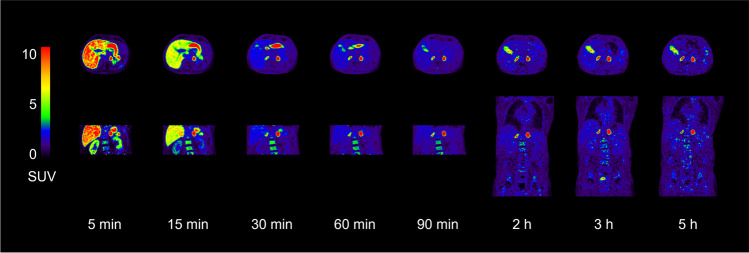
Uptake of [F]CETO was low in the liver and high in adrenals. Initial metabolization was rapid, followed by a plateau. The kinetics of [F]CETO in healthy adrenals and all adrenal pathologies, except for adrenocortical carcinoma, were best described by an irreversible single-tissue compartment model. Standardized uptake values (SUV) correlated well with the uptake rate constant K. Both K and SUV were highly correlated to adrenal blood flow in healthy controls. Repeatability coefficients of K, SUV, and SUV were 25, 22, and 17%.
High adrenal uptake combined with a low unspecific liver uptake suggests that F]CETO is a suitable tracer for adrenal imaging. Adrenal SUV, based on a whole-body scan at 1 h p.i., correlated well with the net uptake rate K.
ClinicalTrials.gov , NCT05361083 Retrospectively registered 29 April 2022. at, https://clinicaltrials.gov/ct2/show/NCT05361083.
[C]美替拉酮正电子发射断层扫描(PET)目前用于肾上腺皮质癌的分期和原发性醛固酮增多症(PA)的侧化。由于碳-11 的半衰期短,[C]美替拉酮在肝脏中的非特异性摄取率高,因此需要改进肾上腺成像方法。在之前的临床前研究中,已证明对氯-2-[F]氟乙基美替拉酮是一种特异性肾上腺示踪剂。目的是首次评估氯-2-[F]氟乙基美替拉酮正电子发射计算机断层扫描([F]CETO-PET/CT)在肾上腺肿瘤患者和健康志愿者中的应用。
15 例患者接受了[F]CETO-PET/CT 检查。招募了 5 名健康志愿者进行测试-重测分析,其中 3 名志愿者还接受了额外的[O]水 PET/CT 以测量肾上腺血流。进行了动脉采血和示踪剂代谢产物分析。评估了[F]CETO 的动力学,并通过与示踪剂动力学分析的结果测量值进行比较,验证了简化的定量方法。
[F]CETO 在肝脏中的摄取量低,在肾上腺中的摄取量高。初始代谢迅速,随后达到平台期。健康肾上腺和除肾上腺皮质癌以外的所有肾上腺病变的[F]CETO 动力学最好用不可逆的单组织室模型来描述。标准化摄取值(SUV)与摄取率常数 K 密切相关。在健康对照组中,K 和 SUV 与肾上腺血流高度相关。K、SUV 和 SUV 的重复性系数分别为 25%、22%和 17%。
高肾上腺摄取率与低非特异性肝脏摄取率相结合表明[F]CETO 是一种适合肾上腺成像的示踪剂。基于 1 小时后全身扫描的肾上腺 SUV 与净摄取率常数 K 密切相关。
ClinicalTrials.gov,NCT05361083 于 2022 年 4 月 29 日进行了回顾性注册,网址为 https://clinicaltrials.gov/ct2/show/NCT05361083。