Institute of Systems, Molecular and Integrative Biology, University of Liverpool, Liverpool, UK.
Institute for Systems Biology, Seattle, Washington, USA.
Proteomics. 2023 Apr;23(7-8):e2200014. doi: 10.1002/pmic.202200014. Epub 2022 Sep 13.
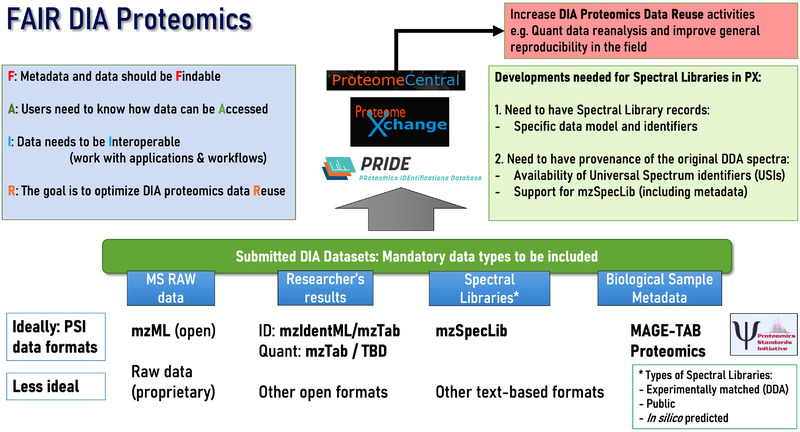
Data independent acquisition (DIA) proteomics techniques have matured enormously in recent years, thanks to multiple technical developments in, for example, instrumentation and data analysis approaches. However, there are many improvements that are still possible for DIA data in the area of the FAIR (Findability, Accessibility, Interoperability and Reusability) data principles. These include more tailored data sharing practices and open data standards since public databases and data standards for proteomics were mostly designed with DDA data in mind. Here we first describe the current state of the art in the context of FAIR data for proteomics in general, and for DIA approaches in particular. For improving the current situation for DIA data, we make the following recommendations for the future: (i) development of an open data standard for spectral libraries; (ii) make mandatory the availability of the spectral libraries used in DIA experiments in ProteomeXchange resources; (iii) improve the support for DIA data in the data standards developed by the Proteomics Standards Initiative; and (iv) improve the support for DIA datasets in ProteomeXchange resources, including more tailored metadata requirements.
近年来,由于仪器和数据分析方法等多个技术的发展,数据独立采集(DIA)蛋白质组学技术已经取得了巨大的发展。然而,在 FAIR(可发现性、可访问性、互操作性和可重用性)数据原则方面,DIA 数据仍有许多改进的空间。这些改进包括更具针对性的数据共享实践和开放数据标准,因为公共数据库和蛋白质组学数据标准主要是基于 DDA 数据设计的。在这里,我们首先描述了一般蛋白质组学和 DIA 方法的 FAIR 数据的现状。为了改善 DIA 数据的现状,我们对未来提出了以下建议:(i)开发光谱库的开放数据标准;(ii)在 ProteomeXchange 资源中强制提供 DIA 实验中使用的光谱库的可用性;(iii)改进 Proteomics Standards Initiative 制定的数据标准中对 DIA 数据的支持;(iv)改进 ProteomeXchange 资源中对 DIA 数据集的支持,包括更具针对性的元数据要求。