Department of Obstetrics and Gynecology, The Second Affiliated Hospital of Wenzhou Medical University, No. 109 Xueyuan Xi Road, Wenzhou, 325027, Zhejiang, China.
BMC Med Genomics. 2022 Sep 8;15(1):191. doi: 10.1186/s12920-022-01342-5.
Patient-derived xenograft (PDX) models were established to reproduce the clinical situation of original cancers and have increasingly been applied to preclinical cancer research. Our study was designed to establish and genetically characterize cervical cancer PDX models.
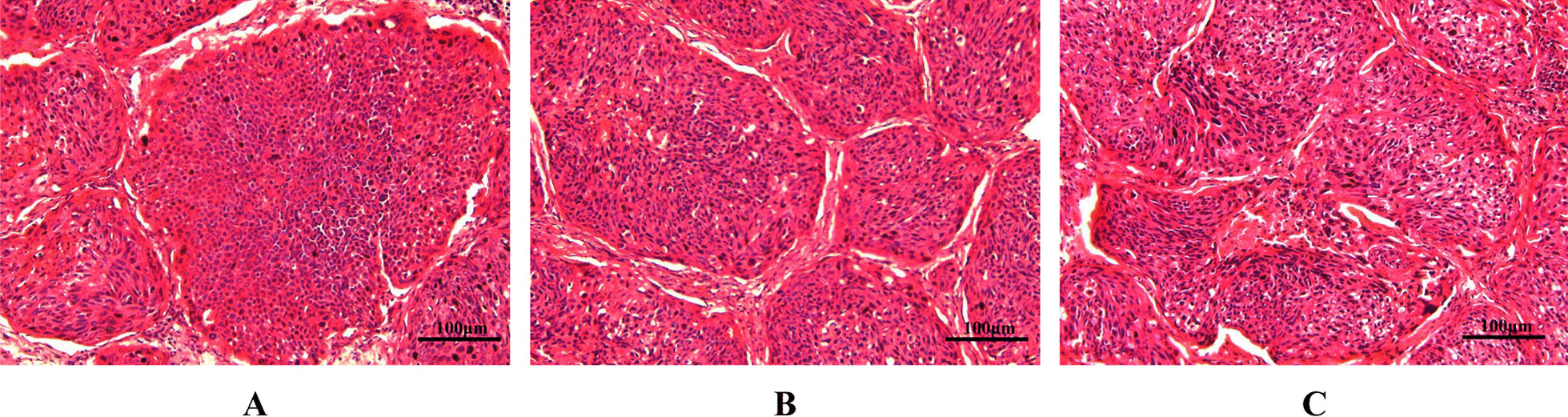
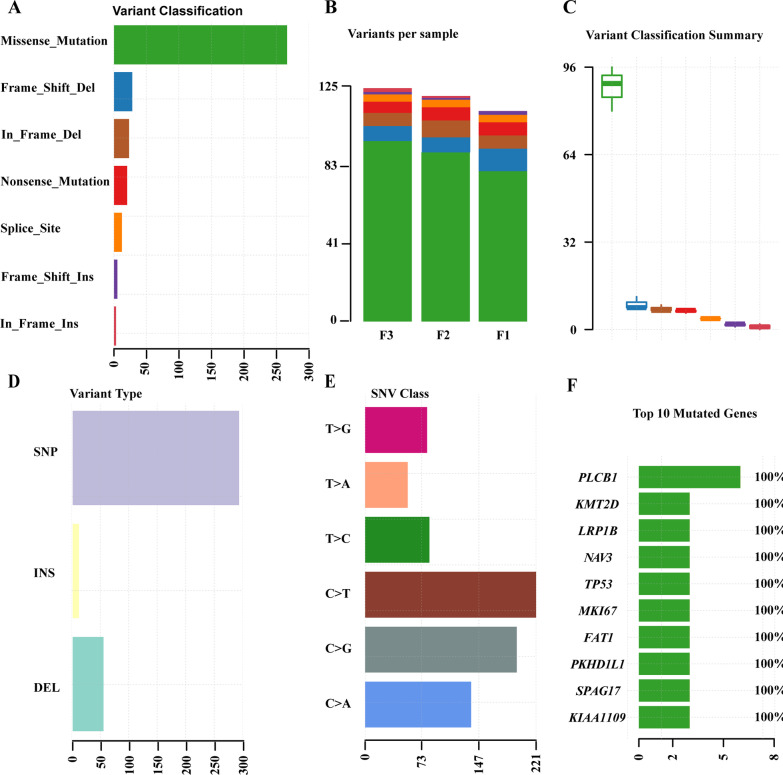
A total of 91 fresh fragments obtained from 22 surgically resected cervical cancer tissues were subcutaneously engrafted into female NOD-SCID mice. Hematoxylin and eosin (H&E) staining was performed to assess whether the established PDX models conserved the histological features of original patient cervical cancer tissues. Moreover, a Venn diagram was applied to display the overlap of all mutations detected in whole-genome sequencing (WGS) data from patient original cervical cancer (F0) and F2-, F3-PDX models. The whole exome sequencing (WES) and the "maftools" package were applied to determine the somatic mutations among primary cervical cancers and the established PDX models.
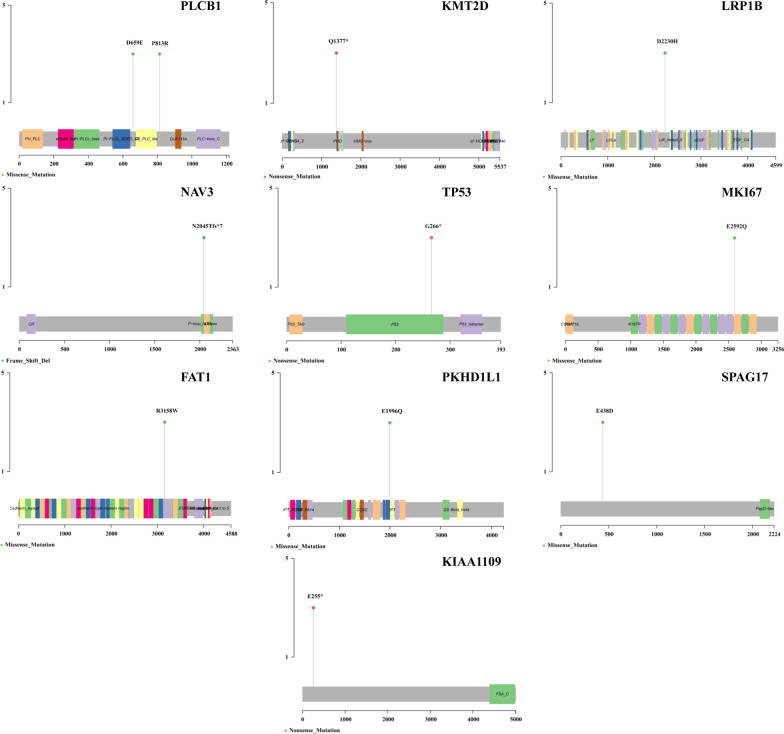
Our study successfully developed a panel of cervical cancer PDX models and the latency time of cervical cancer PDX model establishment was variable with a progressive decrease as the passage number increased, with a mean time to initial growth of 94.71 days in F1 engraftment to 40.65 days in F3 engraftment. Moreover, the cervical cancer PDX models preserved the histological features of their original cervical cancer. WGS revealed that the genome of original cervical cancer was preserved with high fidelity in cervical cancer PDX models throughout the xenografting and passaging process. Furthermore, WES demonstrated that the cervical cancer PDX models maintained the majority somatic mutations of original cervical cancer, of which the KMT2D, LRP1B, NAV3, TP53, FAT1, MKI67 and PKHD1L1 genes were identified as the most frequently mutated genes.
The cervical cancer PDX models preserved the histologic and genetic characteristics of their original cervical cancer, which helped to gain a deeper insight into the genetic alterations and lay a foundation for further investigation of the molecular targeted therapy of cervical cancer.
患者来源的异种移植(PDX)模型被建立以重现原始癌症的临床情况,并越来越多地应用于临床前癌症研究。本研究旨在建立并遗传特征分析宫颈癌 PDX 模型。
将 22 例手术切除的宫颈癌组织中获得的 91 个新鲜组织片段皮下植入雌性 NOD-SCID 小鼠。通过苏木精和伊红(H&E)染色评估建立的 PDX 模型是否保留了原始患者宫颈癌组织的组织学特征。此外,应用 Venn 图显示全基因组测序(WGS)数据中患者原始宫颈癌(F0)和 F2、F3-PDX 模型中所有检测到的突变的重叠。应用全外显子组测序(WES)和“maftools”包确定原发性宫颈癌和建立的 PDX 模型中的体细胞突变。
本研究成功建立了一组宫颈癌 PDX 模型,宫颈癌 PDX 模型的建立潜伏期随传代数的增加而变化,F1 植入的初始生长时间平均为 94.71 天,F3 植入的初始生长时间为 40.65 天。此外,宫颈癌 PDX 模型保留了其原始宫颈癌的组织学特征。WGS 显示,在整个异种移植和传代过程中,原始宫颈癌的基因组在宫颈癌 PDX 模型中以高保真度保留。此外,WES 表明,宫颈癌 PDX 模型保留了原始宫颈癌的大多数体细胞突变,其中 KMT2D、LRP1B、NAV3、TP53、FAT1、MKI67 和 PKHD1L1 基因被确定为最常突变的基因。
宫颈癌 PDX 模型保留了其原始宫颈癌的组织学和遗传特征,有助于更深入地了解遗传改变,并为进一步研究宫颈癌的分子靶向治疗奠定基础。