Heywood Lauren, Conti Janet, Hay Phillipa
School of Psychology, Western Sydney University, Sydney, Australia.
Translational Health Research Institute, Western Sydney University, Sydney, Australia.
J Eat Disord. 2022 Sep 8;10(1):137. doi: 10.1186/s40337-022-00635-5.
There are presently a number of eating disorder treatment interventions that have a research-evidence base to support their effectiveness. However, rates of attrition and treatment outcomes demonstrate that there is no one-size fits all for the treatment of eating disorders. Narrative therapy is a promising, but under-researched, intervention for the treatment of eating disorders (EDs). The aim of this study was to conduct a narrative synthesis of the literature to explore the content and use of narrative therapy in the treatment of EDs.
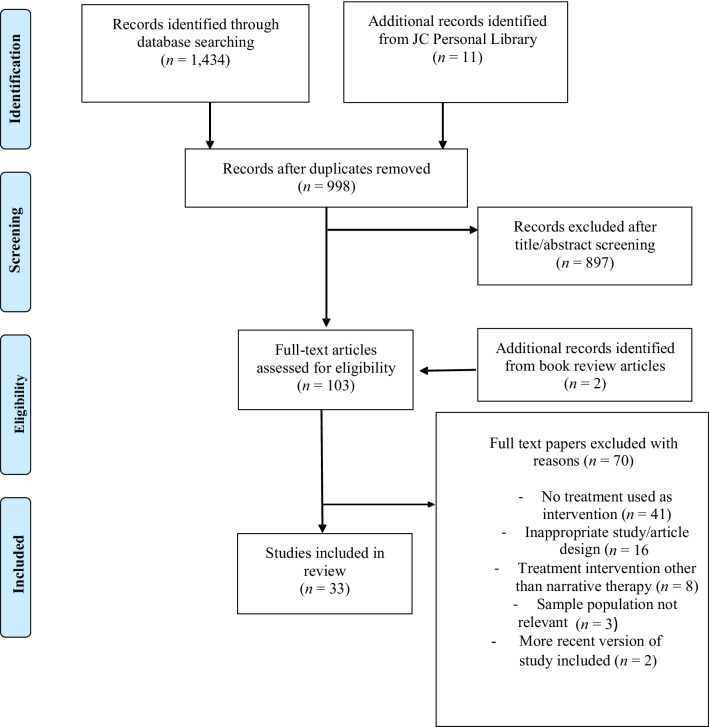
Data were extracted from 33 eligible included studies following systematic search of five data bases. Data included aims and objectives, sample characteristics, treatment details and components of narrative therapy, which informed the narrative synthesis. The study is reported according to the Preferred Reporting items for Systematic Reviews and Meta-Analyses (PRISMA) guidelines.
Narrative therapy interventions for EDs consisted of several components including the narrative worldview; unpacking the problem story; finding, thickening the meaning and performance of stories hidden by the problem story; and safety considerations. A notable proportion of the extracted articles discussed components of unpacking problem stories, and finding and re-authoring openings (or unique outcomes) that were hidden by problematic stories. Relatively fewer papers discussed the processes by identity shifts were performed or lived out, including in the eating practices of those with a lived ED experience. Furthermore, few papers addressed how therapists established client safety within the narrative framework when working with EDs.
This narrative synthesis found that narrative practitioners utilise a variety of narrative therapy techniques in working with individuals with a lived ED experience. The current literature has emphasis on specific narrative therapy techniques used in ED treatments, with some aspects of the narrative worldview and safety considerations left undiscussed. Additional research is needed to explore how identity shifts in narrative therapy are performed and lead to measurable behavioural changes, and to consider how safety considerations can be established within the narrative worldview. There are a number of psychological therapies for eating disorders that have research evidence-base. These treatments, however, do not work for everyone as indicated by drop-out rates and eating disorders running a severe and enduring course for some people. Narrative therapy is a therapeutic intervention that has been reported as a promising intervention for people with an eating disorder. The focus of narrative therapy is to engage the person in finding identities hidden by problem-saturated identities and in the performance of these hidden identities. In this review, we have explored the use of narrative therapy for eating disorders to identify what aspects of this therapy are currently being used and which components are less referenced in the literature. Findings from this study support the need for further research into narrative therapy components in the treatment of eating disorders, particularly how hidden identities are performed and safety considerations are integrated into this therapeutic intervention.
目前有多种饮食失调治疗干预措施有研究证据支持其有效性。然而,脱落率和治疗结果表明,饮食失调的治疗没有一种适用于所有人的方法。叙事疗法是一种有前景但研究不足的饮食失调治疗干预措施。本研究的目的是对文献进行叙事综合,以探讨叙事疗法在饮食失调治疗中的内容和应用。
在对五个数据库进行系统检索后,从33项符合条件的纳入研究中提取数据。数据包括目的、样本特征、治疗细节以及叙事疗法的组成部分,这些为叙事综合提供了信息。本研究按照系统评价和荟萃分析的首选报告项目(PRISMA)指南进行报告。
针对饮食失调的叙事疗法干预措施包括几个组成部分,包括叙事世界观;拆解问题故事;寻找、深化被问题故事隐藏的故事的意义和表现;以及安全考量。相当一部分提取的文章讨论了拆解问题故事以及寻找和重新创作被问题故事隐藏的开端(或独特结果)的组成部分。相对较少的论文讨论了身份转变是如何进行或体现的,包括在有饮食失调生活经历者的饮食行为中。此外,很少有论文探讨治疗师在治疗饮食失调时如何在叙事框架内确保来访者的安全。
这项叙事综合发现,叙事疗法从业者在与有饮食失调生活经历的个体合作时使用了多种叙事疗法技术。当前文献强调了饮食失调治疗中使用的特定叙事疗法技术,而叙事世界观和安全考量的一些方面未被讨论。需要进一步研究叙事疗法中的身份转变是如何进行并导致可测量的行为改变的,以及考虑如何在叙事世界观中确立安全考量。有多种针对饮食失调的心理疗法有研究证据支持。然而,正如脱落率以及对一些人来说饮食失调病程严重且持久所表明的那样,这些治疗方法并非对所有人都有效。叙事疗法是一种被报道对饮食失调患者有前景的治疗干预措施。叙事疗法的重点是让个体寻找被问题饱和身份所隐藏的身份,并践行这些隐藏的身份。在本综述中,我们探讨了叙事疗法在饮食失调治疗中的应用,以确定该疗法目前正在使用的哪些方面以及哪些组成部分在文献中较少被提及。本研究结果支持有必要进一步研究叙事疗法在饮食失调治疗中的组成部分,特别是隐藏身份是如何践行的以及安全考量是如何融入这种治疗干预的。
