Dupin Charles, Sutter Jade, Amintas Samuel, Derieppe Marie-Alix, Lalanne Magalie, Coulibaly Soule, Guyon Joris, Daubon Thomas, Boutin Julian, Blouin Jean-Marc, Richard Emmanuel, Moreau-Gaudry François, Bedel Aurélie, Vendrely Véronique, Dabernat Sandrine
BRIC (BoRdeaux Institute of onCology), UMR1312, INSERM, University of Bordeaux, F-33000 Bordeaux, France.
Radiotherapy Department, CHU Bordeaux, F-33000 Bordeaux, France.
Cancers (Basel). 2022 Aug 31;14(17):4244. doi: 10.3390/cancers14174244.
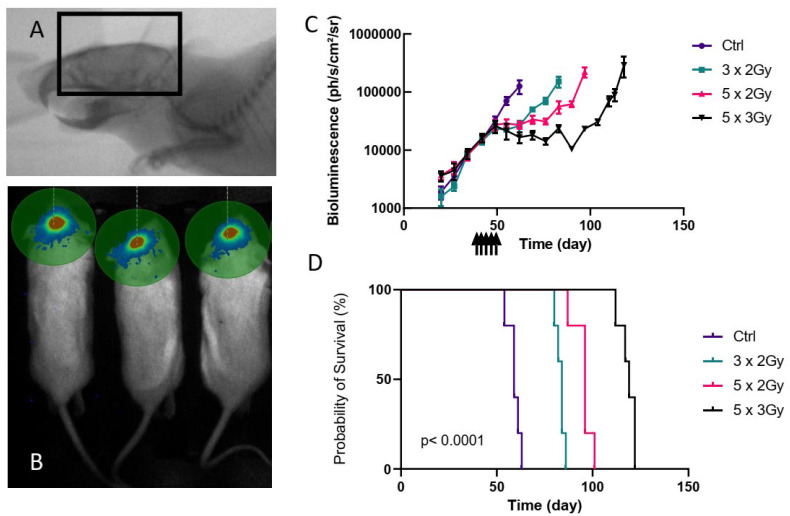
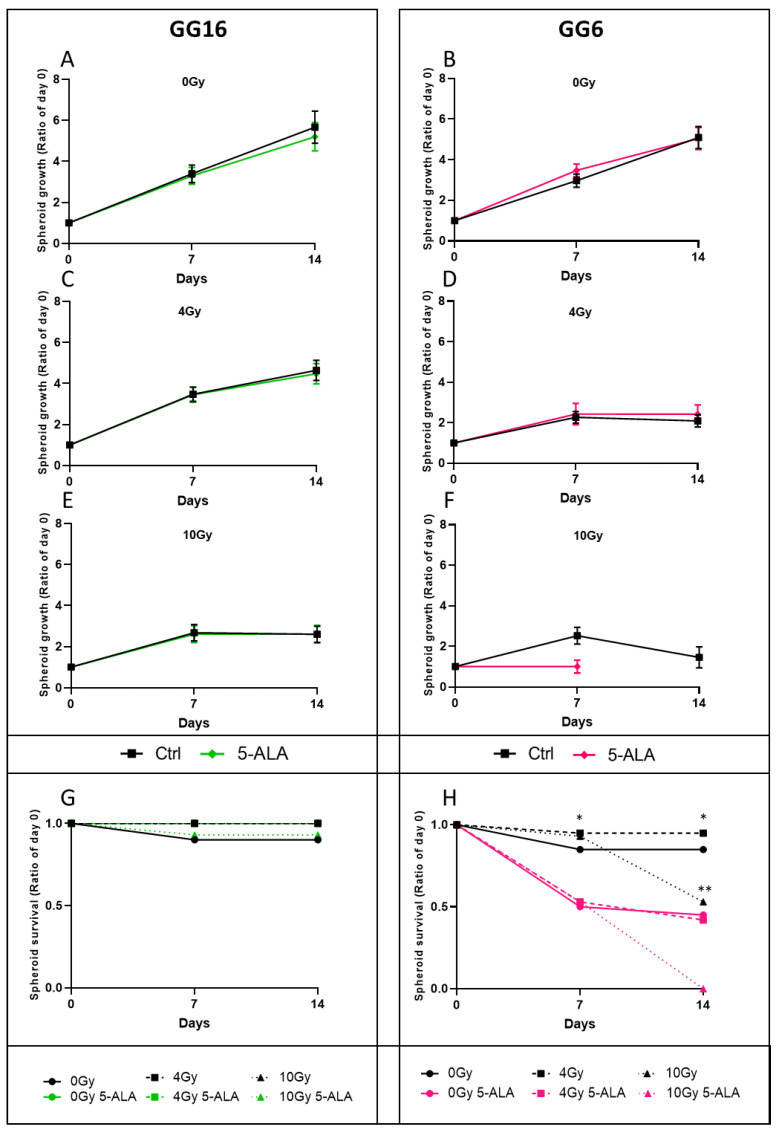
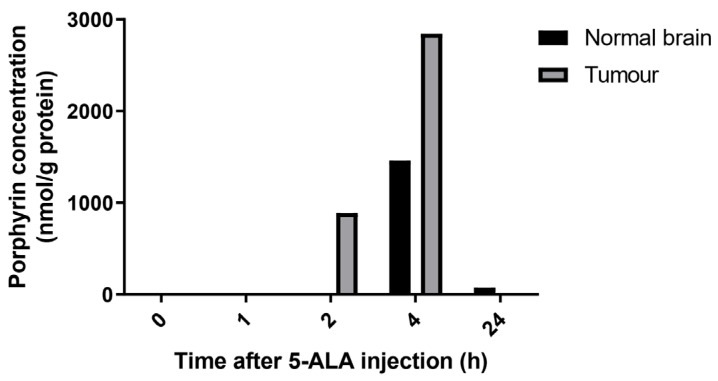
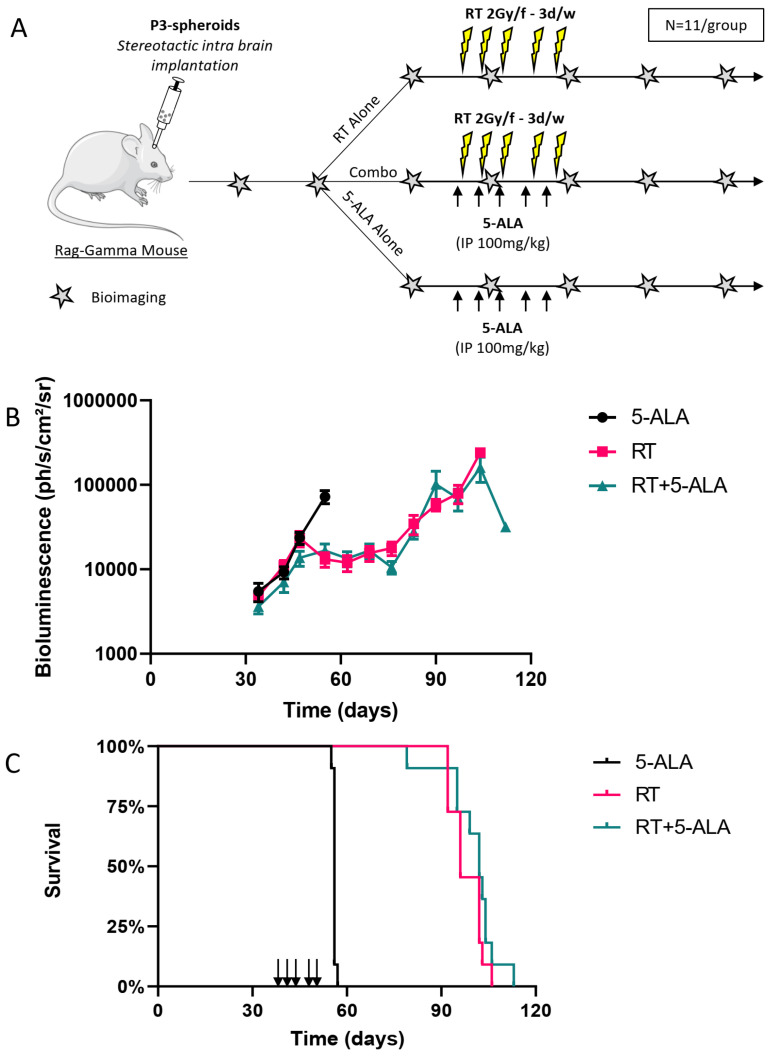
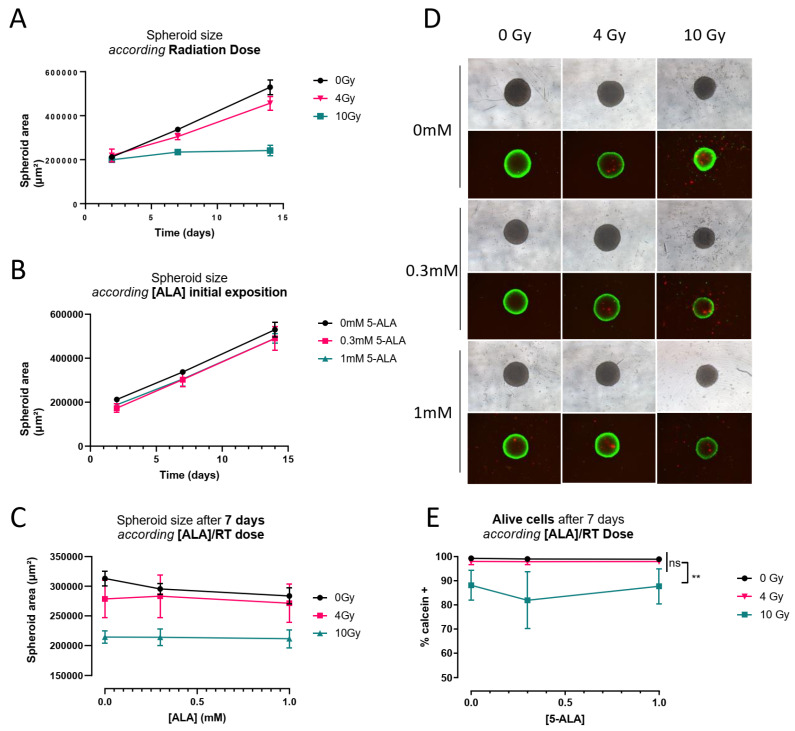
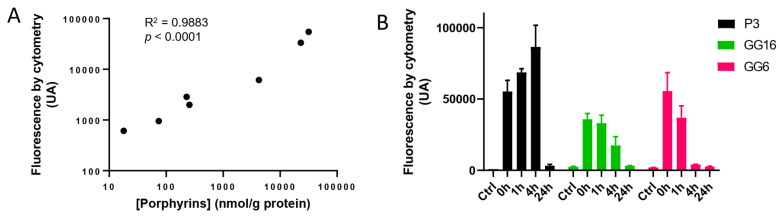
Radiosensitization of glioblastoma is a major ambition to increase the survival of this incurable cancer. The 5-aminolevulinic acid (5-ALA) is metabolized by the heme biosynthesis pathway. 5-ALA overload leads to the accumulation of the intermediate fluorescent metabolite protoporphyrin IX (PpIX) with a radiosensitization potential, never tested in a relevant model of glioblastoma. We used a patient-derived tumor cell line grafted orthotopically to create a brain tumor model. We evaluated tumor growth and tumor burden after different regimens of encephalic multifractionated radiation therapy with or without 5-ALA. A fractionation scheme of 5 × 2 Gy three times a week resulted in intermediate survival [48-62 days] compared to 0 Gy (15-24 days), 3 × 2 Gy (41-47 days) and, 5 × 3 Gy (73-83 days). Survival was correlated to tumor growth. Tumor growth and survival were similar after 5 × 2 Gy irradiations, regardless of 5-ALA treatment (RT group (53-67 days), RT+5-ALA group (40-74 days), HR = 1.57, = 0.24). Spheroid growth and survival were diminished by radiotherapy in vitro, unchanged by 5-ALA pre-treatment, confirming the in vivo results. The analysis of two additional stem-like patient-derived cell lines confirmed the absence of radiosensitization by 5-ALA. Our study shows for the first time that in a preclinical tumor model relevant to human glioblastoma, treated as in clinical routine, 5-ALA administration, although leading to important accumulation of PpIX, does not potentiate radiotherapy.
胶质母细胞瘤的放射增敏是提高这种无法治愈癌症患者生存率的主要目标。5-氨基乙酰丙酸(5-ALA)通过血红素生物合成途径进行代谢。5-ALA过载会导致具有放射增敏潜力的中间荧光代谢物原卟啉IX(PpIX)积累,而这从未在相关的胶质母细胞瘤模型中得到验证。我们使用原位移植的患者来源肿瘤细胞系创建了一个脑肿瘤模型。我们评估了在有或没有5-ALA的情况下,不同方案的脑部分次放射治疗后的肿瘤生长和肿瘤负荷。与0 Gy(15 - 24天)、3×2 Gy(41 - 47天)和5×3 Gy(73 - 83天)相比,每周三次、每次2 Gy共5次的分割方案导致了中等生存期[48 - 62天]。生存期与肿瘤生长相关。在5×2 Gy照射后,无论是否进行5-ALA治疗,肿瘤生长和生存期相似(放疗组(53 - 67天),放疗 + 5-ALA组(40 - 74天),HR = 1.57,P = 0.24)。在体外,放疗可减少球体生长和生存期,5-ALA预处理则无变化,这证实了体内实验结果。对另外两种患者来源的干细胞样细胞系的分析证实了5-ALA不存在放射增敏作用。我们的研究首次表明,在与人类胶质母细胞瘤相关的临床前肿瘤模型中,按照临床常规进行治疗时,尽管5-ALA给药会导致PpIX大量积累,但并不会增强放射治疗效果。