
浸润边缘的T细胞密度和免疫表型可预测外阴鳞状细胞癌的预后。
T-Cell Density at the Invasive Margin and Immune Phenotypes Predict Outcome in Vulvar Squamous Cell Cancer.
作者信息
Burandt Eike, Blessin Niclas C, Rolschewski Ann-Christin, Lutz Florian, Mandelkow Tim, Yang Cheng, Bady Elena, Reiswich Viktor, Simon Ronald, Sauter Guido, Mahner Sven, Gregorio Nikolaus de, Klapdor Rüdiger, Kalder Matthias, Braicu Elena I, Fürst Sophie, Klar Maximilian, Strauß Hans-Georg, Prieske Katharina, Wölber Linn
机构信息
Institute of Pathology, University Medical Center Hamburg-Eppendorf, 20246 Hamburg, Germany.
Department of Obstetrics and Gynecology, University Hospital, LMU Munich, 81377 Munich, Germany.
出版信息
Cancers (Basel). 2022 Aug 31;14(17):4246. doi: 10.3390/cancers14174246.
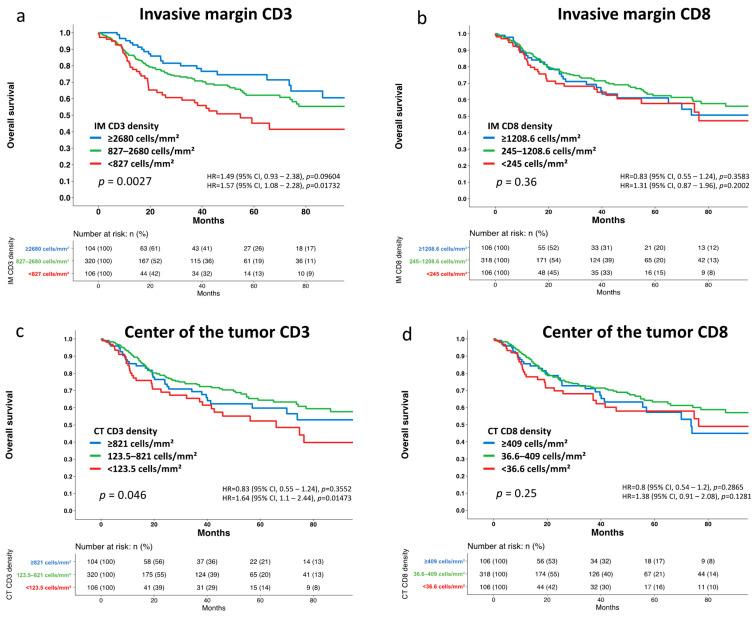
Background: Although quantification of tumor infiltrating lymphocytes (TILs) has become of increasing interest in immuno-oncology, only little is known about TILs infiltration in the tumor microenvironment and its predictive value in vulvar cancer. Methods: Immunohistochemistry and automated digital image analysis was applied to measure the densities of CD3+ (DAKO, #IR503) and CD8+ (DAKO, #IR623) TILs at the invasive margin and in the center of 530 vulvar squamous cell cancers. Results: An elevated density of CD3+ T-cell at the invasive margin was significantly associated with low tumor stage (p = 0.0012) and prolonged survival (overall survival [OS] p = 0.0027, progression free survival [PFS] p = 0.024) and was independent from tumor stage, nodal stage, grade, and HPV-status in multivariate analysis (p < 0.05). The prognostic impact of CD3+ cells in the center of the tumor was weaker compared to the invasive margin (OS p = 0.046, PFS p = 0.031) and lacking for CD8+ T-cell densities at any location (p ≥ 0.14 each). Unsupervised clustering of CD3+ and CD8+ T-cell densities identified three major subgroups corresponding to the immune desert (137 patients), immune excluded (220 patients) and immune inflamed phenotypes (133 patients). Survival analysis revealed a particular poor prognosis for the immune desert phenotype for OS (p = 0.0071) and PFS (p = 0.0027). Conclusion: Our data demonstrate a high prognostic value of CD3+ T-cells at the invasive margin and immune phenotypes in vulvar squamous cell cancer.
背景
尽管肿瘤浸润淋巴细胞(TILs)的定量分析在免疫肿瘤学中越来越受到关注,但关于TILs在肿瘤微环境中的浸润情况及其在外阴癌中的预测价值,人们所知甚少。方法:应用免疫组织化学和自动数字图像分析技术,测量530例外阴鳞状细胞癌浸润边缘和肿瘤中心CD3 +(DAKO,#IR503)和CD8 +(DAKO,#IR623)TILs的密度。结果:浸润边缘CD3 + T细胞密度升高与低肿瘤分期(p = 0.0012)和生存期延长显著相关(总生存期[OS] p = 0.0027,无进展生存期[PFS] p = 0.024),在多变量分析中独立于肿瘤分期、淋巴结分期、分级和HPV状态(p < 0.05)。与浸润边缘相比,肿瘤中心CD3 +细胞的预后影响较弱(OS p = 0.046,PFS p = 0.031),且在任何位置CD8 + T细胞密度均无此影响(各p≥0.14)。CD3 +和CD8 + T细胞密度的无监督聚类确定了三个主要亚组,分别对应免疫沙漠型(137例患者)、免疫排除型(220例患者)和免疫炎症型(133例患者)。生存分析显示,免疫沙漠型在OS(p = 0.0071)和PFS(p = 0.0027)方面预后特别差。结论:我们的数据表明,外阴鳞状细胞癌浸润边缘的CD3 + T细胞和免疫表型具有较高的预后价值。



 Zotero 插件