Capelli Debora, Menotti Diego, Fiorentini Alessandro, Saraceni Francesco, Olivieri Attilio
Departement of Haematology, Azienda Ospedaliera Universitaria Ospedali Riuniti di Ancona, Via Conca 71, 60126 Ancona, Italy.
Cancers (Basel). 2022 Sep 2;14(17):4315. doi: 10.3390/cancers14174315.
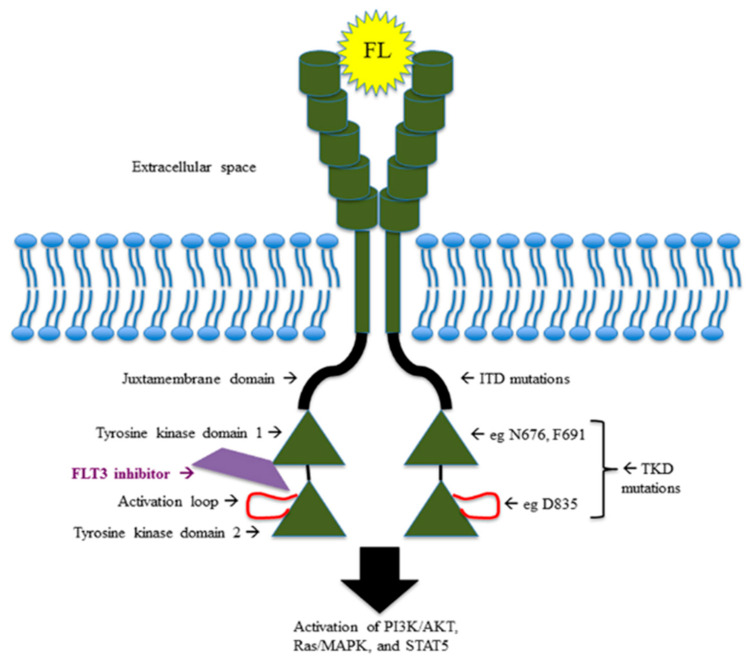
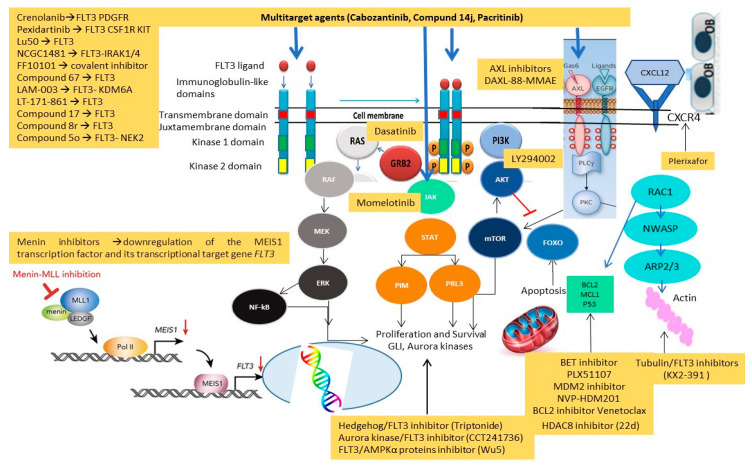
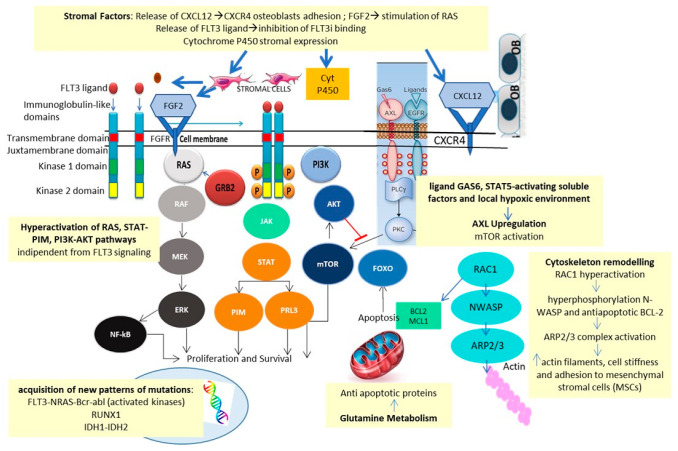
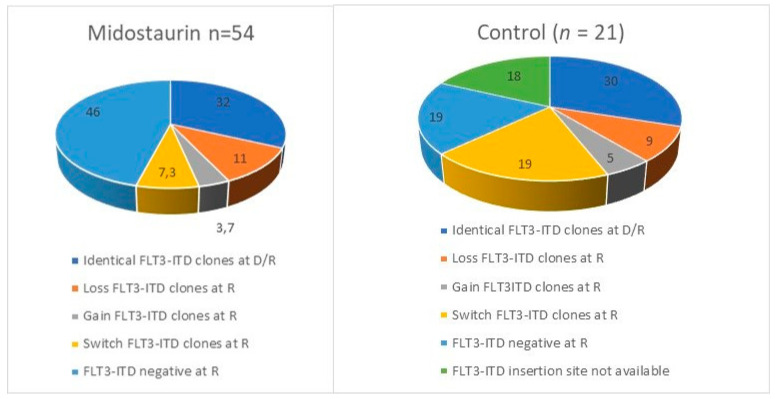
FLT3 ITD and TKD mutations occur in 20% and 10% of Acute Myeloid Leukemia (AML), respectively, and they represent the target of the first approved anti-leukemic therapies in the 2000s. Type I and type II FLT3 inhibitors (FLT3i) are active against FLT3 TKD/ITD and FLT3 ITD mutations alone respectively, but they still fail remissions in 30-40% of patients due to primary and secondary mechanisms of resistance, with variable relapse rate of 30-50%, influenced by NPM status and FLT3 allelic ratio. Mechanisms of resistance to FLT3i have recently been analyzed through NGS and single cell assays that have identified and elucidated the polyclonal nature of relapse in clinical and preclinical studies, summarized here. Knowledge of tumor escape pathways has helped in the identification of new targeted drugs to overcome resistance. Immunotherapy and combination or sequential use of BCL2 inhibitors and experimental drugs including aurora kinases, menin and JAK2 inhibitors will be the goal of present and future clinical trials, especially in patients with FLT3-mutated (FLT3mut) AML who are not eligible for allogeneic transplantation.
FLT3内部串联重复(ITD)和酪氨酸激酶结构域(TKD)突变分别发生在20%和10%的急性髓系白血病(AML)中,它们是21世纪首批获批的抗白血病疗法的靶点。I型和II型FLT3抑制剂(FLT3i)分别仅对FLT3 TKD/ITD和FLT3 ITD突变有活性,但由于原发性和继发性耐药机制,它们在30%-40%的患者中仍无法实现缓解,复发率在30%-50%之间变化,受核仁磷酸蛋白(NPM)状态和FLT3等位基因比例影响。最近通过二代测序(NGS)和单细胞检测分析了对FLT3i的耐药机制,这些检测在临床和临床前研究中确定并阐明了复发的多克隆性质,在此进行总结。对肿瘤逃逸途径的了解有助于识别克服耐药性的新靶向药物。免疫疗法以及BCL2抑制剂与包括极光激酶、Menin和JAK2抑制剂在内的实验性药物的联合或序贯使用将是当前和未来临床试验的目标,特别是对于不符合异基因移植条件的FLT3突变(FLT3mut)AML患者。