Department of Internal Medicine, Texas Tech University Health Sciences Center, 3601 4th Street, Lubbock, TX 79430, USA.
Center of Emphasis in Neuroscience, Department of Molecular and Translational Medicine, Texas Tech University Health Sciences Center, El Paso, TX 79905, USA.
Cells. 2022 Aug 27;11(17):2660. doi: 10.3390/cells11172660.
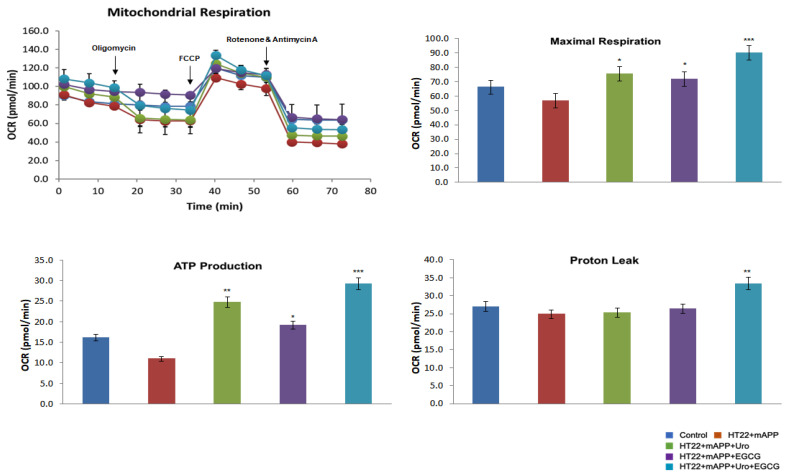
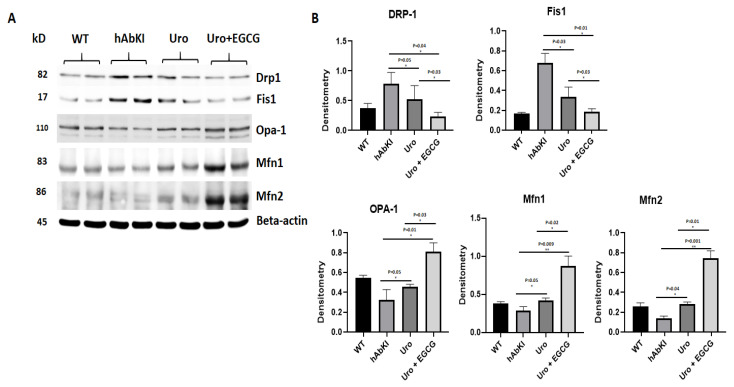
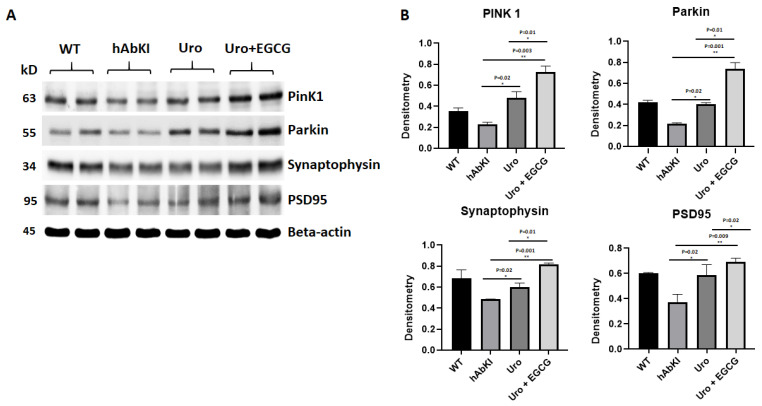
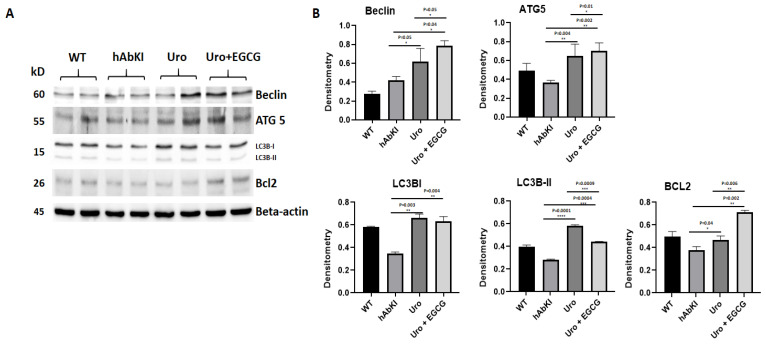
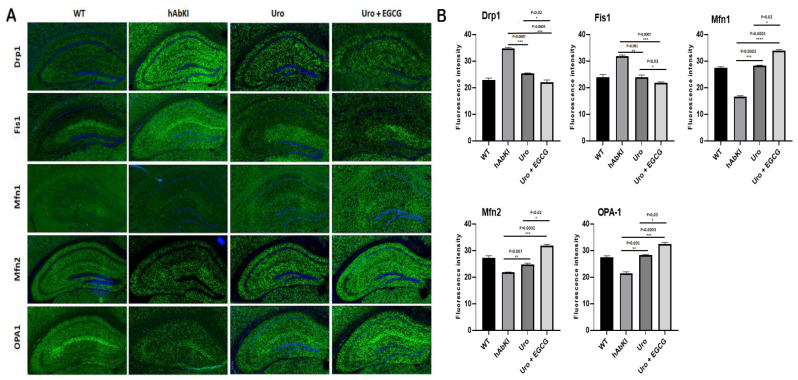
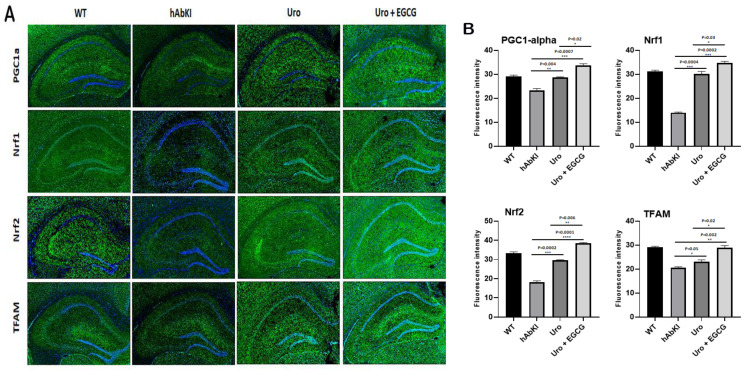
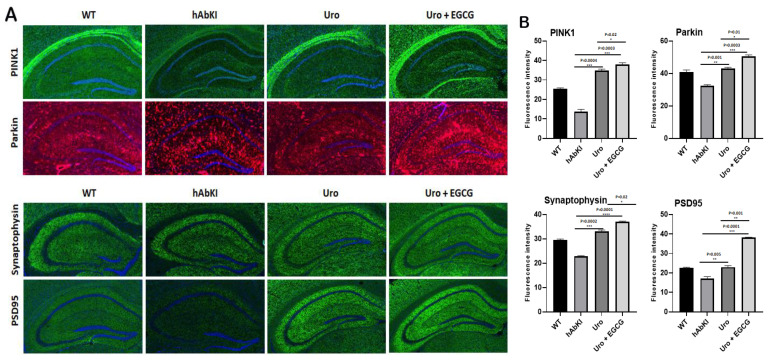
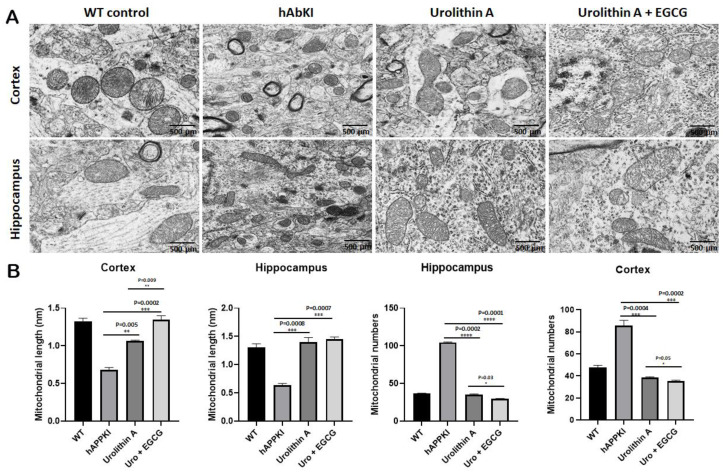
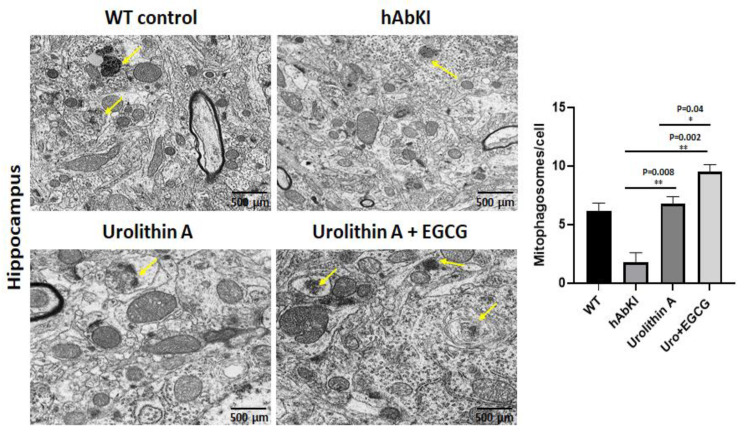
In the current study, for the first time, we study mitophagy enhancer urolithin A and a combination of urolithin A+green tea extract EGCG against human Aβ peptide-induced mitochondrial and synaptic, dendritic, inflammatory toxicities and behavioral changes in humanized homozygous amyloid beta knockin (hAbKI) mice of late-onset Alzheimer's disease (AD). Our findings reveal significantly increased positive effects of urolithin A and a combination treatment of urolithin A+EGCG in hAbKI mice for phenotypic behavioral changes including motor coordination, locomotion/exploratory activity, spatial learning and working memory. mRNA and protein levels of mitochondrial fusion, synaptic, mitophagy and autophagy genes were upregulated, and mitochondrial fission genes are downregulated in urolithin A and combine treatment in hAbKI mice; however, the effect is stronger in combined treatment. Immunofluorescence analysis of hippocampal brain sections shows similar findings of mRNA and protein levels. Mitochondrial dysfunction is significantly reduced in both treatment groups, but a stronger reduction is observed in combined treatment. Dendritic spines and lengths are significantly increased in both treatment groups, but the effect is stronger in combined treatment. The fragmented number of mitochondria is reduced, and mitochondrial length is increased, and mitophagosomal formations are increased in both the groups, but the effect is stronger in the combined treatment. The levels of amyloid beta (Aβ) 40 and Aβ42 are reduced in both treatments, however, the reduction is higher for combined treatment. These observations suggest that urolithin A is protective against human Aβ peptide-induced toxicities; however, combined treatment of urolithin A+EGCG is effective and stronger, indicating that combined therapy is promising to treat late-onset AD patients.
在目前的研究中,我们首次研究了粪石素 A 作为一种线粒体自噬增强剂,以及粪石素 A 和绿茶提取物 EGCG 的联合应用,以对抗人源淀粉样β蛋白(Aβ)肽诱导的线粒体和突触、树突、炎症毒性以及晚发性阿尔茨海默病(AD)的人源淀粉样蛋白β敲入(hAbKI)小鼠的行为变化。我们的研究结果显示,粪石素 A 和粪石素 A+EGCG 的联合治疗对 hAbKI 小鼠的表型行为变化具有显著的增强作用,包括运动协调、运动/探索活动、空间学习和工作记忆。在 hAbKI 小鼠中,线粒体融合、突触、自噬和线粒体自噬基因的 mRNA 和蛋白水平上调,线粒体分裂基因下调;而联合治疗的效果更强。免疫荧光分析海马脑切片显示出与 mRNA 和蛋白水平相似的发现。两组治疗均显著减少了线粒体功能障碍,但联合治疗的效果更强。两组治疗均显著增加了树突棘和长度,但联合治疗的效果更强。线粒体碎片化的数量减少,线粒体长度增加,噬线粒体形成增加,两组治疗均有效果,但联合治疗的效果更强。两组治疗均降低了淀粉样β(Aβ)40 和 Aβ42 的水平,但联合治疗的降低幅度更高。这些观察结果表明,粪石素 A 可预防人 Aβ肽诱导的毒性;然而,粪石素 A 和 EGCG 的联合治疗更有效且效果更强,表明联合治疗有望治疗晚发性 AD 患者。