Department of Respiratory Therapy, Kaohsiung Chang Gung Memorial Hospital, Kaohsiung 833, Taiwan.
Division of Pulmonary and Critical Care Medicine, Department of Internal Medicine, Kaohsiung Chang Gung Memorial Hospital, Kaohsiung 833, Taiwan.
Int J Environ Res Public Health. 2022 Aug 24;19(17):10559. doi: 10.3390/ijerph191710559.
Coronavirus disease (COVID-19) impairs the free movement of human beings. The study aims to determine how the COVID-19 pandemic affected population mobility.
The study obtained Google COVID-19 population mobility report and e Taiwan COVID-19 pandemic information from Our World in Data.
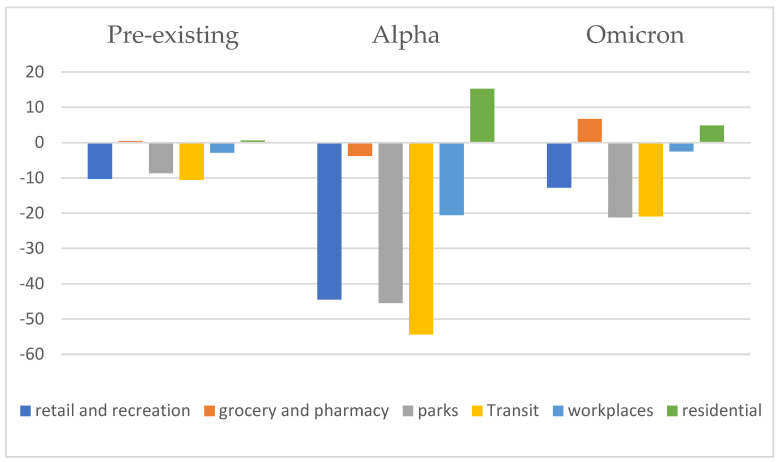
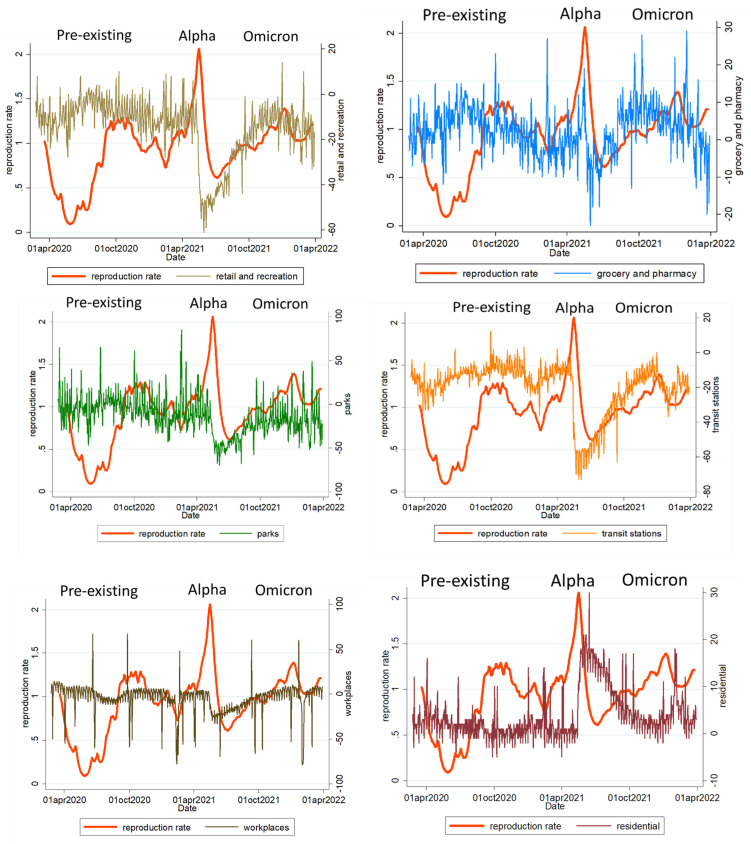
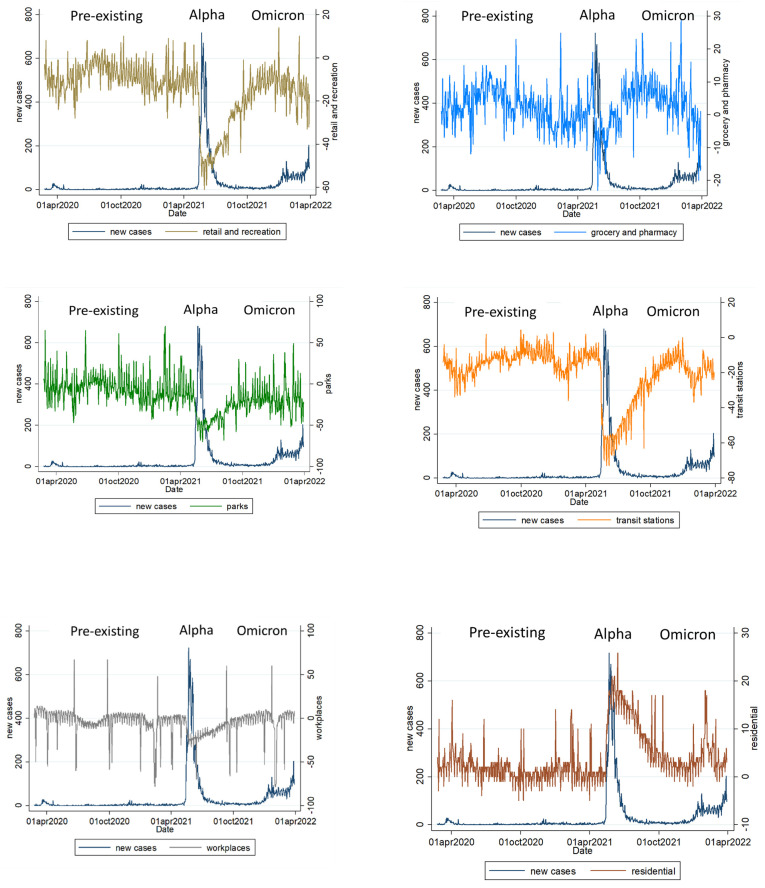
During the Alpha wave, transit decreased the most, with an average difference of >50%, followed by parks, workplaces, groceries, and pharmacies. During the Omicron wave, the average population flow in parks and transit decreased by about 20%. During the pre-existing wave, the average population visits of transit decreased by 10% at the most, followed by parks and workplaces. The peak of daily new confirmed cases per million (7-day rolling average) was 25.02, 6.39, and 0.81 for Alpha, Omicron, and the pre-existing wave, respectively. Daily new confirmed cases per million people correlated with the change in population visits of various places (all < 0.001). The reproduction rate (7-day rolling average) correlated with the change of population visits of most places, except retail and recreation. We conclude the Alpha variant affected more individuals than Omicron and pre-existing type. Furthermore, changes in population visits in transit were most impacted. This change was consistent with daily new confirmed cases per million people and reproduction rate (7-day rolling average).
The Alpha variant affected more individuals than the Omicron and pre-existing types. Furthermore, changes in population visits in transit locations were most impacted. This change was consistent with the daily new number of confirmed cases per million people and the 7-day rolling average reproduction rate.
冠状病毒病(COVID-19)阻碍了人类的自由流动。本研究旨在确定 COVID-19 大流行如何影响人口流动。
本研究从 Our World in Data 获取了谷歌 COVID-19 人口流动报告和 e Taiwan COVID-19 大流行信息。
在 Alpha 波期间,过境人数减少最多,平均差异超过 50%,其次是公园、工作场所、杂货店和药店。在 Omicron 波期间,公园和过境的平均人口流量减少了约 20%。在预先存在的波期间,过境的平均人口访问量减少了 10%左右,其次是公园和工作场所。每日新确诊病例每百万人(7 天滚动平均值)的峰值分别为 Alpha、Omicron 和预先存在波的 25.02、6.39 和 0.81。每日新确诊病例每百万人与各地人口访问量的变化相关(均<0.001)。繁殖率(7 天滚动平均值)与除零售和娱乐业外的大多数地方的人口访问量变化相关。我们得出结论,Alpha 变体比 Omicron 和预先存在的类型影响更多的个体。此外,过境地点的人口访问量变化受到的影响最大。这种变化与每日新确诊病例每百万人和繁殖率(7 天滚动平均值)一致。
Alpha 变体比 Omicron 和预先存在的类型影响更多的个体。此外,过境地点的人口访问量变化受到的影响最大。这种变化与每日新确诊病例每百万人和繁殖率(7 天滚动平均值)一致。