Coordinacion de Nutricion y Bioprogramacion, Instituto Nacional de Perinatologia, Secretaria de Salud, Mexico City 11000, Mexico.
Programa de Posgrado Doctorado en Ciencias Biologicas y de la Salud, Division de Ciencias Biologicas y de la Salud, Universidad Autonoma Metropolitana, Mexico City 04960, Mexico.
Int J Environ Res Public Health. 2022 Aug 25;19(17):10569. doi: 10.3390/ijerph191710569.
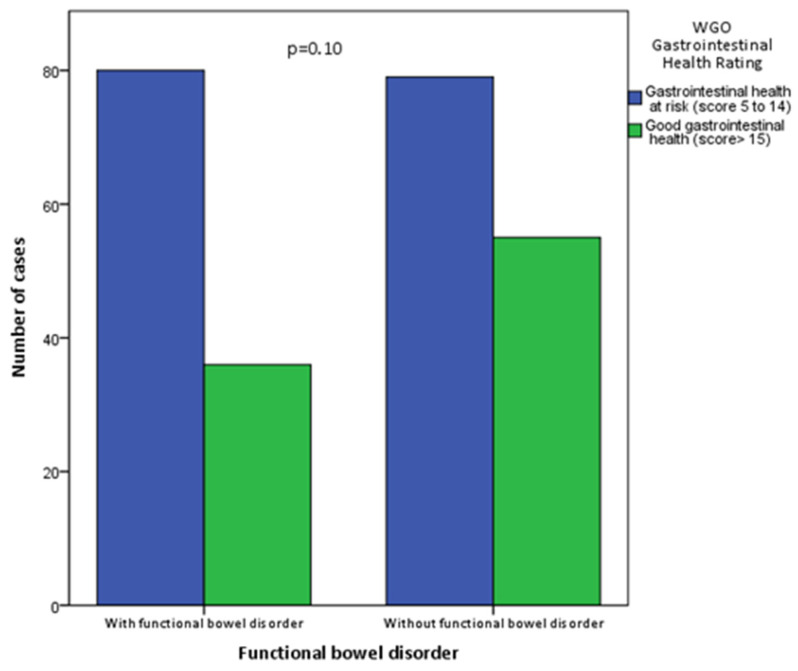
Gastrointestinal functional disorders are characterized by abnormalities in motility with visceral hypersensitivity, representing a global public health problem. We aimed to determine whether eating habits, lifestyle characteristics, and body mass index (BMI) are associated with gastrointestinal health risk. The Gastrointestinal Health (GIH) test of the World Gastroenterology Organization (WGO) and the Roma IV criteria were applied. We obtained information on food consumption habits and aerobic exercise, among other variables. Not exercising regularly, drinking water and eating vegetables less than recommended, having high body weight, and taking symptomatic medication were variables that explained 73% of the probabilities of not having good GIH (R = 0.734). According to Rome IV criteria, women had a 50% higher risk than men of having functional bowel disorder (RR 1.6, 95% CI: 1.04, 2.45). Among the men studied, eating few or no vegetables and drinking less than 1 L of water daily was more frequent; however, the women had significantly more intestinal symptoms. In addition, constipation was higher among women than men ( = 0.020). All of the above explains the prognostic value of eating habits and the importance of paying attention to body weight to reduce the risk of gastrointestinal disease.
胃肠道功能障碍的特征是运动异常伴有内脏高敏性,代表了一个全球性的公共卫生问题。我们旨在确定饮食习惯、生活方式特征和体重指数(BMI)是否与胃肠道健康风险有关。应用了世界胃肠病组织(WGO)的胃肠道健康(GIH)测试和罗马 IV 标准。我们获得了关于食物消费习惯和有氧运动等变量的信息。不经常锻炼、不按推荐量饮水和吃蔬菜、体重过高以及服用对症药物是不能保持良好 GIH 的概率的 73%的解释变量(R = 0.734)。根据罗马 IV 标准,女性患功能性肠病的风险比男性高 50%(RR 1.6,95%CI:1.04,2.45)。在所研究的男性中,每天吃很少或不吃蔬菜以及喝少于 1 升水的情况更为常见;然而,女性的肠道症状明显更多。此外,女性的便秘发生率高于男性( = 0.020)。所有这些都解释了饮食习惯的预后价值以及关注体重以降低胃肠道疾病风险的重要性。