Szymski Dominik, Walter Nike, Alt Volker, Rupp Markus
Department of Trauma Surgery, University Medical Centre Regensburg, Franz-Josef-Strauss Allee 11, 93053 Regensburg, Germany.
J Clin Med. 2022 Aug 27;11(17):5042. doi: 10.3390/jcm11175042.
Fracture-related infections (FRI) and periprosthetic joint infections (PJI) represent a major challenge in orthopedic surgery. Incidence of both entities is annually growing. Comorbidities play an important role as an influencing factor for infection and thus, for prevention and treatment strategies. The aims of this study were (1) to analyze the frequency of comorbidities in FRI and PJI patients and (2) to evaluate comorbidities as causative risk factor for PJI and FRI.
This retrospective cohort study analysed all ICD-10 codes, which were coded as secondary diagnosis in all in hospital-treated FRI and PJI in the year 2019 in Germany provided by the Federal Statistical Office of Germany (Destatis). Prevalence of comorbidities was compared with the prevalence in the general population.
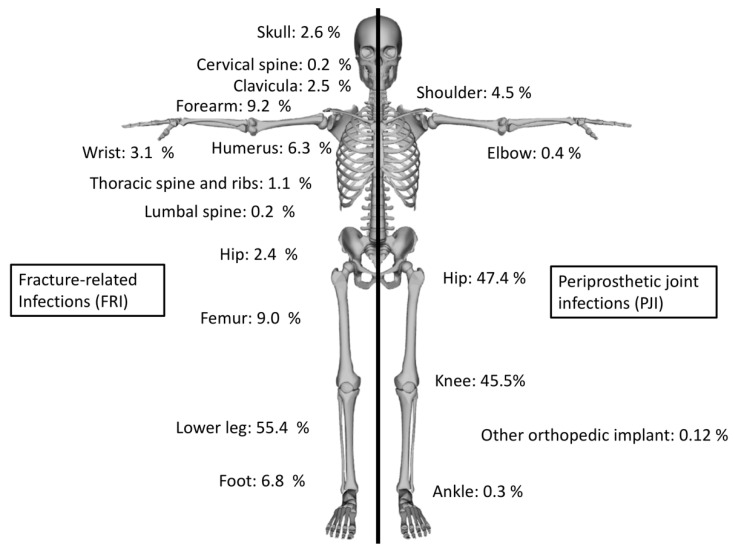
In the year 2019, 7158 FRIs and 16,174 PJIs were registered in Germany, with 68,304 comorbidities in FRI (mean: 9.5 per case) and 188,684 in PJI (mean: 11.7 per case). Major localization for FRI were infections in the lower leg (55.4%) and forearm (9.2%), while PJI were located mostly at hip (47.4%) and knee joints (45.5%). Mainly arterial hypertension (FRI: = 3645; 50.9%-PJI: = 11360; 70.2%), diabetes mellitus type II (FRI: = 1483; 20.7%-PJI: = 3999; 24.7%), obesity (FRI: = 749; 10.5%-PJI: = 3434; 21.2%) and chronic kidney failure (FRI: = 877; 12.3%-PJI: = 3341; 20.7%) were documented. Compared with the general population, an increased risk for PJI and FRI was reported in patients with diabetes mellitus (PJI: 2.988; FRI: 2.339), arterial hypertension (PJI: 5.059; FRI: 2.116) and heart failure (PJI: 6.513; FRI: 3.801).
Patients with endocrinological and cardiovascular diseases, in particular associated with the metabolic syndrome, demonstrate an increased risk for orthopedic implant related infections. Based on the present results, further infection prevention and treatment strategies should be evaluated.
骨折相关感染(FRI)和人工关节周围感染(PJI)是骨科手术中的重大挑战。这两种感染的发病率均呈逐年上升趋势。合并症作为感染的影响因素,在预防和治疗策略中起着重要作用。本研究的目的是:(1)分析FRI和PJI患者合并症的发生频率;(2)评估合并症作为PJI和FRI的致病危险因素。
这项回顾性队列研究分析了德国联邦统计局(德国联邦统计局)提供的2019年德国所有住院治疗的FRI和PJI患者的所有国际疾病分类第10版(ICD-10)编码,这些编码被列为次要诊断。将合并症的患病率与普通人群的患病率进行比较。
2019年,德国登记了7158例FRI和16174例PJI,FRI患者有68304种合并症(平均:每例9.5种),PJI患者有188684种合并症(平均:每例11.7种)。FRI的主要发病部位是小腿感染(55.4%)和前臂感染(9.2%),而PJI主要发生在髋关节(47.4%)和膝关节(45.5%)。主要记录的合并症为动脉高血压(FRI:=3645;50.9% - PJI:=11360;70.2%)、II型糖尿病(FRI:=1483;20.7% - PJI:=3999;24.7%)、肥胖(FRI:=749;10.5% - PJI:=3434;21.2%)和慢性肾衰竭(FRI:=877;12.3% - PJI:=3341;20.7%)。与普通人群相比,糖尿病患者(PJI:2.988;FRI:2.339)、动脉高血压患者(PJI:5.059;FRI:2.116)和心力衰竭患者(PJI:6.513;FRI:3.801)发生PJI和FRI的风险增加。
内分泌和心血管疾病患者,特别是与代谢综合征相关的患者,发生骨科植入物相关感染的风险增加。基于目前的结果,应评估进一步的感染预防和治疗策略。