Hughes Derralynn A, Deegan Patrick, Giraldo Pilar, Göker-Alpan Özlem, Lau Heather, Lukina Elena, Revel-Vilk Shoshana, Scarpa Maurizio, Botha Jaco, Gadir Noga, Zimran Ari
LSD Unit, Royal Free London NHS Foundation Trust, University College London, London NW3 2QG, UK.
Addenbrookes Hospital, Cambridge CB2 0QQ, UK.
J Clin Med. 2022 Aug 31;11(17):5158. doi: 10.3390/jcm11175158.
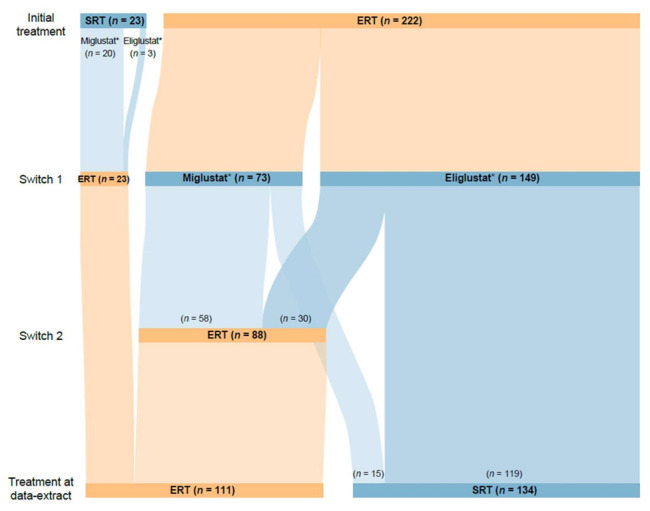
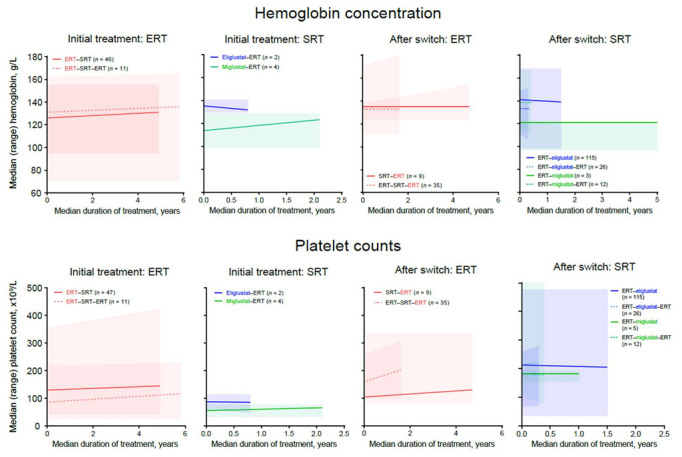
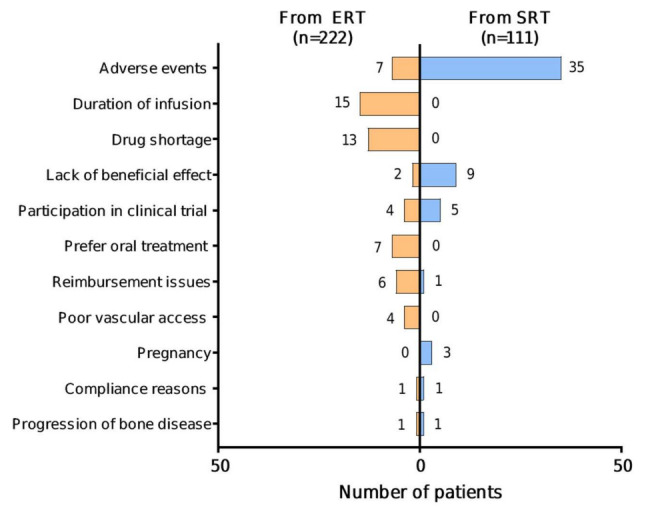
Switching between enzyme replacement therapies (ERT) and substrate reduction therapies (SRT) in patients with type 1 Gaucher disease (GD1) is not uncommon; however, the reasons for switchng treatments have not been explored in detail. Data from the Gaucher Outcome Survey (GOS), an international registry for patients with confirmed GD, were used to evaluate the reasons for, and consequences of, switching between these treatment types. Of the 1843 patients enrolled in GOS on 25 February 2020, 245 had undergone a treatment switch: 222 from initial ERT to SRT (of whom 88 later switched back to ERT) and 23 from initial SRT to ERT. The most common reasons for ERT-SRT switching were duration of infusion (25.4%), drug shortage (22.0%), and adverse events (AEs; 11.9%), and for SRT-ERT switching, AEs (63.6%), lack of beneficial effect (16.4%), and participation in a clinical trial (9.1%). Bodyweight and hematologic parameters largely remained stable before and after switching between ERT and SRT, although with substantial variation between patients. These findings contribute to understanding why treatment switching occurs in patients with GD, and may help physicians recognize the real-world impact of treatment switching between ERT and SRT for patients with GD.
在1型戈谢病(GD1)患者中,在酶替代疗法(ERT)和底物减少疗法(SRT)之间切换并不罕见;然而,切换治疗的原因尚未得到详细探讨。来自戈谢病结果调查(GOS)的数据,这是一个针对确诊戈谢病患者的国际登记处,被用于评估在这两种治疗类型之间切换的原因及后果。在2020年2月25日登记参加GOS的1843名患者中,有245名患者进行了治疗切换:222名从初始的ERT切换到SRT(其中88名后来又切换回ERT),23名从初始的SRT切换到ERT。从ERT切换到SRT的最常见原因是输液时间(25.4%)、药物短缺(22.0%)和不良事件(AE;11.9%),而从SRT切换到ERT的原因是AE(63.6%)、缺乏有益效果(16.4%)和参与临床试验(9.1%)。尽管患者之间存在很大差异,但在ERT和SRT之间切换前后,体重和血液学参数大体上保持稳定。这些发现有助于理解为什么戈谢病患者会发生治疗切换,并可能帮助医生认识到ERT和SRT之间的治疗切换对戈谢病患者的实际影响。