Guangzhou First People's Hospital, School of Medicine, South China University of Technology, Guangzhou 510180, China.
Department of Microbiology, Sun Yat-sen University Zhongshan School of Medicine, Guangzhou 510080, China.
Nutrients. 2022 Aug 26;14(17):3528. doi: 10.3390/nu14173528.
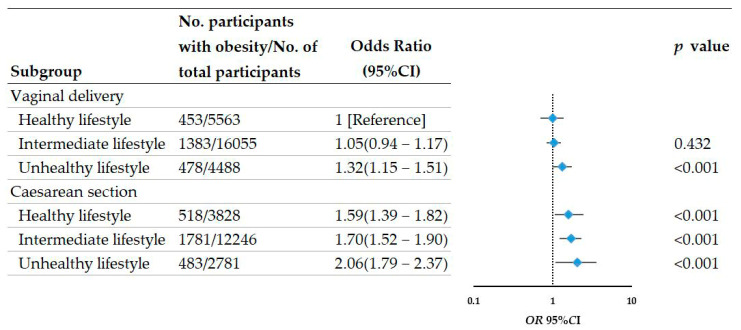
Background: Both caesarean section (CS) and lifestyle were linked with child adiposity. This study aimed to investigate whether CS delivery is linked with elevated risk of child adiposity regardless of a healthy lifestyle. Methods: All the subjects in this study came from a baseline survey of a national school-based program on healthy lifestyle interventions against adiposity among Chinese children and adolescents. A questionnaire was used to collect the information on delivery mode and lifestyle. According to the weighted lifestyle score, subjects were categorized into healthy, intermediate, and unhealthy lifestyle. Results: A total of 44,961 children aged 6−18 years were enrolled in the current study. Overall, 41.9% (18,855/44,961) of children were delivered by CS. Compared with children delivered by vaginal delivery, children delivered by CS had a higher adiposity risk (OR = 1.56; 95%CI: 1.46−1.66; p < 0.001) after adjustment for age, sex, region, mother adiposity, ethnicity, and weighted lifestyle factors. Compared with children with a healthy lifestyle, children with an unhealthy lifestyle had a higher risk of child adiposity (OR = 1.31; 95%CI: 1.19−1.44). Children delivered by CS who had an unhealthy lifestyle had a 106% higher (OR = 2.06; 95%CI: 1.79−2.37) risk of child adiposity compared with children delivered by vaginal delivery who had a healthy lifestyle. However, keeping a healthy lifestyle in later life seems not to offset the increased risk of child adiposity caused by CS (OR = 1.59; 95%CI: 1.39−1.82). Conclusions: Both CS and unhealthy lifestyle were linked with child adiposity risk. Keeping a healthy lifestyle did not counteract the elevated risk of child adiposity caused by CS.
剖宫产(CS)和生活方式都与儿童肥胖有关。本研究旨在调查无论生活方式是否健康,CS 分娩是否与儿童肥胖风险增加有关。
本研究的所有受试者均来自中国儿童和青少年健康生活方式干预预防肥胖的全国性学校基础项目的基线调查。使用问卷收集分娩方式和生活方式信息。根据加权生活方式评分,将受试者分为健康、中等和不健康生活方式。
共有 44961 名 6-18 岁的儿童参与了本研究。总体而言,41.9%(18855/44961)的儿童为 CS 分娩。与阴道分娩的儿童相比,CS 分娩的儿童肥胖风险更高(OR=1.56;95%CI:1.46-1.66;p<0.001),调整年龄、性别、地区、母亲肥胖、种族和加权生活方式因素后。与生活方式健康的儿童相比,生活方式不健康的儿童肥胖风险更高(OR=1.31;95%CI:1.19-1.44)。CS 分娩且生活方式不健康的儿童肥胖风险比阴道分娩且生活方式健康的儿童高 106%(OR=2.06;95%CI:1.79-2.37)。然而,在以后的生活中保持健康的生活方式似乎并不能抵消 CS 引起的儿童肥胖风险增加(OR=1.59;95%CI:1.39-1.82)。
CS 和不健康的生活方式都与儿童肥胖风险有关。保持健康的生活方式并不能抵消 CS 引起的儿童肥胖风险增加。