Li Jingling, Zheng Haixin, Zheng Ziming, Rong Haibo, Zeng Zhidong, Zeng Hui
School of Materials Science and Hydrogen Energy, Foshan University, Foshan 528000, China.
Guangdong Key Laboratory for Hydrogen Energy Technologies, Foshan University, Foshan 528000, China.
Nanomaterials (Basel). 2022 Aug 27;12(17):2969. doi: 10.3390/nano12172969.
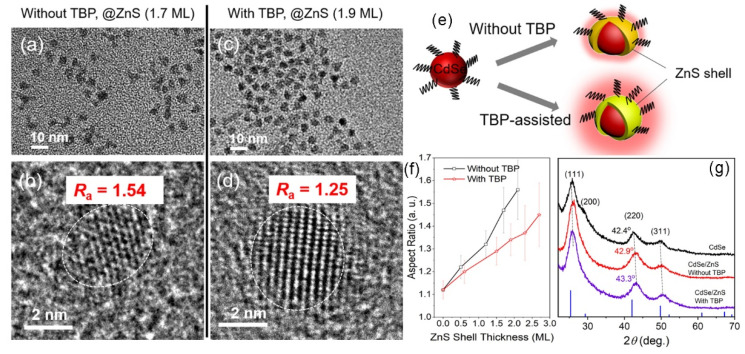
Mastery over the structure of nanocrystals is a powerful tool for the control of their fluorescence properties and to broaden the range of their applications. In this work, the crystalline structure of CdSe can be tuned by the precursor concentration and the dosage of tributyl phosphine, which is verified by XRD, photoluminescence and UV-vis spectra, TEM observations, and time-correlated single photon counting (TCSPC) technology. Using a TBP-assisted thermal-cycling technique coupled with the single precursor method, core-shell QDs with different shell thicknesses were then prepared. The addition of TBP improves the isotropic growth of the shell, resulting in a high QY value, up to 91.4%, and a single-channel decay characteristic of CdSe/ZnS quantum dots. This work not only provides a facile synthesis route to precisely control the core-shell structures and fluorescence properties of CdSe nanocrystals but also builds a link between ligand chemistry and crystal growth theory.
掌握纳米晶体的结构是控制其荧光特性并拓宽其应用范围的有力工具。在这项工作中,CdSe的晶体结构可以通过前驱体浓度和三丁基膦的用量来调节,这通过XRD、光致发光和紫外可见光谱、TEM观察以及时间相关单光子计数(TCSPC)技术得到了验证。然后使用TBP辅助热循环技术结合单前驱体方法制备了具有不同壳层厚度的核壳量子点。TBP的加入改善了壳层的各向同性生长,导致了高达91.4%的高量子产率值以及CdSe/ZnS量子点的单通道衰减特性。这项工作不仅提供了一种简便的合成路线来精确控制CdSe纳米晶体的核壳结构和荧光特性,而且建立了配体化学与晶体生长理论之间的联系。